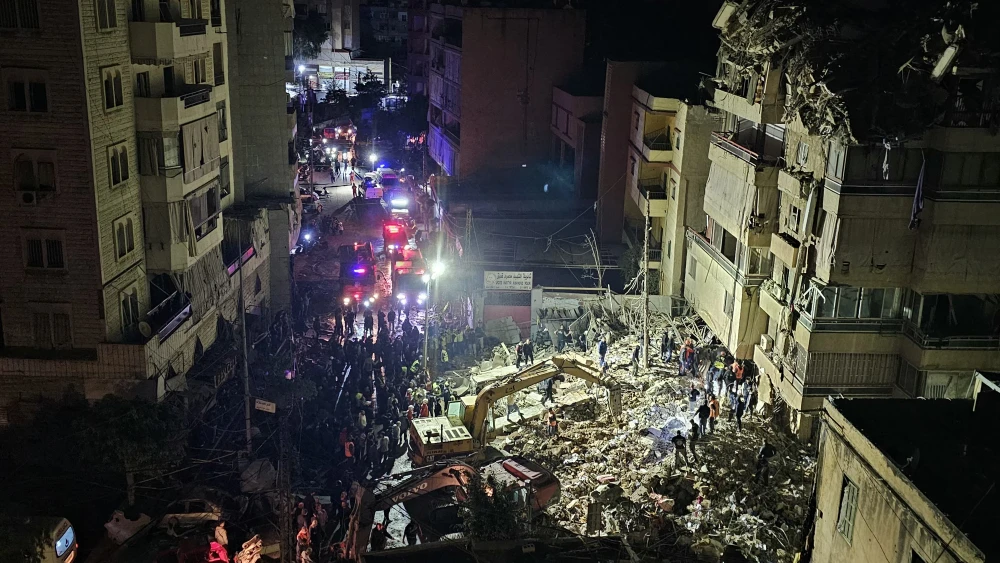
The Israel Defense Forces struck Beirut on Wednesday night for the first time in nearly a month, eliminating the commander of Hezbollah’s Radwan Force, the military said on Thursday.
בתקיפה מדויקת בדאחייה שבביירות: צה"ל חיסל את מפקד יחידת 'כוח רדואן' בארגון הטרור חיזבאללה
— צבא ההגנה לישראל (@idfonline) May 7, 2026
מצורפת הודעת דובר צה"ל בנושא חיסולו של מפקד יחידת 'כוח רדואן', אחמד ע'אלב בלוט: https://t.co/hUibPKRDVV pic.twitter.com/c7EEeQNkGl
Ahmed Ali Balout “commanded dozens of terror attacks against IDF soldiers operating in Southern Lebanon, including anti-tank missile attacks and the detonation of explosive devices,” according to the army.
Balout also spearheaded attempts to rebuild the Radwan Force and Hezbollah’s “Conquer the Galilee” Plan, “which was planned and advanced by the unit for years,” it stated.
Under that plan, the Iranian-backed terrorist organization sought to infiltrate Israel, seize areas along the border and abduct hostages.
The Radwan Force “operates under the sponsorship and direction of the Iranian terror regime with the aim of harming IDF soldiers and Israeli civilians,” the IDF stressed.
Wednesday night’s precision strike came at the orders of Israeli Prime Minister Benjamin Netanyahu and Defense Minister Israel Katz, according to the Prime Minister’s Office.
“The Radwan terrorists led by him are responsible for fire directed at Israeli communities and attacks against IDF soldiers,” the two men said in a joint statement on Wednesday night. “No terrorist has immunity—the long arm of Israel will reach every enemy and murderer.”
“We promised to bring security to the residents of the north. This is how we act and this is how we will continue to act,” the statement added.
Wednesday’s attack in Beirut’s southern suburbs—a Hezbollah stronghold—marked the first IDF strike in the capital in almost a month, with the last having been on April 8.
Hezbollah began firing rockets and drones at Israel on March 2, following the targeted killing of Iranian Supreme Leader Ali Khamenei in the opening strikes of Israel’s “Operation Roaring Lion” on Feb. 28.
In response to the Iranian-backed terrorist organization’s violation of the U.S.-brokered Nov. 27, 2024, truce agreement, Jerusalem launched an aerial campaign against Hezbollah and ordered the IDF to advance and take control of additional areas in Southern Lebanon to halt cross-border attacks.
Jerusalem and Beirut on April 16 agreed to a 10-day ceasefire following mediation by U.S. President Donald Trump. The two countries on April 23 agreed to extend the truce for three more weeks following direct talks in Washington, D.C.
However, Netanyahu last week accused Hezbollah of “essentially disintegrating” the temporary ceasefire through its terrorist attacks.
On Wednesday, two IDF soldiers were seriously wounded when Hezbollah suicide drones impacted near troops stationed south of the ceasefire line in Southern Lebanon, the military said. Three other soldiers sustained light injuries.
The soldiers were evacuated to receive medical treatment at an Israeli hospital and their families were notified, it added.
In several other incidents on Wednesday, “interceptors were launched toward rockets and suspicious aerial targets in the area in which IDF soldiers are operating in Southern Lebanon,” the army continued. No injuries to troops were reported.
The IDF also intercepted an unmanned aerial vehicle launched from Lebanon toward Israeli territory, triggering air-raid sirens in the Galilee communities of Kiryat Shmona, Kibbutz Manara and Moshav Margaliot. The attack sent some 25,000 people running for bomb shelters, according to the IDF’s Home Front Command.
“Missiles and rocket alerts were activated due to concerns of falling debris from the interceptor,” the military stated.