Newsletter
Newsletter Support JNS

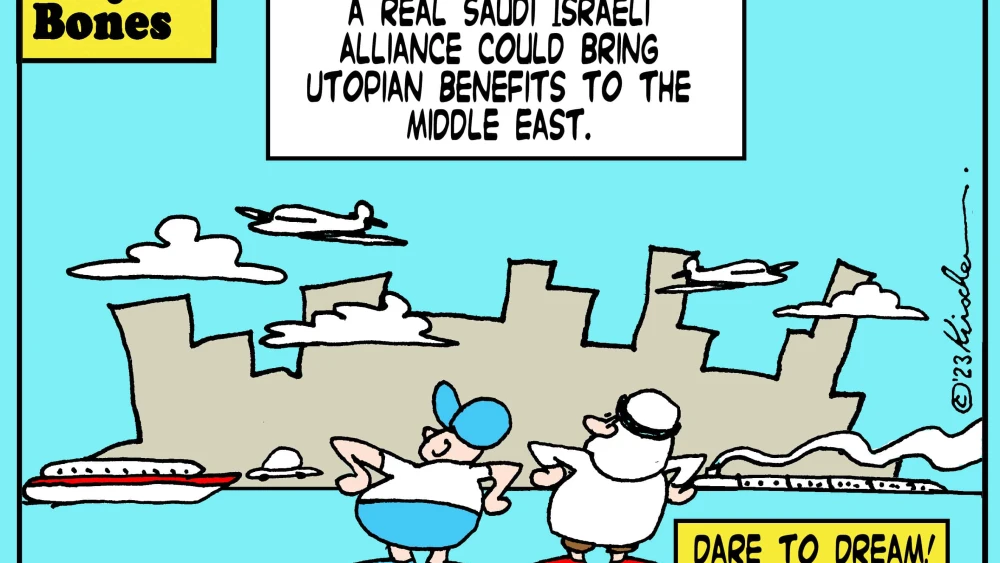
Dare to dream

When Neom and the population of the Hashemite Kingdom of Palestine intersect...

Credit: Yaakov (DryBones) Kirschen.

Two facts and a conclusion:

1. The Saudis are building a giant futuristic city on the Red Sea coast called Neom. It is located south of Israel and across from the Sinai Peninsula. The effort is part of Crown Prince Mohammed bin Salman’s Vision 2030 plan. The city covers an area of more than 10,000 square miles (about the same size as Massachusetts).

2. On June 8, 2022, the Saudi government-controlled newspaper Al Arabiya published a plan for uniting the Palestinian Arabs and the Kingdom of Jordan in an entity that would live in peace with the State of Israel. It would be called the Hashemite Kingdom of Palestine.

The population of this new territory could benefit from work opportunities in Neom.

The media has largely ignored this solution, but I, like MBS, dare to dream.

Political cartoonist Yaakov Kirschen grew up in Brooklyn, N.Y., made aliyah to Israel in 1971 and began drawing “Dry Bones” in January 1973. The internationally syndicated, award-winning cartoons ran in The Jerusalem Post for 50 years. They were reprinted in The New York Times, The Los Angeles Times, The Wall Street Journal, TIME and other mainstream media publications. The “Dry Bones” story has been covered by CBS, CNN and Forbes, among other outlets. He was a member of America’s National Cartoonists Society and the Israeli Cartoonists Society. Kirschen died at 87 on April 14, 2025.
“If Michigan Hillel wants to remain the center of Jewish life on campus, it cannot retreat from one of the central and challenging parts of being Jewish there,” Seth Mendel, of CAMERA, told JNS.
“Your ability to find the strength to rise above the pain, to combat the immediate threat to your life, and to operate sound judgment demonstrates the strength of your character,” Israel’s president wrote.
“We tried to make it clear to them that this is a memorial that was built for those who died in a horrible terrorist attack,” Lawrence Puccini told JNS.
Israel assailed the decision as a “grotesque weaponization of an award to legitimize anti-Israel hatred and prejudice.”