Newsletter
Newsletter Support JNS

Hamas delegation to Saudi Arabia hopes to restore ties

The terror group’s boss, Ismail Haniyeh, is in Mecca on a religious and political mission.

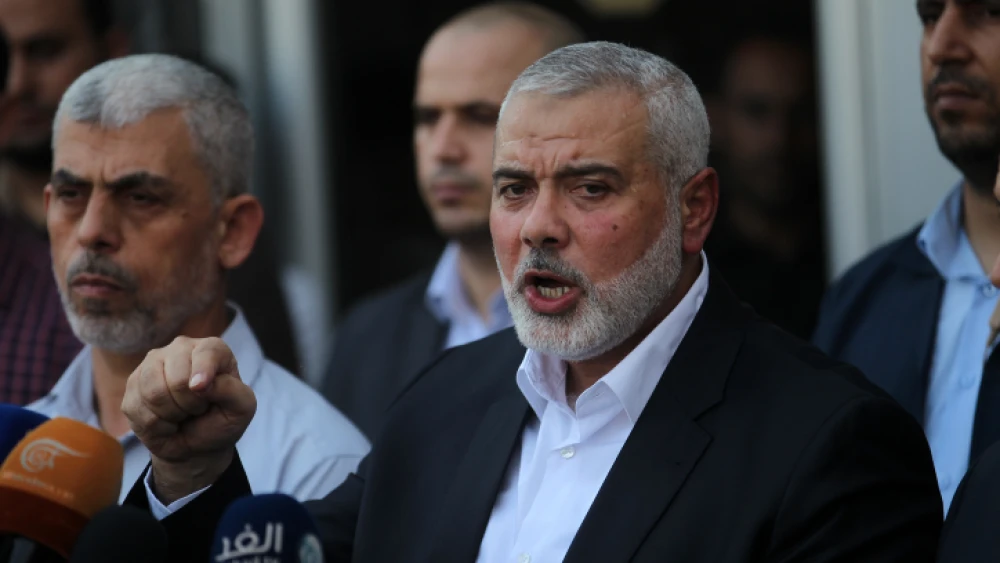
Hamas chief Ismail Haniyeh (right) and leader in Gaza Yahya Sinwar speak to the press in the southern Strip, Sept. 19, 2017. Photo by Abed Rahim Khatib/Flash90.

A delegation from the Hamas terrorist group will arrive in Saudi Arabia on Sunday for a pilgrimage to Mecca. Hamas hopes the visit will serve to improve relations with the kingdom, Arab media reported.

The delegation is being led by the head of Hamas’s political bureau, Ismail Haniyeh, accompanied by the bureau’s deputy chairman, Musa Abu Marzouk; the head of Hamas’s Office of Martyrs, Wounded and Prisoners, Zaher Jabarin; and the head of the group’s Diaspora Office.

Abu Marzouk said that efforts are ongoing to close the gaps between the sides and that the outstanding issues have begun to resolve themselves.

Hamas has tried to restore its relations with Riyadh over the years with a Hamas delegation visiting Saudi Arabia in July 2015. That meeting didn’t lead to a warming of ties.

The current visit follows Saudi Arabia and Iran’s announcement during talks hosted by China on March 10 of the reestablishment of diplomatic ties.

Hamas, a proxy of Iran, issued a statement in support of the agreement at the time: “We believe that this important step is in the interest of the Palestinian cause and supports the steadfastness of our people in the face of the occupation and its continuous aggression against our land, people and sanctities.”

According to the Saudis, the agreement rests on Iran’s promise to stop attacks on Saudi Arabia and reduce support for terrorist groups that have targeted the kingdom.

Matt Dorsey is “absolutely right to call out Piker, whose rhetoric is misogynistic, violent and traffics in conspiracy theories, antisemitism and hate speech,” according to the JCRC in San Francisco.
Kimberly Richey, assistant U.S. secretary of education for civil rights, stated that “such institutional neglect will not be tolerated.”
The governor’s office is awaiting information from the federal government about whether there are any “poison pills that could harm New York’s education system,” a spokesman told JNS.
“It will take at least a decade to rehabilitate,” said Orit Sulitzeanu, CEO of the Israeli Association of Rape Crisis Centers.
Texas American Muslim University at Dallas founder and board chairman Shahid A. Bajwa told JNS the program is “actively engaging” with the state education board after receiving a cease-and-desist letter halting operations.
The crowdsourced encyclopedia hasn’t repaired the “content contamination” that the banned editors left behind, according to Shlomit Lir, of University of Haifa.
