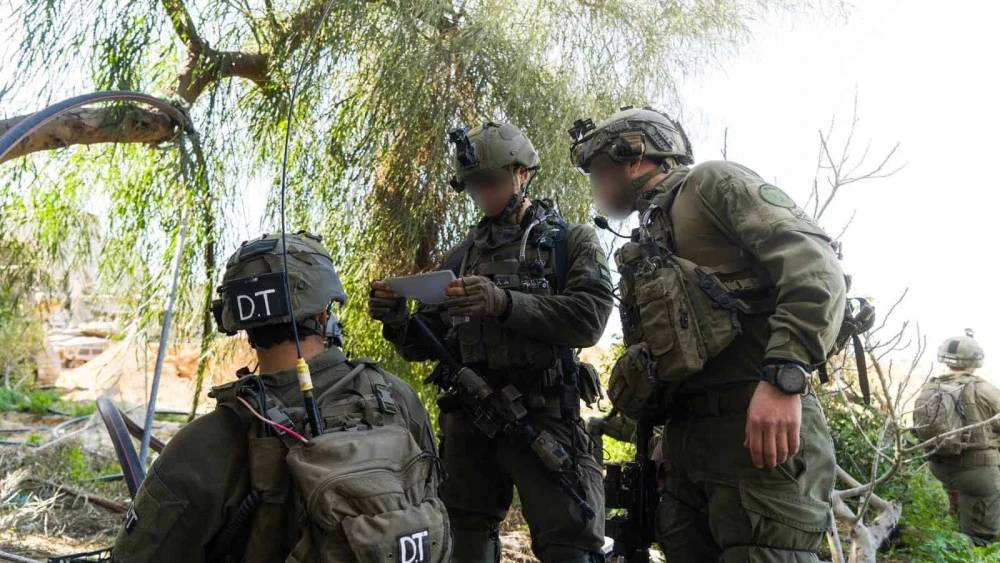
The Israel Defense Forces on Saturday carried out a precise strike on a Hamas tunnel shaft in the northern Gaza Strip containing a rocket launcher “loaded and ready to be launched toward the city of Sderot,” the military said.
“The shaft was used by Hamas to conceal a rocket launcher that was ready to fire toward southern Israel and posed an immediate threat to Israeli civilians,” the IDF Spokesperson’s Unit said.
The army added that the terrorist group’s action was a “blatant violation” of the ceasefire.
The IDF noted that steps were taken before the strike to mitigate harm to civilians, including the use of precise munitions, aerial surveillance and additional intelligence information.
On Friday, IDF troops operating in southern Gaza on Friday killed a Palestinian terrorist who violated the ceasefire by crossing the Yellow Line.
The suspect posed an “immediate threat” as he approached troops, prompting them to open fire, the IDF said.
Israeli Prime Minister Benjamin Netanyahu told Fox News on Tuesday that progress toward Phase 2 of the Gaza ceasefire hinges on Hamas disarming, calling the terrorist group’s refusal to give up its weapons the central obstacle to stabilizing the territory in 2026.
“A new government in Gaza is possible if you disarm Hamas, because no one’s going to come in there if Hamas stays armed,” Netanyahu said. “They’ll put a bullet right through the back of their head, you know, anyone of any potential new government.”
The premier stressed that the next phase of U.S. President Donald Trump’s peace plan, which envisions Gaza’s full demilitarization and the deployment of an International Stabilization Force, has stalled because of Hamas.
The Foreign Ministers of the Hashemite Kingdom of Jordan, the United Arab Emirates, the Republic of Indonesia, the Islamic Republic of Pakistan, the Republic of Türkiye, the Kingdom of Saudi Arabia, the State of Qatar and the Arab Republic of Egypt expressed their deepest concern… pic.twitter.com/D7hRPcHFMt
— وزارة الخارجية وشؤون المغتربين الأردنية (@ForeignMinistry) January 2, 2026
Also on Friday, the foreign ministers of Egypt, Indonesia, Jordan, Pakistan, Qatar, Saudi Arabia, Turkey and the United Arab Emirates expressed their “deepest concern regarding the deteriorating humanitarian situation in the Gaza Strip.”
The diplomats called on the international community “to uphold its legal and moral responsibilities and to pressure Israel, as the occupying power, to immediately lift constraints on the entry and distribution of essential supplies including tents, shelter materials, medical assistance, clean water, fuel and sanitation support.”
They urged “the immediate, full, and unhindered humanitarian aid into the Gaza Strip without any interference by either party, through the U.N. and its agencies, the rehabilitation of infrastructure and hospitals, and the opening of the Rafah Crossing in both directions as stipulated in President Trump’s Comprehensive Plan.”
The foreign ministers reaffirmed their “full support” for Trump’s 20-point peace plan and their “intention to contribute to the successful implementation thereof, with a view to ensuring the sustainability of the ceasefire, bringing an end to the war in Gaza, to secure a dignified life for the Palestinian people who have endured prolonged humanitarian suffering, and leading to a credible pathway to Palestinian self-determination and statehood.”
Netanyahu reiterated in November that Israel will not allow the creation of a Palestinian state.
“Our opposition to a Palestinian state on any territory west of the Jordan River exists, is firm, and has not changed in the slightest,” the prime minister stated, adding, “I have been pushing back against these attempts for decades, doing so against external pressure as well as internal pressure.”
Meanwhile, Israel on Jan. 1 began enforcing updated regulations for international nongovernmental organizations, suspending the licenses of groups “that have failed to meet required security and transparency standards,” according to the Ministry of Diaspora Affairs and Combating Antisemitism.
The move followed findings that employees of several NGOs operating primarily with the Palestinian population were involved in terrorist activity.
In particular, investigations determined that individuals affiliated with “Doctors Without Borders (MSF) were linked to terrorist organizations, including Palestinian Islamic Jihad and Hamas (one identified as a Hamas sniper),” the ministry said.
According to the government, fewer than 15% of international NGOs reviewed were found to violate the regulatory framework, primarily due to refusal to provide complete and verifiable information about employees—requirements intended to prevent terrorist infiltration into humanitarian structures.
Israeli officials emphasized that the measures will not disrupt humanitarian aid to Gaza. Assistance continues to be delivered through approved and vetted channels, including United Nations agencies, bilateral partners and compliant humanitarian organizations, the government said.