By Bradley Martin/JNS.org
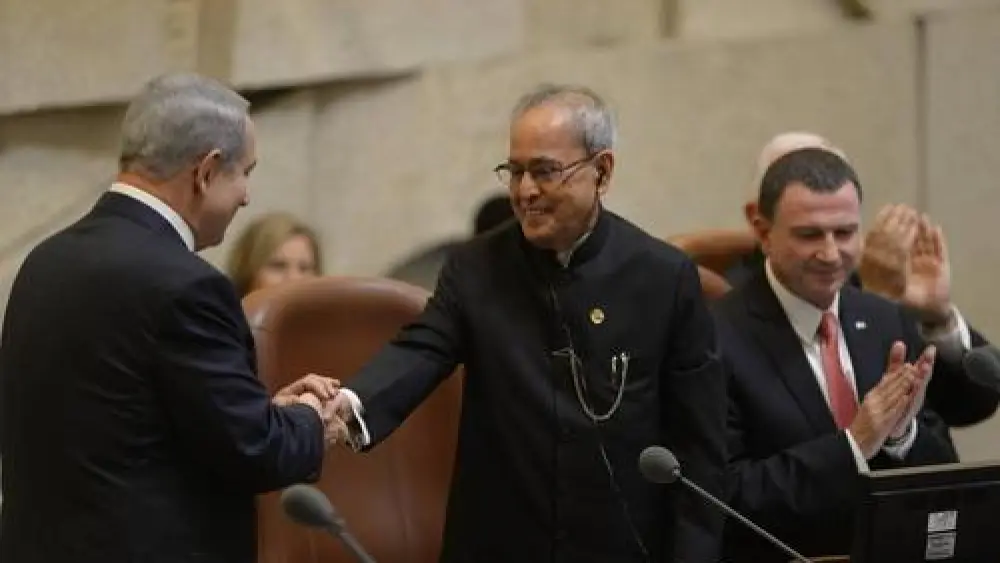
In the first-ever official visit by an Indian head of state to Israel, President Pranab Mukherjee arrived in Jerusalem this week to discuss a wide range of issues including the negotiation of an extensive free-trade agreement, bilateral cooperation in agricultural and other technologies, and expanded counter-terrorism coordination.
“India attaches high importance to its relationship with Israel, a relationship which has taken great strides in the last few years,” said Mukherjee.
Israel President Reuven Rivlin described the visit as deepening “the friendship between our states in the fields of economy, science, medicine and agriculture.”
Relations between India and Israel have recently undergone a major shift. In 1947, India voted against Israel joining the United Nations and did not establish official relations with Israel until 1991. This was mainly out of concern over how this would affect India’s diplomatic relations with Muslim countries, as well as India itself hosting “the world’s second-largest Muslim population in raw numbers,” according to a 2013 report by the Pew Research Center.
Nevertheless, this recent development demonstrates how ties between the two countries have expanded considerably since then. The most recent example of a warming of relations between the countries came when India decided to abstain from the U.N. Human Rights Council vote condemning Israel during the 2014 Gaza conflict. This was a significant policy change, since India for decades was a leading force for nations that automatically voted against Israel in all international forums.
At the same time, the Press Trust of India recently quoted Mukherjee as saying, “India’s traditional support to the Palestinian cause remains steadfast and unwavering while we pursue strong relations with Israel. Our bilateral relations [with Israel] are independent of our relations with Palestine.”
During Mukherjee’s visit, India and Israel signed a double taxation avoidance pact as well as a number of accords promoting cultural and technological exchange between the two nations. Mukherjee and his delegation reserved 70 rooms in Jerusalem’s King David Hotel and another 30 rooms in the nearby Dan Panorama. Celebrity chef Reena Pushkarna was hired by the King David Hotel to prepare Indian dishes for the delegation and some 300 members of Israel’s Indian community.
Israeli Prime Minister Benjamin Netanyahu shares a very warm relationship with Indian Prime Minister Narenda Modi, referring to him as his friend multiple times when hosting Mukherjee in Israel’s Knesset. The prime ministers earlier this year congratulated one another on their respective electoral victories, with Modi making a point of doing so in Hebrew and Netanyahu expressing his good wishes in Hindi. Mukherjee extended an invitation to Netanyahu to become the second Israeli prime minister to visit India, the first being former prime minister Ariel Sharon, who visited India in 2003.
Further illustrating the growing ties between the two countries, Israel is India’s second-largest arms supplier after Russia. But relations are not limited to military ties and a mutual commitment to fight terrorism. Vijeta Uniyal, founder of Indian Friends of Israel, describedhow Israel’s commitment to developing the desert “extends to the Thar Desert, Gangetic Plain and Wetlands of Bengal.”
Bilateral trade between Israel and India grew from $200 million in 1992 to $4.39 billion in 2013, with both countries importing and exporting precious stones, metals, machinery, minerals, plastics, chemical products, textiles, agricultural products, and transport equipment.
Ties between the two countries are expected to strengthen considerably as a result of Mukherjee’s visit, signifying the solidification of a strong alliance between India and Israel.
Bradley Martin is a fellow for the Salomon Center for American Jewish Thought and research assistant for the Canadian Institute for Jewish Research.