Newsletter
Newsletter Support JNS

Iran nuclear deal must remove enrichment capabilities, Netanyahu tells JNS

“We cannot live with anything short of that,” said the Israeli premier.

Netanyahu
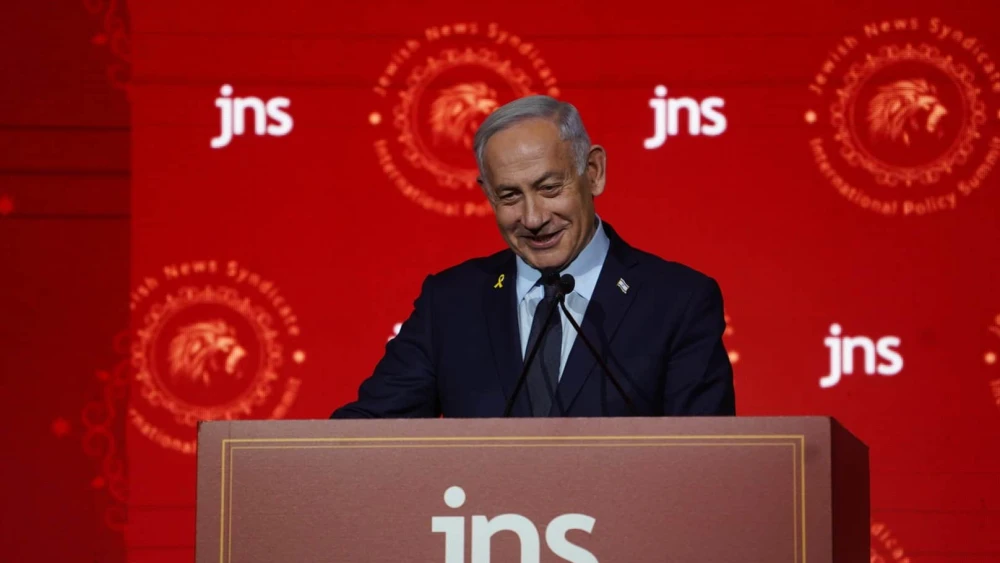
Israeli Prime Minister Benjamin Netanyahu addresses the inaugural JNS International Policy Summit in Jerusalem, April 27, 2025. Photo by Hillel Maeir.

Israel will only agree to a nuclear deal with Iran that eliminates Tehran’s capacity to enrich uranium, Israeli Prime Minister Benjamin Netanyahu told the JNS International Policy Summit on Sunday.

The only way to prevent the Islamic Republic from building a nuclear weapon is to dismantle “all the infrastructure of Iran’s nuclear program,” he said, adding, “That is the deal.”

Israel, he continued, “cannot live with anything short of that—anything short of that could bring you the opposite result, because Iran will say, all right, I won’t enrich, wait, run out the clock, wait for another president, do it again.” This, he said, was “unacceptable.”

According to the prime minister, “a bad deal is worse than no deal.”

“And the only good deal that works is a deal like the one that was made with Libya, that removed all the infrastructure,” he declared, echoing remarks he made during an April 7 meeting at the White House.

He emphasized that while it is “important” that Jerusalem and Washington share the same goals, “We have to make sure that Iran does not get nuclear weapons.”

In addition to eliminating Tehran’s ability to enrich uranium, the prevention of Iran’s development of ballistic missiles should also be addressed, he continued.

“I think these are the two requirements. I said to President Trump that I hope that this is what the negotiators will do,” he said. “But I said one way or the other, Iran will not have nuclear weapons.”

Iran and the United States concluded a third round of indirect nuclear talks on Saturday in Muscat, Oman, with both sides citing “serious progress” but warning that significant disagreements remain.

Akiva Van Koningsveld is a news desk editor for JNS.org. Originally from The Hague, he made the big move from the Netherlands to Israel in 2020. Before joining JNS, he worked as a policy officer at the Center for Information and Documentation Israel, a Dutch organization dedicated to fighting antisemitism and spreading awareness about the Arab-Israel conflict. With a passion for storytelling and justice, he studied journalism at the University of Applied Sciences Utrecht and later earned a law degree from Utrecht University, focusing on human rights and civil liability.
“We are deeply grateful for speaker Julie Menin’s leadership, her presence and for standing up against antisemitism when it truly matters,” David Greenfield, CEO of the Met Council, told JNS.
“Obviously, our number one effort is geared towards Iran, but if the regime goes, you know that Hezbollah goes,” the prime minister told JNS at a live press conference.
The website also offers guidance for faith organizations seeking grants from the federal agency.
Nathan Diament, of the Orthodox Union, told JNS that the statement “could not come at a more important time with bad actors weaponizing Catholicism to spread antisemitic views.”
“What happened at Berkeley is a cautionary tale,” stated Kenneth Marcus, of the Brandeis Center, after the public school settled a lawsuit alleging Jew-hatred.
Four people were wounded in a separate missile attack on Kiryat Shmona.