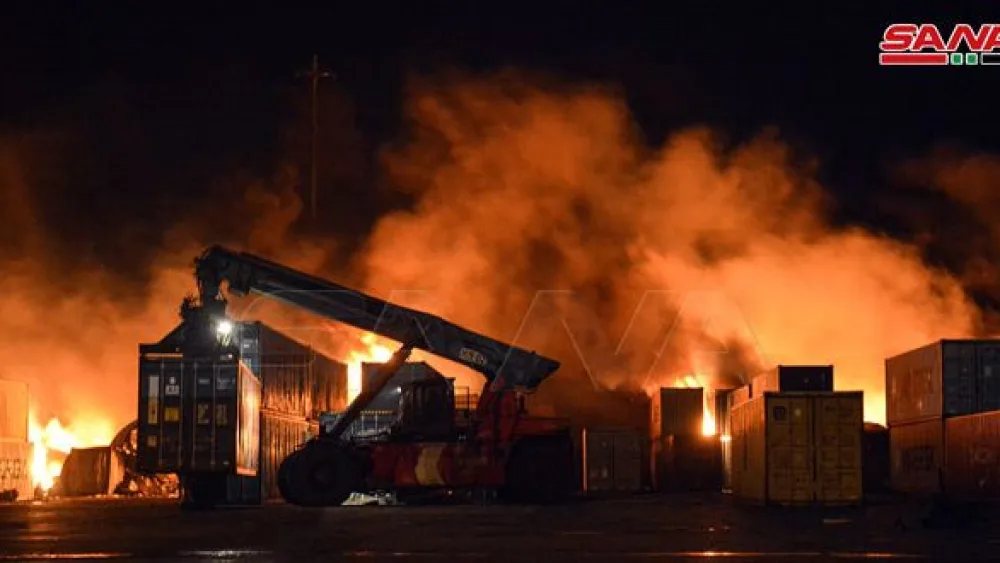
The Israel Defense Forces on Friday night attacked surface-to-air missiles and weapon storage facilities containing coastal missiles in the Latakia Governorate in Syria, the Israeli military said.
These weapons “posed a threat to international and Israeli maritime freedom of navigation,” the IDF Spokesperson’s Unit said.
“The IDF will continue to operate to maintain freedom of action in the region, in order to carry out its missions and will act to remove any threat to the State of Israel and its citizens,” the statement concluded.
⭕️ The IDF struck components of surface-to-air missiles and weapon storage facilities containing coastal missiles that posed a threat to international and Israeli maritime freedom of navigation, in the Latakia area of Syria, a short while ago.
— Israel Defense Forces (@IDF) May 30, 2025
The IDF will continue to operate… pic.twitter.com/FAXmPOoTqX
The Latakia area is located in northwestern Syria on the shores of the Mediterranean Sea.
These strikes come on the backdrop of reports from earlier in May that Syrian leader Ahmed al-Sharaa’s government was engaged in talks with Israel aimed at de-escalating tensions between the two countries.
“There are indirect talks taking place through mediators to calm the situation and try to contain it so it does not spiral out of control,” al-Sharaa said at a press conference in Paris on May 7 alongside French President Emmanuel Macron, according to AFP.
Following President Bashar Assad’s fall from power in December 2024 in the wake of a Sunni-jihadist-led rebellion, the IDF has carried out a series of air raids in Syria, destroying army bases, equipment and weapons of the old regime.
Israeli forces have moreover taken control of a small strip of land eastward of the border running along the Golan Heights, to serve as a security buffer zone between the two countries.
About a week after Assad’s regime collapsed, Israeli fighter jets bombed military targets of the deposed dictator in the port cities of Latakia and Tartus, with reports at the time saying that the target in Tartus was an air-defense base and a surface-to-surface missile depot.
The Syrian Observatory for Human Rights, a war monitor associated with the opposition that maintains a network of sources in the country, said that the strikes were the heaviest in Syria’s coastal region in more than a decade.
A small earthquake (3.0 on the Richter scale) was recorded in the Tartus area at the same time that the strikes were conducted.
Meanwhile on Thursday, U.S. Special Envoy for Syria Thomas Barrack called for a non-aggression agreement between Syria and Israel, speaking during a high-profile visit to Damascus.
Barrack proposed the pact as a first step toward normalizing relations between Jerusalem and Damascus, following his meeting with al-Sharaa at the presidential palace, AFP reported.
The initiative comes as the United States and Syria restore official diplomatic engagement after more than a decade of severed ties.