


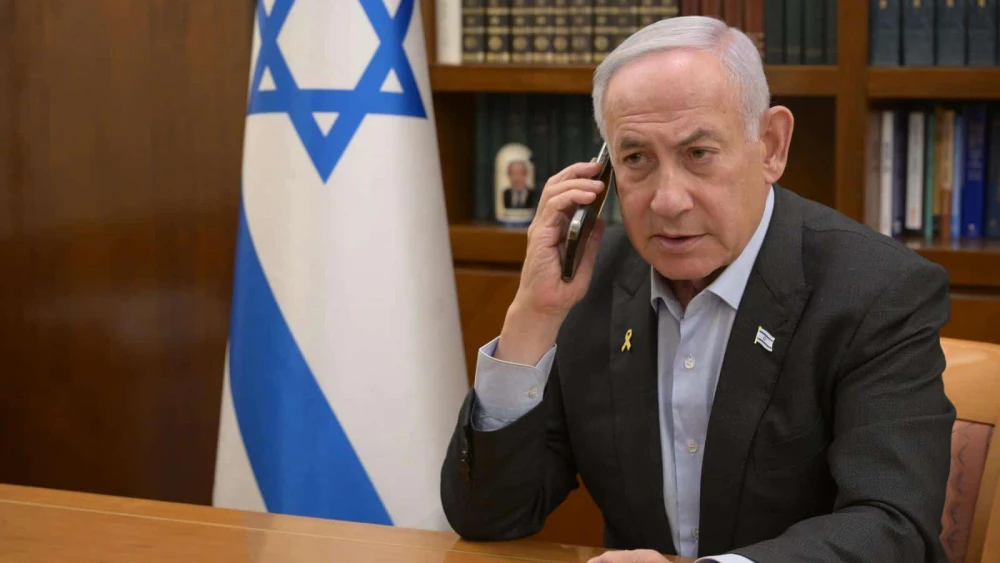
Israeli Prime Minister Benjamin Netanyahu was set to convene the Security Cabinet on Monday to discuss Jerusalem’s stance toward the Phase 2 talks with the Hamas terrorist group in the Gaza Strip, the Prime Minister’s Office said in a statement on Sunday night.
Following a phone call with U.S. Mideast envoy Steve Witkoff on Sunday evening, Netanyahu “instructed the negotiations team to leave for Cairo tomorrow to discuss the continued implementation of the first stage of the deal,” the statement said.
The Jewish state’s negotiators in Egypt and Qatar are currently only focused on the implementation of the first phase of the Gaza truce.
According to the announcement, after Monday’s Cabinet meeting, “the team will receive instructions for the continuation of the negotiations regarding the second stage.”
Netanyahu is working in “full cooperation and coordination” with the U.S. administration on the next phase of the ceasefire, the Israeli prime minister emphasized during a joint press conference with U.S. Secretary of State Marco Rubio in Jerusalem on Sunday afternoon.
“We have a shared strategy, which cannot always be detailed to the public—including when the gates of hell will open. And they will open if all our hostages are not returned, every last one of them,” he stressed.
Israel will demand the expulsion of Hamas’s leadership from Gaza, the dismantling of its terrorist army and the release of all hostages. Officials in Jerusalem believe that the terror group is likely to reject the demands.
Witkoff told Fox News on Sunday that the talks on Phase 2 were already taking place this week “at a location to be determined.”
Witkoff noted that he had “very productive and constructive” calls on Sunday with Netanyahu, Qatari Prime Minister Sheikh Mohammed bin Abdulrahman Al Thani and the head of Egypt’s General Intelligence Major General Hassan Mahmoud Rashad.
He said they spoke about “the sequencing of Phase 2, setting forth positions on both sides, so we can understand … where we are today, and then continuing talks this week at a location to be determined so that we can figure out how we get to the end of Phase 2 successfully.”
The three latest returnees from Hamas captivity in the Gaza Strip were reunited on Saturday with their families—American-Israeli Sagui Dekel-Chen, 36; Alexander (“Sasha”) Troufanov, 29, who has dual Russian-Israeli citizenship; and Argentine-Israeli national Iair Horn, 46.
Saturday’s release of hostages by Hamas was the sixth such round under Phase 1 of the truce that took effect on Jan. 19 and is to end on March 1.
Netanyahu has said that his government will “soon” meet to discuss Israel’s response to U.S. President Trump’s call for Hamas to release all the captives.
Netanyahu praised Trump’s leadership and Israel’s coordination with the U.S. in a statement on Saturday, highlighting that the reinforcement of IDF troops around Gaza and the U.S. president’s firm stance led to the release of three hostages despite Hamas’s prior threats to delay the exchange.
For his part, Trump on Saturday congratulated the freed hostages, but made clear that their release fell short of his call to free all the captives.
“Hamas has just released three Hostages from GAZA, including an American Citizen. They seem to be in good shape! This differs from their [Hamas’s] statement last week that they would not release any Hostages,” he wrote on his social media platform Truth Social.
“Israel will now have to decide what they will do about the 12:00 O’CLOCK, TODAY, DEADLINE imposed on the release of ALL HOSTAGES. The United States will back the decision they make!” he added, apparently referring to U.S. Eastern Time, or 7 p.m. in Israel.
Trump’s deadline was a reference to his previous warning that the “gates of hell” could be unleashed if Hamas did not release all of the hostages.
According to official estimates, 73 hostages remain in Hamas captivity in Gaza after 500 days, including 70 abducted during the terror group’s Oct. 7, 2023, cross-border massacre in southern Israel.



