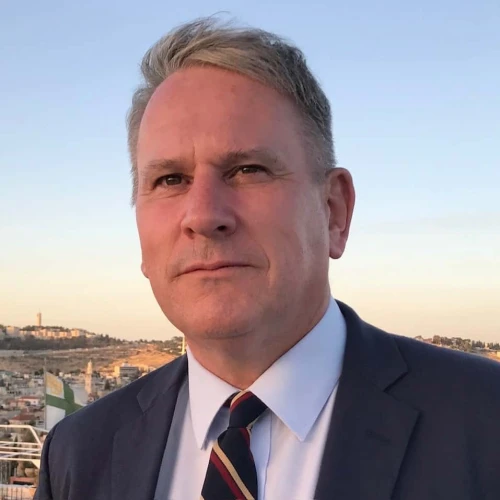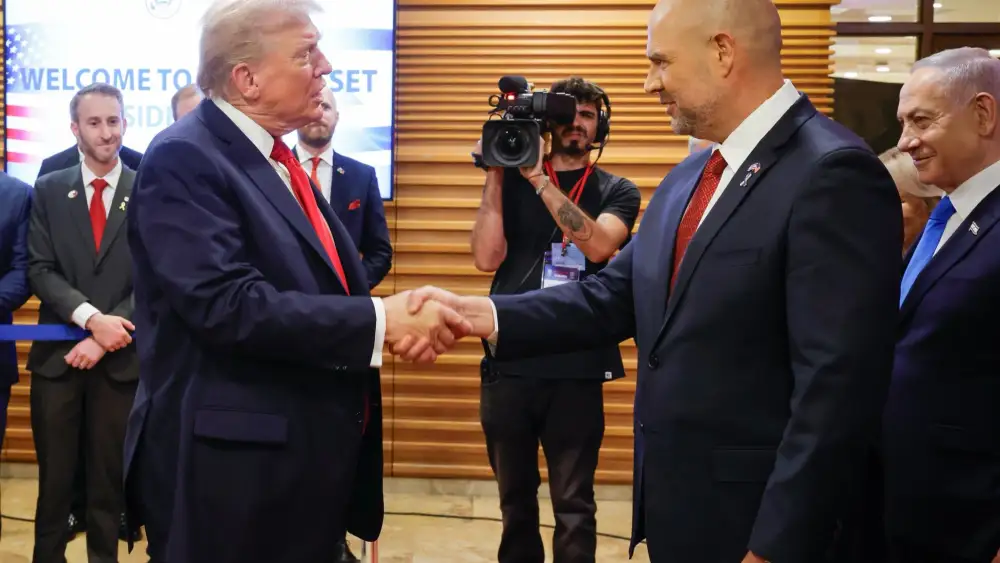
Israel’s parliament speaker has put a new twist on the concept of “America first.”
An increasing number of those who subscribe to the America first philosophy, which prioritizes the United States in foreign and domestic policy spheres, has grown critical of the U.S.-Israel relationship, which, these adherents say, favors Jerusalem too much.
Amir Ohana, the Knesset speaker, said in a talk in Washington last week that the United States reaps tangible benefits from its relation with the Jewish state.
“For the $3.8 billion America invests annually in Israel, the returns are estimated at $48 billion in defense contracts, shared research and development and real-world testing that accelerates U.S. hardware upgrades,” he said. “Israeli technologies protect American troops.”
Ohana added that “our medical innovations save American lives. Our cyber units shield American networks. Our intelligence defends the American homeland.”
“Many want access to Israel’s capabilities, but guess who gets them?” he said. “America, first.”
JNS asked the Knesset speaker how Israel can make the case to disaffected young Americans that U.S.-Israel bonds are broader than biblical foundations and shared values. Ohana said there is no need to choose between the traditional view of the relationship and the one he expressed on Wednesday.
“It is about the Judeo-Christian values that we share—the values of freedom and democracy and liberty, which Israel represents in our region,” he told JNS. “But it is also a matter of interests.”
Ohana said that there is a thriving global market for Israeli technologies and intelligence, but Washington, due to its relationship with the Jewish state, “gets it first.”
“I think they are making a very good investment,” he said. “There are many other interests that we share. So it’s values and interests, hearts and minds.”
Ohana said on Wednesday that the Israel-Hamas war, and the related threats to American interests from Iran and the Houthis in Yemen, “confirmed that strong allies do not drain American strength.”
“They multiply it. Israel helped prevent an attempt by the ayatollah regime of Iran to dominate a region vital to global stability and American interests,” he said.
Amid increasing criticism, including from Republicans, of the U.S. military aid package to Jerusalem, Israeli Prime Minister Benjamin Netanyahu said last month that “the most important thing is that we want to strengthen our independent capabilities.”
“I want to eliminate, or at least significantly reduce, our dependence on external supplies, even from very good and truly loyal friends like the United States,” he said. “I want us to be as self-reliant as possible.”
JNS sources say that Israeli officials and allies in Congress have begun taking steps to shape a future defense relationship focused more on joint research and development and other initiatives rather than traditional defense aid. They said that even as much of that funding returns to U.S. arms manufacturers.