“This is not the Morocco we knew,” said Kobi Ifrah, co-founder of Kulna, a nonprofit organization that aims to preserve and promote Jewish Moroccan heritage.
Ifrah moved from Dimona, Israel to Marrakesh 10 years ago, and has been mapping Jewish sites across the country while leading trips for Israelis and Americans.
Ifrah described the North African country as a model of coexistence, with Jews, Christians and Muslims living together largely peacefully.
Hundreds of thousands of Jews have explored Morocco over the past year, said Ifrah, but they have stopped coming in the wake of the Oct. 7 murderous attacks by Hamas in southern Israel.
“A lot of Israelis with Jewish roots considered Morocco to be their second home. Since the war broke out, we see at the protests here the expression of hatred for the Jews, for Israelis and support for Hamas. We expected basic levels of solidarity and we did not get it,” said Ifrah.
“Morocco used to be a place where everyone could feel at home no matter who they are, where they come from and what they believe in. It made Morocco unique. If Jews and Israelis are no longer welcome, it won’t be safe for anyone,” he added.
Tens of thousands of Moroccans took to the streets post-Oct. 7, with many chanting antisemitic slogans and holding placards reading phrases such as “Down with Zionism '' and “Palestine is Hamas.”
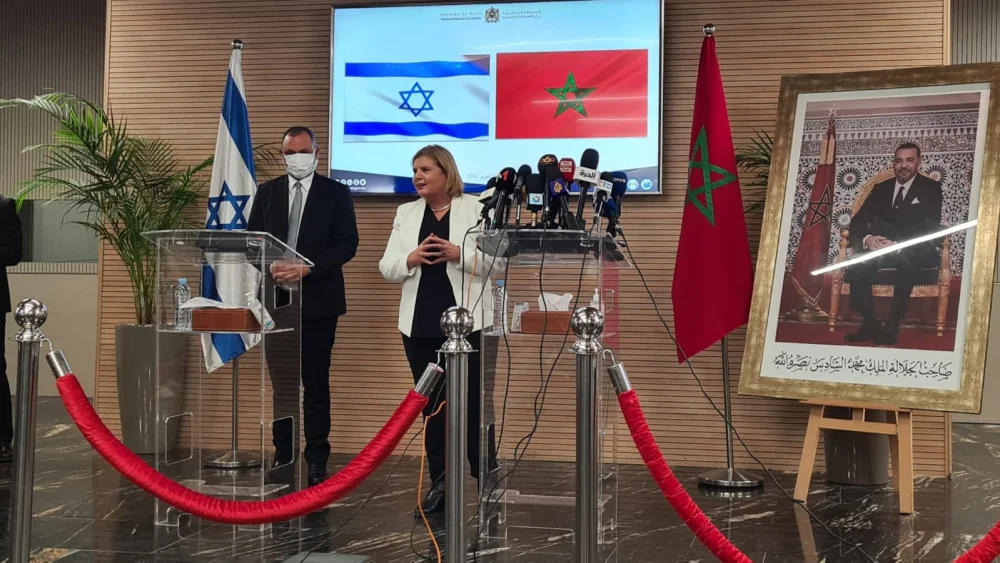
In December 2020, Israel and Morocco agreed to formally normalize ties under the auspices of the Trump administration-brokered Abraham Accords. Economic, scientific and defense ties have since been significantly bolstered. Jerusalem recognized Moroccan sovereignty over the Western Sahara, prompting King Mohammed VI in July to invite him to visit the country.
Raphael Trojman, 60, was born in Rabat and specializes in kosher products and kosher luxury vacations, having opened hotels in Marrakesh, Casablanca and Fez.
On Oct. 7, Trojman was hosting clients at the Mazagan Beach and Golf Resort in El Jadida.
“We knew right away that it was serious, given the scope of the attack. Everyone left and we started receiving cancellation requests for our busiest period, which usually comes right after Sukkot,” Trojman told JNS.
“We closed our kosher restaurants we had set up in Moroccan hotels and we stopped all our kosher discovery tours,” he added.
After Oct. 7, 12 of the 14 kosher restaurants in Marrakesh closed, with only a few having reopened in recent days. Weddings and Jewish pilgrimages (hilulot) were also canceled, according to community leaders.
Morocco has become the third most-visited destination in the world for Passover, after Israel and the United States, with some 45 organizers hosting thousands of Jews each year.
While Trojman has in the past had 100 locals on his payroll to meet demand for the holiday, he told JNS that in 2024 he will instead be holding events in Tel Aviv and Jerusalem.
“It changed overnight. Jews must reassess their attachment to the country and their relationship with Moroccans,” he said. “Until the authorities clarify the position towards Moroccan Jews and Israelis, we will be taking our business elsewhere.”
‘Keeping in mind the country’s Jewish heritage’
Before Oct. 7, Morocco’s anti-normalization movement did not generate much momentum. However, last week some 3,000 people marched in the capital Rabat demanding the king sever ties with Israel. The protest was led by members of Morocco’s Justice and Development Party, which, like Hamas, has its roots in the Muslim Brotherhood.
During the so-called Arab Spring, PDJ leader Abdelilah Benkirane was elected Morocco’s prime minister. The party governed for a decade until 2021 when it was voted out largely due to its disastrous socio-economic program.
“During the Arab Spring, Jews in Morocco were very concerned that the monarchy would be targeted. However, the king handled the situation very well. As such, I trust that the current state of affairs will be no different,” said Eric Benabou, 59, from Agadir.
“I trust that the government will manage to address the Moroccan people’s attachment to the Palestinian cause while keeping in mind the country’s Jewish heritage and the hundreds of thousands of Jews of Moroccan ancestry,” he said.
Marrakesh Jewish community leader Jackie Kadosh, who met with local police following the Oct. 7 massacre, says authorities are taking the Jewish community’s security concerns seriously.
For Kadosh, the attachment of Moroccan Jews to their traditions and their country cannot be harmed by any conflict.
“As we talk, there are about 50 Israelis attending a pilgrimage in Taroudant,” he told JNS. “They did not let anything stand in their way.”