
The peace treaty with Egypt is vital to Israel. The fait accompli of decades without war, even in the absence of true normalization, is no small feat in this neighborhood.
However, particularly in the wake of Oct. 7, it is critical to ask: Is today’s Egypt the same country Israel signed a peace agreement with? Is Egypt’s interest in maintaining stability, alongside its relentless crackdown on the Muslim Brotherhood at home, still enough for Cairo to preserve its strategic treaty with Israel?
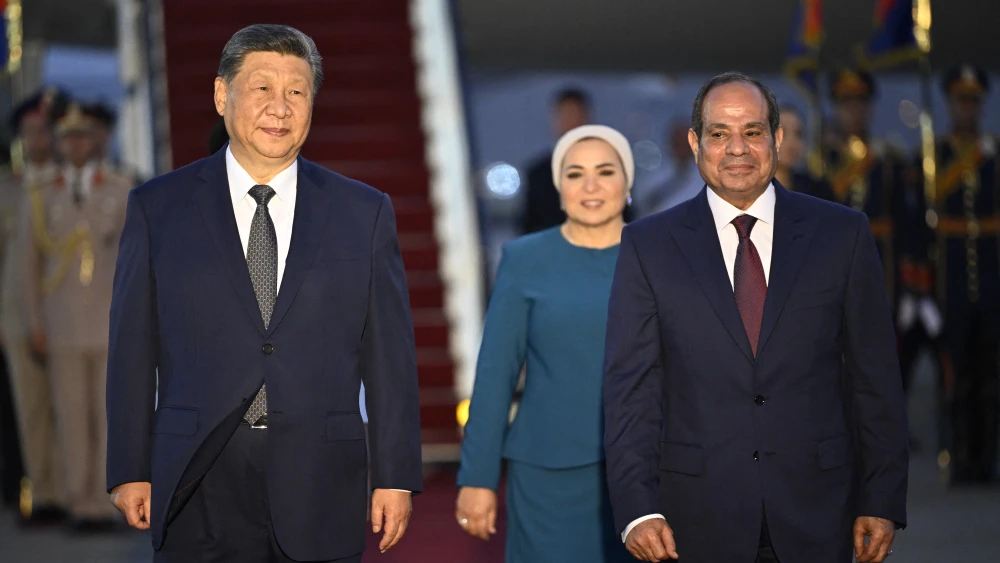
Recent visits by the Chinese president and the Qatari prime minister to the Egyptian capital illustrate that the Egyptian regime is seeking to diversify its revenue streams while demonstrating a willingness to accommodate foreign powers seeking a foothold in Egypt.
For years, Qatar was a major red flag for Egypt. The wealthy emirate sheltered elements of the Muslim Brotherhood—despised by the Egyptian regime—and frequently used Al Jazeera to criticize Cairo. Recently, however, Qatar has enjoyed a diplomatic thaw with the Egyptian leadership. Mohamed Shinawi, official spokesperson for the Egyptian presidency, recently posted in Arabic about the Qatari prime minister’s visit, noting that discussions focused on expanding Qatari investments in Egypt, particularly in infrastructure.
But the price Egypt will pay is clear: A Qatari foothold means a move toward a more conservative form of Islam. It would be wise for Israel and the West to understand the implications.
Egypt’s dire economic crisis, high illiteracy rates, lack of youth employment and absence of significant growth engines weigh heavily on the country’s leadership. The regime’s primary fear remains a popular uprising, particularly one driven by its youth, who make up the vast majority of the population. Every effort by the regime to curb the birth rate has failed: Of roughly 120 million Egyptians, more than 60% are under the age of 30.
Furthermore, the escalation between the United States and Iran, alongside maritime blockades, has dealt a severe financial blow to the Egyptian economy over the past year. This shock has manifested in a currency devaluation of at least 8%, coupled with a steep rise of nearly 17% in fuel prices.
All this has exacerbated inflation, directly affecting every Egyptian household. Breadlines are a familiar reality in Egypt, but any further economic distress that squeezes the pockets of ordinary citizens heightens the danger of internal instability and unrest against the regime.
At the same time, Egypt faces acute tension with Ethiopia over water rights and the division of the Nile. It confronts similar friction along its long and volatile border with Libya, fueled in part by Turkey’s creeping influence in the North African country. And, of course, Egypt remains deeply unnerved by the Palestinian issue on its doorstep, driven by geographic proximity and a constant fear that the problem will spill over into Egyptian territory.
The quiet inroads made by Turkey, Qatar and China in Egypt, however counterintuitive, have been underway for several years. This push is designed to fill the void left by Saudi Arabia and the United Arab Emirates, Egypt’s traditional financial backers, which have grown weary of bankrolling Cairo. Furthermore, Egypt’s military pivot toward these new partners aims to diversify its defense sources, driven by the belief that relying solely on the United States is no longer a viable strategy.
During the 12-day war between Israel and Iran, Egypt’s official stance backed the Islamic Republic—a move that should have set off major alarm bells among Israeli decision-makers. Sunni Egypt, which has long viewed Shi’ite Iran with deep suspicion and has repeatedly expelled Iranian diplomats over espionage scandals, displayed a striking alignment with the regime in Tehran.
Even the longstanding personal animosity between Turkish President Recep Tayyip Erdoğan and his Egyptian counterpart, Abdel Fattah el-Sisi, has virtually vanished. Recently, the two nations even held joint military exercises for the first time in years. This rapprochement is well-documented and indisputable.
Moreover, the high-level visit by the Chinese president was intended, among other things, to signal to Washington that Cairo has options. Egyptian-Chinese ties align neatly with China’s Belt and Road Initiative, through which massive infrastructure investments in developing nations secure Beijing a foothold and leverage over local decision-makers.
Egypt is, in fact, pursuing a policy of strategic duality toward its partners.
It has adopted a similar duality toward Hamas. Cairo understands, perhaps better than anyone, what Hamas truly represents, given its roots as an offshoot of the Muslim Brotherhood. Yet despite this understanding, and perhaps even because of it, Cairo struck a tacit arrangement with the group prior to Oct. 7: Hamas would refrain from cooperating with jihadist cells operating in the Sinai Peninsula, and in return, Egypt would not impede Hamas from arming itself through cross-border smuggling aimed at Israel.
All of this is difficult to digest after more than four decades of strategic peace between the two nations. However, it is essential to recognize that the Egyptian leadership still perceives Israel, and particularly its current political establishment, as an adversary. This message is systematically communicated to the next generation through official school curricula and textbooks. It is reinforced across state-controlled media, cinema and cultural institutions.
This view is held not only by the vast majority of the Egyptian public but also by the inner circle at el-Sisi’s Ittihadiya Palace. While el-Sisi recently made measured public statements affirming that Egypt seeks no war with its neighbors, hostility takes many forms; outright war is merely its most extreme manifestation.
The prevailing mindset in Cairo is that it serves Egyptian interests to keep Israel constantly bogged down in military confrontations with various regional threats. For instance, the Egyptian regime has turned a blind eye to Egyptian Bedouins smuggling firearms via drones to criminal networks in the Negev. This issue has drawn almost no scrutiny in Israeli public debate, even though a similar operation originating from the Israeli side into Egypt would be treated as nothing less than a casus belli.
At the same time, Egypt is training tens of thousands of Palestinian police officers on its soil, intending for them to serve as a security force in Gaza on the “day after.” This comes even as there are already roughly 70,000 armed Palestinian security personnel in Judea and Samaria, itself a blatant violation of the agreements Israel signed with the Palestinian Authority in Oslo.
As a general rule, Egypt’s push for an independent Palestinian state in Gaza and Judea and Samaria is rooted in its desire to untether itself from the Palestinian issue altogether. By doing so, Cairo hopes to permanently remove from the table any future demands to open its border with Gaza while minimizing the risk of the conflict spilling into Egyptian territory.
Recognizing that the Egyptian regime operates under intense internal and external pressures, Israel must base its strategy on four primary pillars:
Direct diplomatic channels: Establish a direct, high-level diplomatic line to el-Sisi and his innermost circle to manage crises and capitalize on opportunities in real time.
Military readiness: Prepare for every security contingency in light of the disproportionate military buildup on the Egyptian side of the border.
Energy leverage: Strategically leverage Israel’s natural gas exports, given Egypt’s critical dependence on energy supplies.
Countering incitement: Demand that Cairo actively move to curb the virulent anti-Israel and antisemitic rhetoric prevalent in Egyptian public discourse, using both existing economic levers and diplomatic backing from the United States.