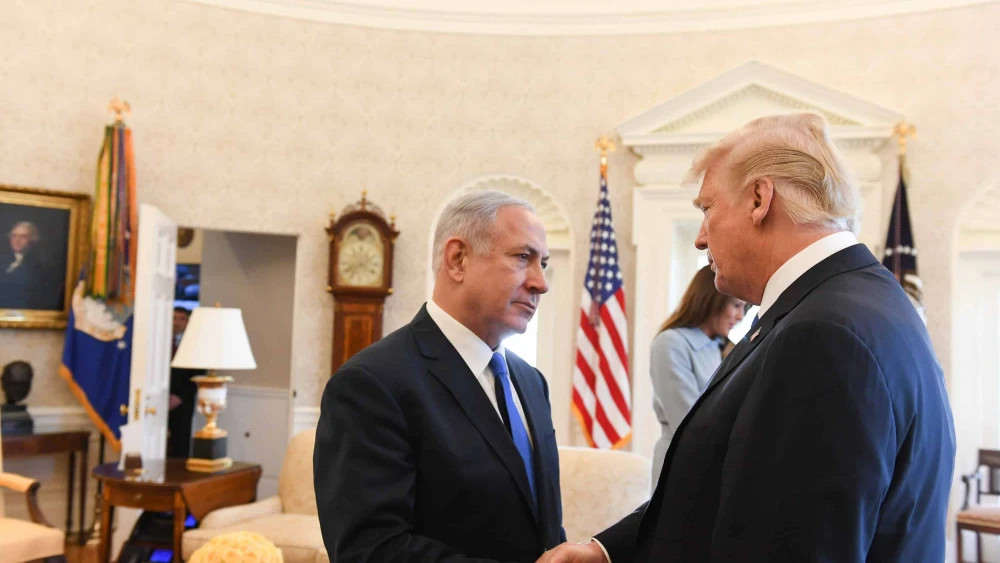
U.S. President Donald Trump invited Israeli Prime Minister Benjamin Netanyahu to visit the White House on Feb. 4, the Prime Minister’s Office stated on Tuesday.
The reported visit wasn’t mentioned at the Trump administration’s first White House press briefing on Tuesday, and the administration hasn’t commented on it publicly.
Sen. Rick Scott (R-Fla.) told JNS that he is “very glad to see my friend Prime Minister Benjamin Netanyahu, the leader of Israel and our greatest ally in the Middle East, slated as the first state visit to Trump’s White House.”
“I look forward to working with President Trump and the prime minister on securing the release of the hostages and continuing the strategic objectives to secure the region,” Scott said.
Former President Joe Biden invited Netanyahu to the White House for the first time of his tenure on July 25, 2024—some 20 months after Netanyahu was re-elected in November 2022.
David May, research manager and a senior research analyst at the Foundation for Defense of Democracies, told JNS that “Biden and Trump started their presidencies at very different points of Israeli politics.”
“When Biden took office, Israel was in the middle of a political impasse, and Bibi didn’t return to office until two years into Biden’s term. Trump started his second term with Israel at war against genocidal enemies,” May said.
“That being said, the immediate invitation is a strong indication of the importance Trump and his team place on the U.S.-Israel relationship,” May told JNS. “Trump has started his term with several moves that help Israel and a return to not having daylight between the two allies in public.”
Rep. Andy Barr (R-Ky.) thanked Trump for inviting Netanyahu. “It’s crucial that America stands with our key ally, Israel, to promote security, stability and our shared democratic values in the region,” he wrote.
The Associated Press reported on Jan. 27 that Trump “teased the upcoming visit in a conversation with reporters aboard Air Force One, but didn’t provide scheduling details.”
“I’m going to be speaking with Bibi Netanyahu in the not-too-distant future,” Trump said.
An image of what appeared to be an invitation that Trump sent to Netanyahu circulated on social media. “I would like to formally invite you to the White House next week,” states the letter, dated Jan. 28 and signed by Trump.
“I look forward to discussing how we can bring peace to Israel and its neighbors, and efforts to counter our shared adversaries,” it adds. “It will be my honor to host you as my first foreign leader during my second term.”