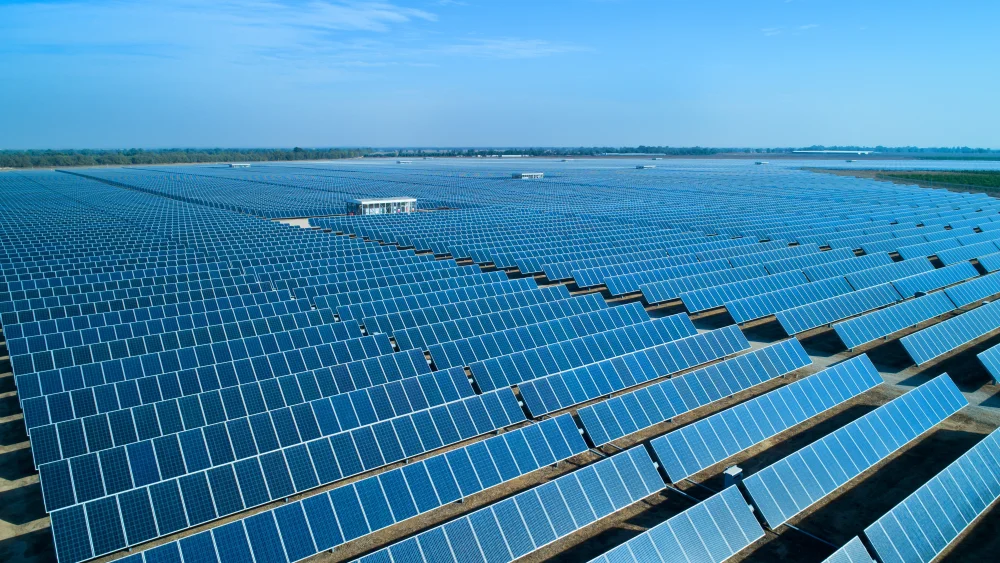
The financial closing for Israel’s largest solar power plant, set to be built near Dimona, southeast of Beersheva, across roughly 3,000 dunams (300 hectares, or 740 acres) of land, was completed on Sunday.
EDF Renewables, which won the tender with a record-low bid of less than 6.5 agorot per kilowatt-hour (approximately $0.022 per kWh), is expected to begin construction immediately. The project is scheduled to take approximately two years to complete.
The facility will have an installed capacity of 265 megawatts and use photovoltaic technology. It will be developed under a public-private partnership (PPP) model, under which the concessionaire is responsible for the project’s planning, financing, construction, operation and maintenance for 25 years before ownership reverts to the state.
“This power plant is good news for the State of Israel as a whole, and for the South in particular. The AI revolution is driving increased energy demand and fueling a global race to establish data centers and server farms, and this is one of many mega-projects we are advancing across the country,” Energy and Infrastructure Minister Eli Cohen told JNS on Sunday.
“The southern region, with its abundant sunshine, has the potential to become a hub for clean energy production located near server farms, which is a significant advantage. In this way, we are strengthening Israel’s energy security, creating high-quality jobs and positioning Israel—already a technological powerhouse—as a global leader in artificial intelligence,” he added.
The project joins a series of PPP renewable energy initiatives in the Ashalim area led by the Energy Ministry, the Accountant General’s Department and the Electricity Authority, which together are expected to generate more than 800 megawatts.
The Dimona tender was issued as part of efforts to expand renewable energy capacity in line with the government’s goal of generating 30% of Israel’s electricity from renewable sources by 2030.
“The largest solar power plant in Israel, to be built in Dimona at the lowest electricity rate ever set, is a significant achievement for the public and the economy,” Israeli Finance Minister Bezalel Smotrich said.
“The project reflects the right combination of innovation, competition and efficiency, and will help increase electricity supply, reduce emissions and advance progress toward the government’s 2030 targets. We will continue to promote advanced infrastructure and strengthen the Israeli economy,” he added.