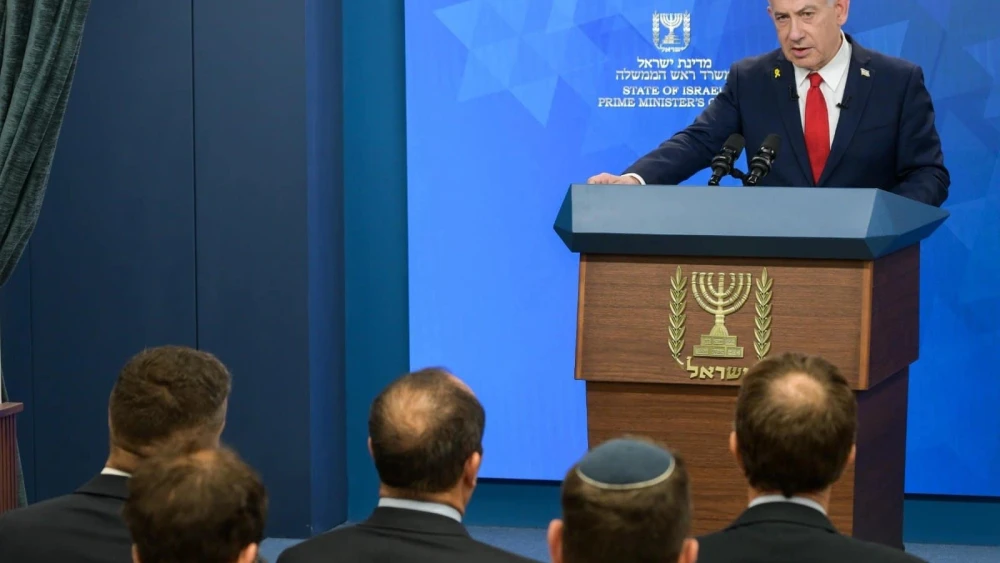
Israeli Prime Minister Benjamin Netanyahu on Tuesday praised the resilience of the country’s economy after nearly two years of war.
The premier brought reporters and cameras to his office in Jerusalem a day after saying that Israel has no choice but to become a “super-Sparta,” warning that the Jewish state increasingly needs to become self-reliant amid ongoing attempts to sanction the government’s ability to import weapons.
“The Israeli economy is very strong. I have terrific confidence in it,” Netanyahu said from the podium on Tuesday. “It is strong. It is innovative. It weathered two economic crises—the Corona crisis, came out first in the world; and the two-year war, where we have an enormous amount of investments. People are coming and they will continue to come not only in the economy and the technology of today, but the technology of the future—cyber, AI and so many other things.”
He then delivered a call to global investors, telling them to “get onboard now because we are about to take off,” using the 12-day war with Iran in June as an example of Israel’s technological capabilities.
Netanyahu used visuals to demonstrate the strength of Israel’s economy, including the growth of the Tel Aviv stock exchange, the shekel to dollar exchange rate, GDP per capita, debt to GDP ratio, a declining unemployment rate and lower electricity prices.
He also highlighted in a slide that Israel ranks second only to the United States in business expenditure on research and development funded from abroad.
The prime minister also showed record year-by-year defense industry exports.
“There is a race now for weapons in the world, but it is not a market race, because unlike everything else that we could talk about, that’s controlled by governments and their calculations can sometimes be political. Not necessarily economic,” said Netanyahu.
“And therefore, what we are going to do is to build an arms industry that will match the best arms industries in the world, with one proviso—we want to produce first for ourselves on a much larger scale and with unimaginable innovation ... very powerful, very strong, that can withstand any kind of international political constraints and will provide security for the state of Israel.”
The prime minister concluded his remarks before taking questions: “This is what I envision for the state. It’s going to continue to grow. It’s going to continue to innovate. And it’s going to continue to provide for our security and our prosperity and I think soon with expanded peace treaties in the Middle East. It will take time, you don’t see it right now but it’s coming.”
“And the last thing I would say is the future belongs to those who innovate. Israel is the innovation nation, so get onboard because we’re about to take off to a new stage of prosperity.”