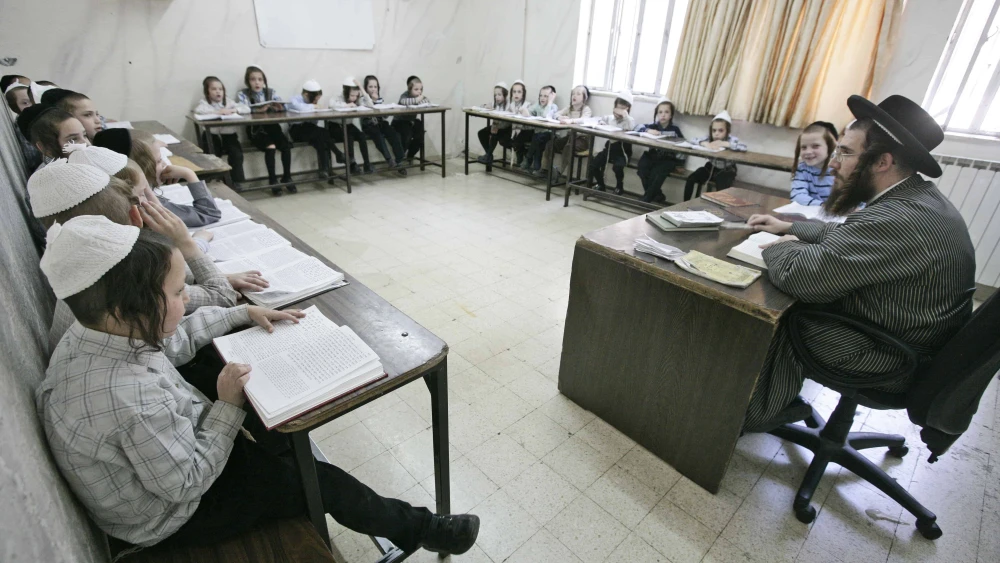
Shortly after the New York State Education Department pulled the accreditation of six Brooklyn yeshivahs, Richard McNally, a judge on the state’s Supreme Court, issued an injunction last week staving off their closure.
The department said that the schools, located in the neighborhoods of Borough Park and Williamsburg, didn’t comply with state law requiring that private schools provide “substantially equivalent” education to that of public schools, because, it said, the yeshivahs provided inadequate teaching in math, science and English.
A new law, which the state legislature passed over the summer, allows schools to create educational “pathways” to comply with state law. The state’s Education Department said the yeshivahs were ineligible to take advantage of the new law since they were already said to be out of compliance when the law passed. (The state told the schools that they had to end operations by June 30.)
Parents at the yeshivahs were informed that students would need to find alternative educational options for the 2025-26 school year.
McNally ruled that the state acted “contrary to law” when it stated that the yeshivahs ceased to be schools when they were deemed out of compliance with the law. Instead, the judge said, the yeshivahs were still schools—just noncompliant ones.
As such, he said, the yeshivahs have the opportunity to apply for and undergo evaluation for alternative pathways.
The ruling allows the yeshivahs to remain open during that process and to receive public funding for services, such as transportation and special education.
The New York Times has published several articles claiming that Brooklyn yeshivahs do not provide adequate education. Critics have called those articles antisemitic.
“This case may have long-term implications if, in the future, any school is declared non-equivalent,” Agudath Israel stated. “Based on this ruling, a school can still choose to avail itself of a pathway. The ‘non-school’ argument was soundly defeated.”