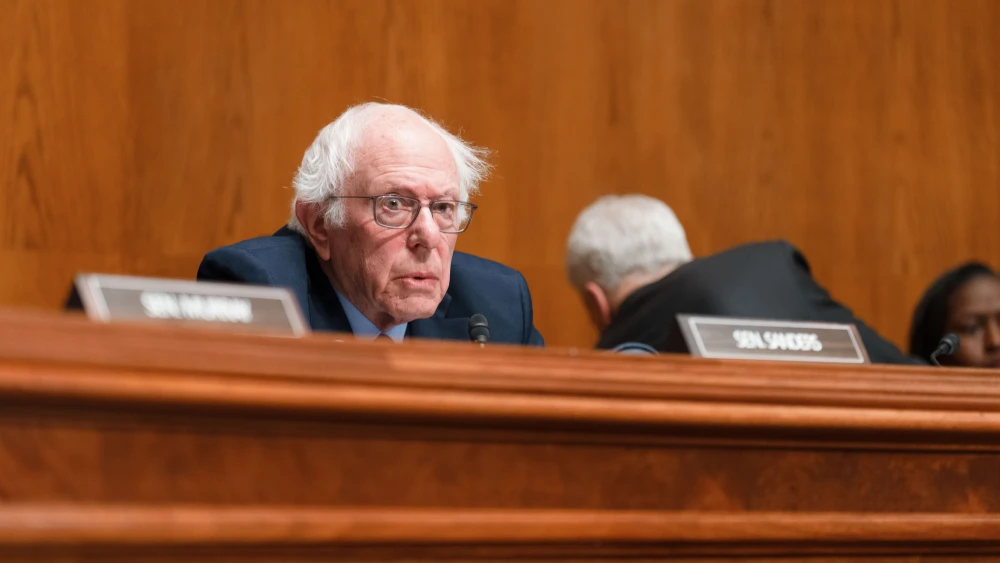
The U.S. Senate voted down a pair of resolutions from Sen. Bernie Sanders (I-Vt.) on Thursday that would have blocked nearly $9 billion in arms sales to Israel.
Just 15 senators, all Democrats, voted in favor of the measures—fewer than voted for similar resolutions that Sanders put forward in November.
Speaking on the Senate floor before the vote, Sen. Jim Risch (R-Idaho) said that the resolutions were “misguided” and would “reinstate the failed policies of the Biden administration.”
“Worse, they would abandon Israel, our closest ally in the Middle East, during a pivotal moment for global security,” Risch said. “No one in the world is coming to the support of Hamas. No one with the exception of some misguided people in this organization.”
The resolutions targeted $8.8 billion in arms sales for bomb guidance kits, penetrators and 2,000-pound, 500-pound and small-diameter bombs. Sanders alleged that these systems have been “linked to dozens of illegal airstrikes.”
The two resolutions failed by votes of 15-82 and 15-83.
The 15 “yea” votes in each instance came from Sens. Sanders, Dick Durbin (D-Ill.), Martin Heinrich (D-N.M.), Mazie Hirono (D-Hawaii), Tim Kaine (D-Va.), Andy Kim (D-N.J.), Ben Ray Luján (D-N.M.), Ed Markey (D-Mass.), Jeff Merkley (D-Ore.), Chris Murphy (D-Conn.), Brian Schatz (D-Hawaii), Tina Smith (D-Minn.), Chris Van Hollen (D-Md.), Elizabeth Warren (D-Mass.) and Peter Welch (D-Vt.).
All 15 voted for Sanders’ previous efforts to block arms to Israel, except for Kim, who took office in December when he won the Senate seat vacated by pro-Israel stalwart Bob Menendez following his conviction in July on corruption charges.
Kim, who represents one of the most Jewish states in the country, said that he voted to block the aid because Israeli Prime Minister Benjamin Netanyahu’s “decision to resume military strikes and operations is not the path to take.”
“Netanyahu’s decision to block all international aid from entering Gaza is wrong,” Kim stated. “Hamas’s brutality to the Israeli people and their negligence to the Palestinian people does not give reason for others to act without regard to the humanity of civilians.”
Notable “nay” votes on the measures included Sens. Angus King (I-Maine), Jeanne Shaheen (D-N.H.) and Raphael Warnock (D-Ga.), who voted for all three of Sanders’ November resolutions, and Sen. Jon Ossoff (D-Ga.), who voted for two of them.
The Georgia senators faced a backlash from local Jewish groups, including AIPAC and the Georgia chapters of the Anti-Defamation League and American Jewish Committee, over their votes in November.
King issued a statement saying that he has been sharply critical of Israel’s “bombing campaign in Gaza” but that he believed that voting for Thursday’s resolutions would encourage Hamas to resist negotiations for a ceasefire and the release of hostages. (JNS sought comment from Ossoff, Shaheen and Warnock.)
AIPAC welcomed the Senate votes to defeat the Sanders resolutions on Thursday.
“We applaud the Trump administration for approving these sales and helping ensure Israel has the resources it needs to win,” the pro-Israel group stated.
“The majority of Senate Democrats and Senate Republicans reaffirmed profound American support for our ally and rejected the repeated dangerous efforts by Sen. Sanders and his allies to weaken Israel and undermine the U.S.-Israel relationship,” it added.