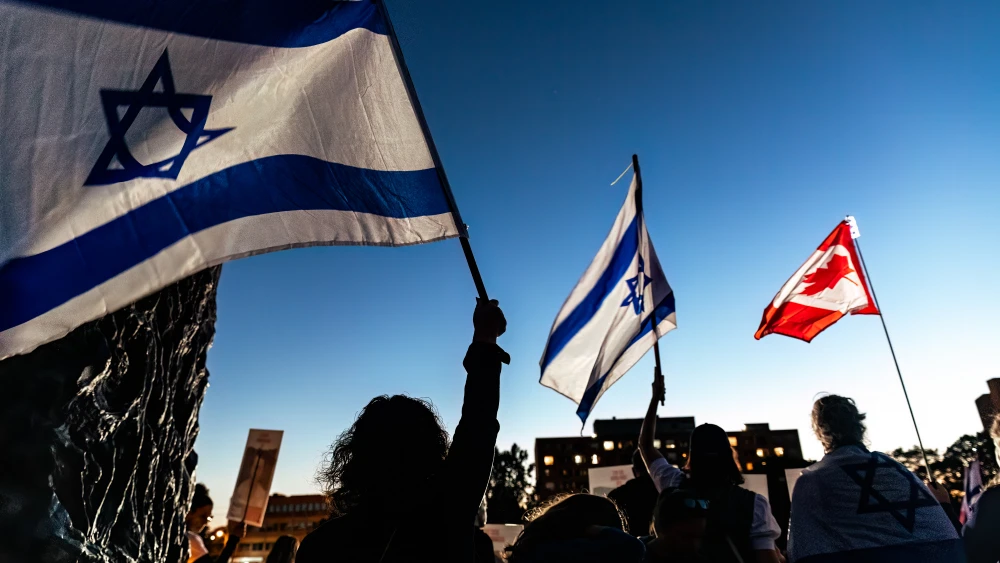
Of the hate crimes based on religion that Canadian police recorded in 2024, 68% targeted Jews, followed by 17% that were anti-Muslim, the Canadian government said in September.
“Under the Liberals, antisemitism is tolerated, excused and waved away for political convenience,” Conservative Party leader Pierre Poilievre stated last week. “When hatred against Jews is met with leniency instead of punishment, the message sent to everyone is crystal clear.”
Canadian Jewish leaders told JNS that it is indeed a dark time but that they are bullish, as the new year begins, about how Canadian Jews will fare in 2026 and beyond.
The two “consequential shifts” that Adam Minsky, president and CEO of UJA Federation of Greater Toronto, saw in 2025 were physical threats that affected “virtually every aspect of Jewish life” and “the very fabric of our country,” as well as an “extraordinary surge of participation in Jewish life.”
“Jewish pride, belonging and commitment are growing in ways we haven’t seen in decades,” Minsky told JNS. “The opportunity in 2026 and beyond will be transforming this short-term burst of Jewish pride into long-term community strength by engaging as many people as possible in Jewish life.”
Minsky said enrollment is up at Jewish day schools and summer camps in Canada and that there has been greater engagement at Jewish Community Centers, on trips to Israel, at Shabbat programs and in the annual ‘Walk with Israel.’ He told JNS that he sees a sense of “optimism,” with young families “deepening their connection to Jewish life in whatever ways are most meaningful to them.”
The challenge, he said, is to continue that deepening connection to Judaism amid “an environment of intensified antisemitism.” That requires strengthening the community from within and working with allies to “push antisemitism back to the margins and safeguard our society from extremism” and “motivating a critical mass of Canadians beyond our community,” he said.
He thinks Canadians “overwhelmingly” have positive views of Jews and eschew antisemitism. “On a global scale, Canada is one of the least antisemitic countries as measured by our population’s views,” he told JNS.
Noah Shack, CEO of the Centre for Israel and Jewish Affairs, the advocacy arm of the Jewish Federations of Canada-UIA, told JNS that Canada and Australia, both commonwealth countries, have a lot in common.
He noted the “horrific attack” at Bondi Beach in Sydney over Chanukah, which was “something that we all experienced as though it happened right here in our own communities.”
“You need look no further than the assessment from Canada’s Integrated Threat Assessment Centre that acknowledged that the same ingredients that were in place in Australia are in place here in Canada as well,” he told JNS. “And that there is a likelihood of the same thing playing out here.”
“That, I think, has framed the Jewish experience indelibly and underscores the need for urgency in dealing with the challenges that we face,” he said.
In the coming year, Jews and non-Jews need “some clarity” that terror attacks in the West aren’t a Jewish problem but one of “unchecked extremism, radicalization” and the “glorification and promotion of violence,” Shack said.
“It’s time for people to recognize that it’s not the analogy of the Jewish community being the canary in the coal mine that people should be concerned about antisemitism, because it will come for them next,” he told JNS. “It’s not coming next. It’s here now.”
He noted that days after the attack in Sydney, Canadian law enforcement agencies arrested a terror ring with ISIS ties that planned to attack Jews.
“It’s important to recall that the Holocaust was able to happen largely because of apathy,” he told JNS. “It’s when otherwise good people do nothing that evil prevails.”
Canada is at a crossroads, according to Shack.
“It may be more comfortable for people to look the other way—to put their head in the sand,” he said. “But this country is worth fighting for, and it’s imperative that all Canadians recognize the stakes and unite in pushing back against the extremism that continues to metastasize in this country.”
In 2026, Shack thinks there will be “some opportunities to drive back some of that darkness on the horizon with concerted action by Jews and non-Jews alike.”
The coming year will be a “pivotal moment for our community and the whole country,” he added.
‘We know right from wrong’
Simon Wolle, CEO of B’nai Brith Canada, told JNS that there was too much “complacency across all levels” in the country in 2025, and that Jew-hatred is an “emergency being ignored through finger-pointing that has led to an existential crisis for the Jewish community in Canada.”
“We have laws that are in place that are not being enforced in the way they need to right now,” he said. “We know that, because we have hateful protests that are happening all over the city and have been happening now for literally years without proper enforcement.”
“Terror symbols, hateful commentary, hateful chants,” he told JNS. “We’re watching that happen under our nose.”
In 2026, politicians ought to make decisions and take action based on “morality and Canadian values,” according to Wolle.
“It might not be where the most votes come from. It might be hard to say. There might be a lot of pressure, but we know right from wrong,” he told JNS. “We feel that Jewish people should be safe in the country of Canada, and if we’re not getting there, then we are falling or failing.”
He, too, managed some optimism amid the bleakness.
“I actually think that hope is starting to surface over fear,” he said. “As we get past the fear, and the hope emerges, and our courage gets stronger, and we seek truth and unity, all things that are starting to converge, we have lots of reasons to be hopeful.”