Newsletter
Newsletter Support JNS

Netanyahu planning visit to the United Arab Emirates

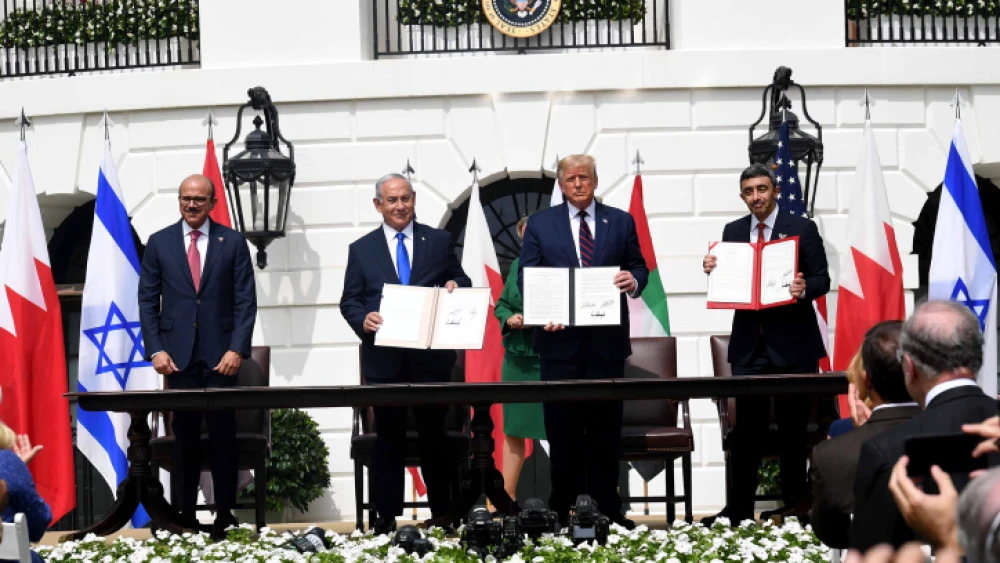
Netanyahu was prime minister in Sept. 2020 when Israel normalized relations with Abu Dhabi as part of the Abraham Accords.

Israeli Prime Minister Benjamin Netanyahu, U.S. President Donald Trump, UAE Foreign Minister Abdullah bin Zayed Al Nahyan and Bahraini Foreign Minister Abdullatif bin Rashid Al Zayani hold up the Abraham Accords, during the signing ceremony at the White House, Sept. 15, 2020. Photo by Avi Ohayon/GPO.

Israeli Prime Minister Benjamin Netanyahu is planning to visit the United Arab Emirates, likely next month, in what is expected to be his first trip outside the country since the swearing-in of his new government.

The reports surfaced after UAE President Mohamed bin Zayed Al Nahyan on Saturday called Netanyahu to congratulate him on forming a government, the sixth time he has done so in his record-setting political career.

A statement from Netanyahu’s office said that the UAE leader had repeated his invitation for Netanyahu to make an official visit to Abu Dhabi.

Netanyahu was prime minister in Sept. 2020 when Israel normalized relations with the UAE and Bahrain as part of the Trump administration-brokered Abraham Accords.

Sudan and Morocco subsequently signed onto the accords, and Netanyahu has made it a central tenet of his new government to expand them even further, with an eye on Saudi Arabia.

Meanwhile, UAE Foreign Minister Sheikh Abdullah bin Zayed Al Nahyan called his newly inaugurated Israeli counterpart, Eli Cohen, according to the official Emirates News Agency.

Abdullah expressed his desire to work with Cohen to further strengthen their countries’ bilateral relations, which have produced many achievements over the past two years, the report said.

Last month, Israeli President Isaac Herzog traveled to the UAE and Bahrain to mark the second anniversary of the historic agreements.

“The Abraham Accords are a national consensus in Israel on all sides of the political spectrum,” Herzog said at the time, adding: “Now we have to…upgrade ties between us even more, to strengthen them and to bring more nations [on board].”

Jerusalem cut contact with the top E.U. diplomat after reports she called Israel an apartheid state, exposing growing tensions with Brussels.
Rabbi Zushe Cunin, of the Chabad Jewish Community Center of Pacific Palisades, told JNS that there has been “tremendous anxiety” in the community over Bruce Lion’s behavior.
“At our own endorsement meeting, when asked to condemn Hamas and its Oct. 7th attacks, she point-blank refused, turning the question into yet another attack on Israel,” the Broadway Democrats wrote about their decision not to endorse Darializa Avila Chavelier, who is running for Congress in New York.
“Even if any Arab or Palestinian thinks that injustice has befallen them because of the existence of the state of Israel, moving on and forgetting about the injustice is much more in their interest than looking backwards,” Hussain Abdul-Hussain, author of The Arab Case for Israel, told JNS.
A month after his father was killed in a Queens park, Tzvi Yonie Itzkowitz told JNS that his family believes that the still-unsolved killing was motivated by Jew-hatred.
“The gravity of the situation and its widespread impact on our school community make this not the right time for a celebration,” the school stated in an email to parents.