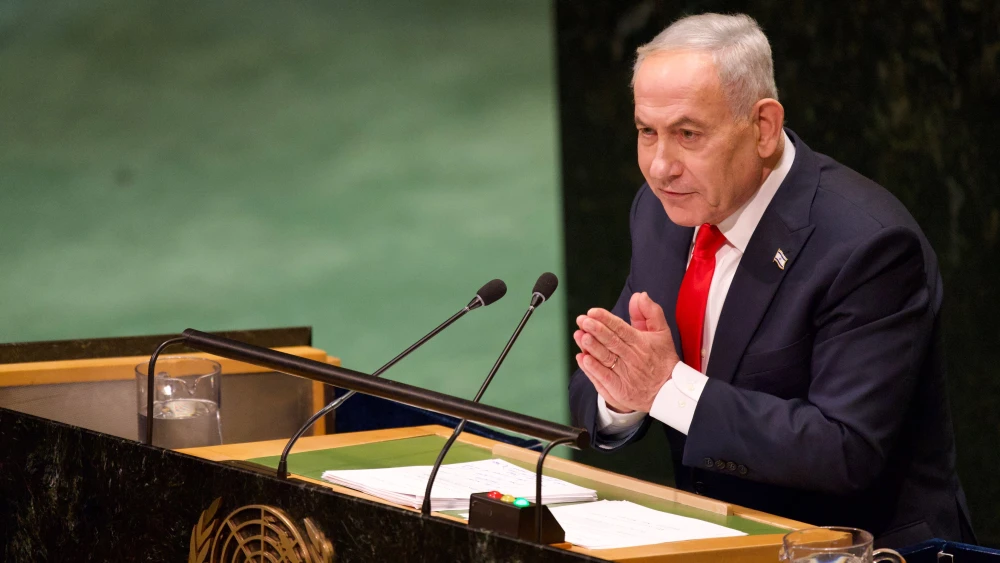
Israeli Prime Minister Benjamin Netanyahu’s speech to the United Nations General Assembly in New York City on Thursday may not prove the final push the premier needs to get more Israelis to vote for him in upcoming elections, but Israeli leaders who tuned in live, or watched shortly afterwards, told JNS that they agree with the substance of his remarks.
“Israelis were definitely watching, but it’s a little bit hard because we’re heading up to an election,” Rabbi Steven Burg, CEO of Aish World Center, told JNS minutes after the speech ended.
“Bibi’s either your guy or he’s not your guy,” the rabbi said. “Everything is kind of discolored by that.”
Burg, who divides his time between Israel and New Jersey, told JNS that “if you pull people over in a very honest moment, I’ll tell you they basically agree with what he said.”
The rabbi spent the prior night at a Torah dedication ceremony for Yonatan Samerano, whom Hamas terrorists murdered at the Nova music festival on Oct. 7. A U.N. Relief and Works Agency staffer took Samerano’s body to Gaza.
“The juxtaposition of us being at the United Nations and all those people walking out while literally their employees helped to perpetuate Oct. 7 was put in a certain frame,” Burg said.
“The bottom line is, I think Bibi was totally on target,” he told JNS. “The Jewish people had to defend themselves.”
The Israel Defense Forces “defended ourselves, and the bottom line is we face an existential threat from all those different places,” Burg said. “The genocide is a farce, and anyone that bothers with any statistics understands that.”
Ya’akov Selavan, deputy head of the Golan Regional Council, told JNS on Thursday night that Israelis have yet to turn much of their attention to the upcoming elections.
“As Israelis, we’ve seen a lot of elections in the last—what is it now?—seven years. This is the sixth round,” he said. “You don’t feel the same—how can I say—not hype, but people still aren’t feeling elections.”
“I’m not sure if this thing can have an impact and sort of wake up the campaigns,” he said.
Selavan was on reserve duty during the speech and said that soldiers were on high alert that day.
“We were all aware of the speech, because it’s one of the things you take into consideration, that some enemy might try doing something big while it’s happening,” he said. “Of course, we were aware of this, but we didn’t watch it.”
Netanyahu told the U.N. General Assembly on Thursday that the Jewish presence in the Golan Heights dates to the time of Moses. “You can read it in the Bible,” the premier said.
Selavan told JNS that “what the prime minister said means a lot for us, because this is something we always point out.”
“We didn’t capture the Golan in 1967,” he said. “We returned home. We returned to the Golan. We liberated the Golan 1,900 years after we lost our sovereignty here in October ’67.”
“Even more important,” Selavan said, were Netanyahu’s comments about Syrian President Ahmed al-Sharaa, whom Selavan called a “moderate president” who is “al-Qaeda.”
“If they chant ‘death to Israel’ in their schools and their military academies, I believe them,” Selavan said. “That means I have to stay strong and present here, in my homeland, in the land of my forefathers.”
‘Israel must defend itself without apology’
Davidi Ben Zion, deputy and acting head of the Shomron Regional Council, was also serving in the reserves during the speech. He watched it from Lebanon, he told JNS.
“The prime minister was right to remind the world what Israel has been fighting since Oct. 7, and to speak clearly about the threat posed by Iran and its proxies,” he told JNS. “As someone who has spent hundreds of days in reserve duty since Oct. 7, including in Gaza and Lebanon, I know firsthand that our soldiers are not fighting because we seek war. We are fighting because our families and our country must be protected.”
The one thing Netanyahu left out is “what we are fighting for,” Ben Zion said.
“I would have liked to hear more about the day after, not only what Israel is fighting against but what we are fighting for,” he told JNS. “Israel should present a clear vision for a stronger Middle East—expanding partnerships with moderate Arab states, strengthening those in the region who reject Iranian extremism and terrorism and creating a future based on security, strength and cooperation.”
“Israel must defend itself without apology,” he said. “But alongside military strength, we also need a clear diplomatic vision for the region that can turn our achievements on the battlefield into a better and more secure future.”
Brig. Gen. (Res.) Amir Avivi, founder and chairman of the Israel Defense and Security Forum, told JNS that Netanyahu’s speech had two goals as he saw it.
“One was really stating the morality of the idea of Israel; on one hand, the resolution to win decisively the war against Iran and its proxies,” he told JNS. The other was to show “the morality of the society and the Israel Defense Forces in the way we are fighting.”
Netanyahu told the General Assembly on Thursday that Britain and France “accuse Israel of colonialism” when “for God’s sake, they invented the term. Their colonies braced the entire globe.”
“As the prime minister said, it’s funny that countries like Britain or France or Spain are the ones accusing the ancestral people of Israel of what they did all around the world,” Avivi told JNS.
Netanyahu “sent a clear message regarding the Iranian regime,” he said. “Israel won’t stop, will work together with the United States to finalize the goal of the war and bring down this monstrous regime, also empowering the Iranian people.”
“Unfortunately, amid these terrible atrocities that the regime is doing in Iran, we see a world that is completely indifferent and is more busy trying to vilify Israel and accusing Israel instead of really dealing with the real problems of the world, like ethnic cleansing in Syria or the killings of more than 100,000 Iranians so far in the last year or two, all of them citizens, not in a state of war like Israel is experiencing,” Avivi said.
Some 123 states sat and listened to Netanyahu’s speech, according to Avivi, including “all the world powers and the vast majority of the Western countries.” Those who left the room were mostly from Muslim countries, he said.
“We are living in a clash of civilizations, and Israel is really at the front of the fight of the West and, with that, Western values, against radical Islamism that is spreading around the world,” he told JNS.
“Looking at Netanyahu together with President Trump, these are two really iconic leaders fighting for the future of Western civilization,” he said.
“In a world where many of these countries lost willingness to fight, I think this resolution, both Israeli and U.S., is very, very important for the future of the world overall, especially Western civilization.”