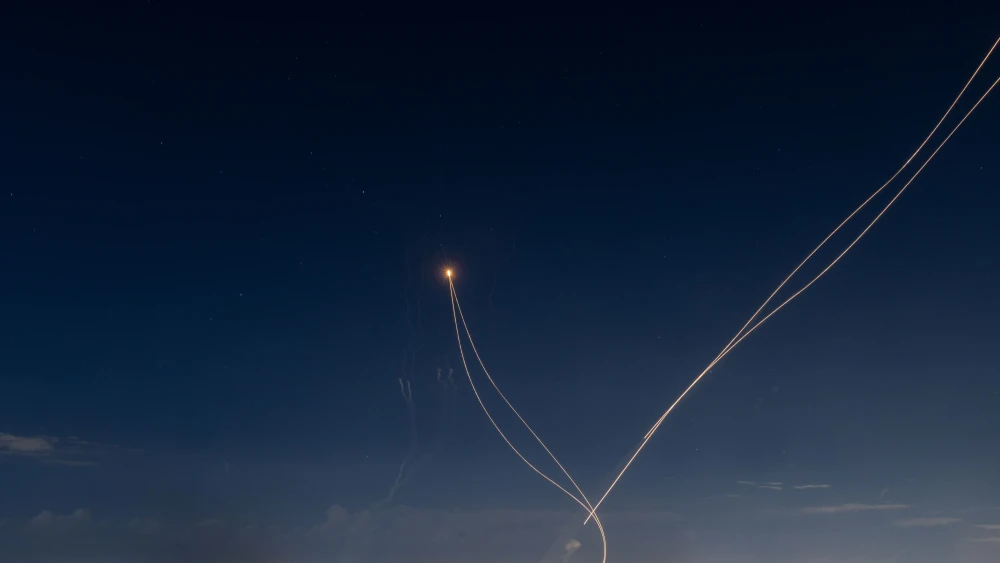
The Iranian-backed Houthis in Yemen joined the war in the early morning hours of Saturday, firing a ballistic missile at Beersheva in southern Israel, precisely a month after the Israel Defense Forces and the U.S. military preemptively attacked Iran on Feb 28.
The missile was intercepted before it reached Israeli airspace, Ynet quoted the Eilat Municipality as saying.
A few hours later, the Houthis fired a cruise missile at Israel that was also intercepted, the report added. As a result, no air-raid sirens sounded.
At 8 p.m. sirens were activated in Eilat, warning of an incoming drone, also most likely launched from Yemen, according to Ynet.
Earlier in the day, Houthi spokesman Yahya Saree said in a recorded address that the “Yemini Armed Forces, with the help of Allah Almighty and relying on Him, has carried out its first military operation with a volley of ballistic missiles targeting sensitive Israeli targets in southern occupied Palestine.”
He said that his terrorist group has joined the war effort in solidarity with the “mujahideen” [jihadist fighters] of Iran and Hezbollah in Lebanon.
Saree vowed that the Houthis would continue fighting until the U.S. and Israeli “aggression stops on all resistance fronts.”
A day earlier, Saree issued a statement warning that his forces would join the war if any Arab state joined the United States’ and Israel’s military campaign, if the Red Sea was used to launch attacks against Iran, or if the attacks on Iran and its proxies continued to escalate.
The Houthis in Yemen warn “our fingers are on the trigger for direct military intervention” if attacks on Iran and its proxies continue, and threaten to attack Gulf Arab countries if they join.
— Ariel Oseran أريئل أوسيران (@ariel_oseran) March 27, 2026
The Houthi’s Military spokesman, Yahya Saree, said what would prompt their… pic.twitter.com/sSx623n2Po
Media reports suggested that the Yemini rebels might attempt to force the closure of the Strait of Bab el-Mandeb, an 18-mile-wide maritime passageway connecting the Red Sea to the Gulf of Aden and the Indian Ocean.
Closing the vital trade route, responsible for some 10% of global crude oil shipments, would come on top of Iran’s closure of the Strait of Hormuz of the other side of the Arabian Peninsula, through which about 20% of sea-borne oil normally transits.
The aircraft carrier USS Gerald R. Ford is reportedly expected to enter the Red Sea after wrapping up maintenance work at Souda Bay on Crete in the Mediterranean Sea.
Additionally, CBS News reported that the aircraft carrier USS George H.W. Bush is en route to the Middle East to join the U.S. Central Command’s (CENTCOM) area of responsibility, likely to pass through the Red Sea.