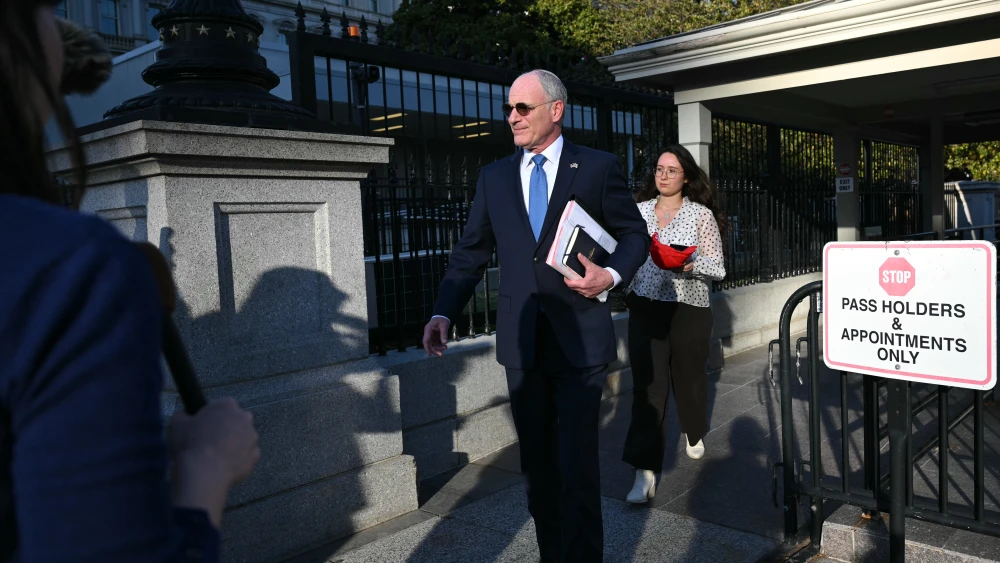
Yechiel Leiter, Israeli ambassador to the United States, told JNS at the embassy’s Independence Day celebration in downtown Washington on Wednesday that Israel and Lebanon have “made some advancements over the initial meetings.”
Speaking to JNS ahead of resumed talks between the two countries on Thursday, Leiter said that the two will look toward “setting the framework for two teams,” one on peace and one on security, each independent of the other.
The U.S. State Department plans to host a third round of talks between Israeli and Lebanese delegations on Thursday and Friday. State Department counselor Mike Needham, U.S. Ambassador to Israel Mike Huckabee and U.S. Ambassador to Lebanon Michel Issa will represent Washington.
Israel is sending Leiter and Yossi Draznin, deputy national security adviser, as well as senior military representatives.
Lebanon’s delegation is to be headed by Simon Karam, a former Lebanese ambassador to the United States who has been designated as the Lebanese presidential special envoy, who is to be joined by Nana Hamadeh, current Lebanese ambassador to the United States.
Leiter told JNS that it’s “almost accurate” to say that the Jewish state’s discussions with Beirut have moved beyond setting parameters for talks and that they could now be considered direct negotiations.
The envoy wants to focus on setting up a team “that will deal with achieving peace, a peace treaty, full peace, as if Hezbollah doesn’t exist,” and a team on the security track, which will function “as if the peace talks don’t exist.”
This week’s talks are the first that won’t focus on a potential Israel Defense Forces withdrawal from positions in southern Lebanon or halting kinetic military activity in the area to root out Hezbollah, he said.
The terror group has long controlled that portion of the country and used it as a firing range against Israel, while Hezbollah blended in with civilian areas.
“Everybody understands today that our presence in Lebanon is because Hezbollah is there, Hezbollah is armed to the teeth and Hezbollah is interested in firing missiles into our cities, towns, villages,” Leiter told JNS.
“We’re not gonna let that happen anymore,” he said.
Reaching a peace treaty with Lebanon while fighting Hezbollah is achievable, according to the Israeli envoy.
“I think we’re going to accomplish both,” he said. “That’s our position.”
He noted that Hezbollah won’t be afforded an effective veto over the peace process with Beirut, but “we’re not going to be able to implement the peace that we signed unless the second track is fulfilled, and that’s the dismantlement of Hezbollah.”
Jerusalem has no immediate plans to withdraw troops, but “we have no designs on Lebanese territory,” Leiter told JNS.
“We are going to operate for the security of our citizens, period, and that’s something that the Lebanese government just has to understand,” he said.
Leiter believes that the Lebanese population, by and large, understands. The Israeli envoy cited surveys suggesting that Shiites, who heavily populate southern Lebanon, support peace agreements in much larger numbers than in recent years.
“That’s very significant, so we have to bring that to manifest itself,” Leiter told JNS. “We have a lot of work cut out for us.”
“This is not going to be an easy process, because there’s 30-40 years of doing things differently,” he said. “The Lebanese are also very hesitant about moving forward, even though they want Hezbollah out as much as we do.”
Jerusalem will “have to be patient but be firm at the same time,” Leiter told JNS. “I do think that the shared interest in freeing that country from Hezbollah is ultimately going to win the day and be vindicated.”