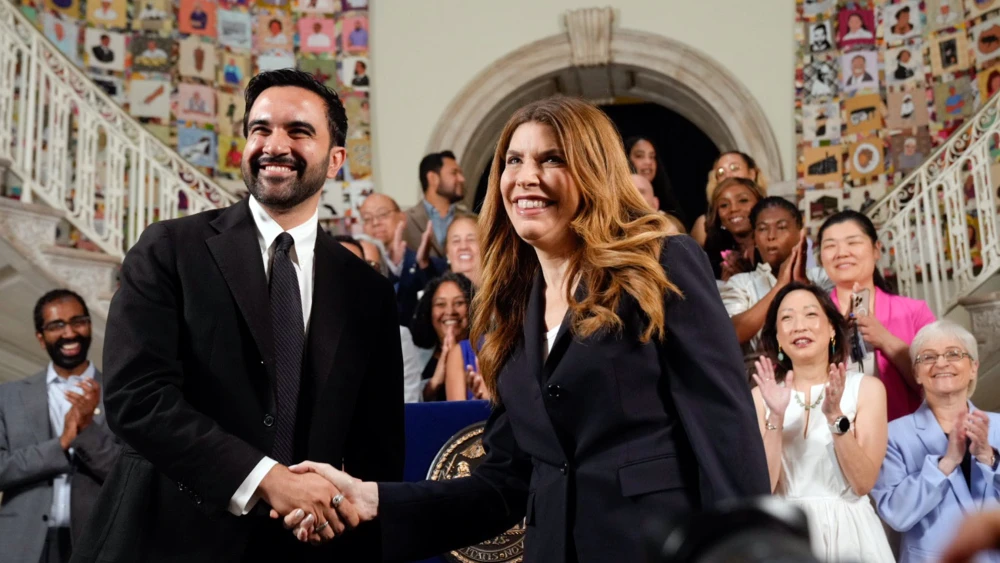
New York City’s top elected officials on Tuesday approved a $125.8 billion budget for the 2027 fiscal year, which includes creating a $300 million housing voucher program that experts say is likely to benefit the Jewish community.
That program, details of which have yet to be released, will begin with a $175 million allocation for the fiscal year, city officials announced. The balance will be included in New York City’s 2028 budget.
Leaders of Jewish organizations applauded the new housing funding.
The program will “definitely” benefit the many families struggling to pay rent, Eli Cohen, director of community relations and advocacy at the Crown Heights Jewish Community Council, told JNS.
As many as one-third of Crown Heights’ 6,000 Jewish families are “really struggling to make ends meet,” Cohen said.
The new housing voucher program will supplement existing city and federal eviction-prevention programs, which require proof of eviction proceedings already underway, Cohen told JNS.

An existing program also provides one-time grants for back payment of unpaid rent, but it doesn’t assist tenants with ongoing rent, according to Cohen.
The new budget also includes $12 million in additional funding to increase reimbursement to nonprofits for providing “culturally competent” food delivered seven days a week to the homes of senior citizens, Linda Lee, the New York City Council finance chair, said at a press conference announcing the budget on Tuesday.
“I got to make sure my Korean grannies get their rice and their seaweed soup and, of course, that we get the halal and kosher meals that everyone deserves,” said Lee, who represents eastern Queens and is the first Korean-American elected to the City Council.
“This budget takes an important step towards ensuring that no older New Yorker has to worry about where their next meal will come from,” Lee said. “We should be giving them the dignity that they deserve.”
“The increased funding for housing vouchers, Fair Fares and food will definitely be helpful, and all things we were advocating for for the past few months,” David Greenfield, CEO of the Met Council, a major Jewish social services agency, told JNS.
The Fair Fares NYC program reduces transit costs for low-income New Yorkers, and increased funding for the program will make about 350,000 additional New Yorkers eligible, according to Greenfield.
The funding also covers a program to deposit $1,000 into a college savings account for each child attending public school kindergarten.

Greenfield told JNS that city funding has been maintained for the City Council’s Elie Wiesel Holocaust Survivor Initiative, which provides trauma-informed care and practical help to thousands of aging survivors.
But overall, 26% of New York City residents are poor by federal standards, which is twice the rate of elsewhere in the country, according to Greenfield.
“The cost of living has outpaced folks’ income,” he told JNS. “Especially now, as we’re seeing cuts and changes to who qualifies for SNAP,” the federally funded and state-administered Supplemental Nutrition Assistance Program, or food stamps, “we’re going to see more challenges, not less,” he said.
Since the city is home to the largest public school system in the United States, New York City Mayor Zohran Mamdani said at the press conference that the new initiative “will be the largest universal college savings program in the country.”
The new, as-yet-unnamed housing voucher program will expand rental subsidies to an additional 5,600 households, or about 14,000 New Yorkers, according to the mayor’s office.
That program was something that the Jewish community wanted and was a contentious part of budget negotiations between Mamdani’s administration and the City Council, sources said.

Rents in now-trendy Crown Heights, which has also long housed a black community with roots in the Caribbean, start at about $2,500 for a one-bedroom apartment, said Cohen, of the Crown Heights Jewish Community Council. Local Jewish families generally have at least two or three children, and often six or more.
Many pay more than half of their income in rent, Cohen told JNS. “If you’re making $5,000 a month, that’s a nice salary,” he said. “But when you’re paying $3,500 or more in rent, there’s not much left.”
Cohen thanked Julie Menin, the first Jewish speaker of the City Council, for making the new voucher program a reality.
“We congratulate the speaker and the council for their hard work on this issue,” he told JNS. “The speaker is the one who was fighting for it.”
Mark Treyger, CEO of the Jewish Community Relations Council of New York, also thanked Menin.
“We applaud Speaker Julie Menin and the City Council for investing in the people who need it most, from expanding rental assistance and transportation access to helping children build financial security” through the college savings program, he told JNS.

“We are especially grateful for their continued partnership with community anchors like the Met Council and countless nonprofits rooted in the Jewish community that open their doors to neighbors of every background with emergency food, essential services and hope,” Treyger said.
“This budget reflects a simple but powerful truth: a stronger safety net builds a stronger New York for everyone,” he told JNS.
New York City is well known for having a housing affordability crisis, and political campaigns, including those of the recent Democratic primary election on June 23, focused on it.
In January, Mamdani reported a budget deficit of $12 billion for fiscal year 2027 in his initial budget plan.
The gap was closed, in part, by an additional $8 billion in New York state funding. That includes anticipated payments of the pied-à-terre tax on high-value properties in New York City when they are not the owners’ primary residence.
The pied-à-terre tax went into effect on July 1.
Cost savings were found by not adding 580 members to the New York City Police Department, something Mamdani had earlier pledged.
Jessica Tisch, commissioner of the NYPD, “and I were able to identify ways to keep the NYPD head count at the originally authorized 35,000, while also meeting all of our crime-fighting needs,” Mamdani said on Tuesday. Tisch is Jewish.

New York’s Jewish community, the world’s largest outside of Israel and an estimated 12% of the city’s residents, is facing unprecedented levels of anti-Jewish hate crimes, according to NYPD statistics. However, those earlier-promised additional police officers would reportedly have had different assignments.
Eric Fusfield, a rabbi and deputy director of B’nai B’rith International’s international human rights and public policy center, told JNS that “we are pleased the New York City budget agreement includes funds that will help some seniors in need to access kosher meals seven days a week.”
“Facilitating home-delivered kosher meals will make a meaningful difference in the lives of New York’s seniors,” he said.
With the new budget, New York City is also adding $350 million to its fiscal reserve, Mamdani said at the press conference.
Mark Levine, New York City comptroller, stated on Tuesday that it was the “most challenging budget cycle in recent memory.”
Mamdani and the City Council “agreed on a budget that preserves and strengthens essential services, and partially restores next year’s general reserve,” he stated. It also includes “meaningful achievements that New Yorkers can and should celebrate,” he said.
“This budget also reveals the city’s ongoing structural imbalance between recurring spending and recurring revenue, and the enormous extent to which we rely on the strength of the financial sector to support growing spending,” he stated. “Even with billions of dollars in unexpected additional revenue, the city still needed state support and $6.1 billion in short-term and one-time measures to close the gap.”
“This agreement gets the city through an exceptionally difficult year, but it does not resolve the structural challenges ahead,” he added. “With large out-year gaps, limited reserves, and significant economic uncertainty, next year’s budget could be even more difficult.”