
History is inexorable. Just as Henry VIII’s break with the Catholic Church shifted the balance of England’s military relations with Spain—and later with France—so today the realm of ideas is reaching beyond the daily practice of politics and beginning to draw the map of the future.
What we are witnessing is the coalescing of authoritarian regimes and Islamist fundamentalists against the democracies. The democratic powers may criticize one another and disagree, sometimes bitterly, but increasingly they, too, are forming an alliance on the ground.
The world is beginning to divide into two fronts.
Repeated attempts have failed to calm the confrontation between the United States and Iran. At the same time comes news of a Russian agreement with the regime of the ayatollahs to develop, beginning in 2023, advanced supersonic anti-ship and land-attack cruise missiles capable of flying at several times the speed of sound. They are being produced for Iran by Rosoboronexport, Russia’s state-owned arms exporter.
Meanwhile, the world’s other authoritarian superpower, China, has demonstrated where it stands. The G20 had sought agreement on a statement calling for a Strait of Hormuz with “free, safe and predictable navigation.” China’s lone abstention prevented consensus, leaving the United States to issue a statement on its own.
The outlines of the authoritarian front are becoming clearer.
The first meeting of a new Turkey-Saudi Arabia-Pakistan grouping is being organized around objectives that remain, for the moment, nebulous. Turkey, meanwhile, continues to threaten Israel with disaster.
Yet on the other side, a powerful new strategic reality is also taking shape.
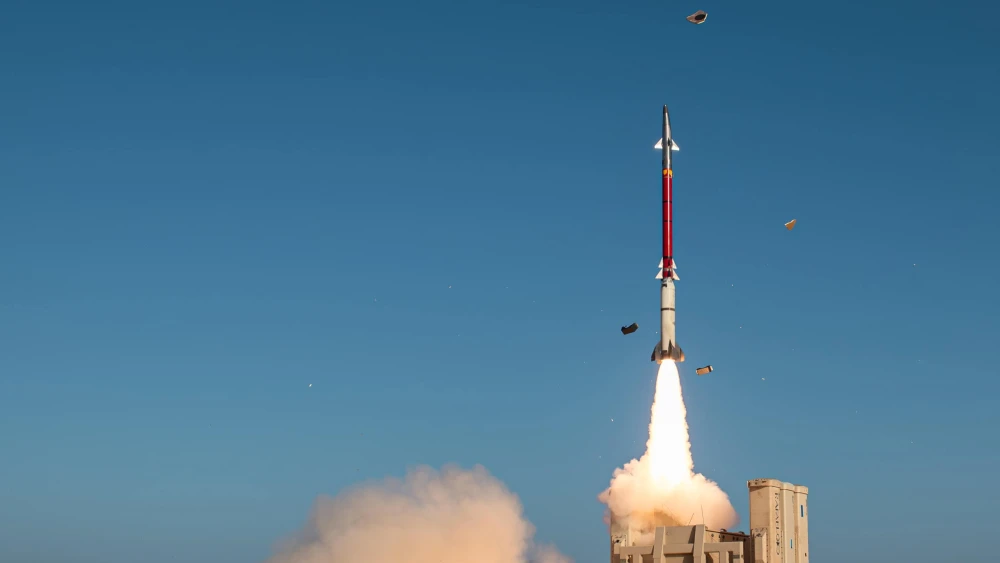
Germany has announced the acquisition of a new Israeli ballistic-missile defense system from Israel Aerospace Industries. With a range of 400 kilometers—distances that matter enormously in Europe—and accuracy of 10 meters, the system has already been successfully tested.
Europe is organizing itself as Russia becomes increasingly aggressive.
In the Mediterranean, another significant alliance is emerging through an agreement between Israel and Greece for the “Achilles Shield,” an ambitious, comprehensive air-defense system incorporating Israeli technology. It includes David’s Sling for intercepting ballistic missiles; Spyder and Barak MX for countering drones and cruise missiles; sophisticated MMR radars; and anti-drone capabilities.
The Republic of Cyprus, particularly exposed to Turkey, is naturally part of this developing strategic picture.
It is not difficult to imagine that neither Turkish President Recep Tayyip Erdoğan nor Russian President Vladimir Putin will be particularly pleased.
This is a strategic earthquake.
Europe is moving in other important ways as well. European Union High Representative Kaja Kallas has said that 10 European countries are prepared to contribute personnel and resources to a new mission in Lebanon after UNIFIL ends on Dec. 31.
The objective would be significant: to relieve the Lebanese army of policing duties so that it can concentrate on the task that matters most—disarming Hezbollah.
None of this means that the transformation is complete or that a new democratic security architecture is already firmly in place. It is not.
But the direction is becoming unmistakable.
Russia, China, Iran and other authoritarian or Islamist powers are increasingly finding common interests. Facing them, Israel, the United States and European democracies are discovering that their security interests increasingly converge as well.
The alliances are not perfect. The countries involved do not always agree, and they certainly do not share identical interests.
History has never required that.
What matters is that the map is being redrawn. A new world is emerging, and its two fronts are beginning to take shape.