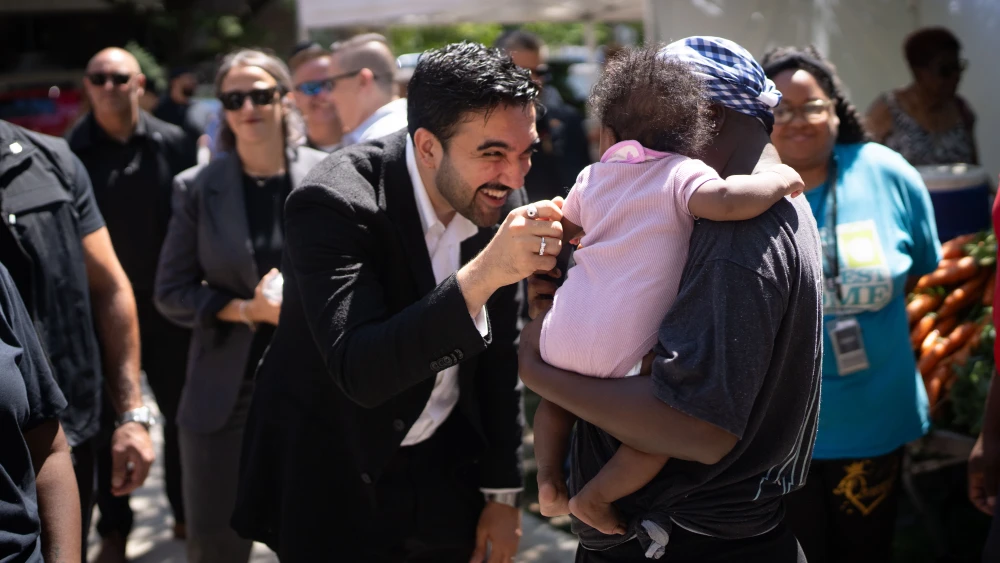

Although the matter is quite serious—that is, the safety and security of the Jewish residents of New York City, and their economic and social future there—I have a sneaking suspicion that with the High Holiday coming up, starting with Rosh Hashanah on Friday, Sept. 11, rabbis realized that they would have to address this subject in their sermons. And so, a group recently met with Mayor Zohran Mamdani.
I read that there were nine rabbis and one lay leader present (she represents herself as a rabbi nevertheless) with an over-representation of the liberal-oriented synagogues (JNS reporter Rikki Zagelbaum lists them). The New York Times noted 10 rabbis. The New York Board of Rabbis and the Rabbinical Council of America, representing many hundreds of more Orthodox Rabbis, were not invited. According to Jewish Insider, the previous week, the mayor had met with leaders of the anti-Zionist Satmar community based in Brooklyn, N.Y.
A JTA report quoted Rabbi Jonathan Leener of the Modern Orthodox Prospect Heights Shul as saying, “There were certainly moments of tension and passion, particularly as people tried to convey how isolated and vulnerable many Jewish New Yorkers feel right now.”
The Times decided to characterize the meeting with a headline that the rabbis had been “pleading” with Mamdani to gather and talk. (If there is a way by which that newspaper can twist and turn a story upside-down if it relates to Israel, it will do so.) I have a subconscious concern that what they were doing was bleating, instead of speaking truth to power and making demands. Mamdani has succeeded, in a fairly short time, in instilling a sense of fear into the Jews of New York.
For his part, Mamdani expressed his feelings that the conversation was “candid and productive” and that he “appreciated hearing from them.”
In the words of another rabbi—this time, the Satmar Rebbe Zalman Leib Teitelbaum of Williamsburg, N.Y.; his brother, Aaron Teitelbaum, lords over the Chassidic haven of Kiryas Joel in Upstate New York—very much revolved around the element of fear.
According to the quoted Yiddish recording, he condemned Orthodox Jews’ attacks against Mamdani. He was speaking during his annual address at the yahrzeit of his uncle, Yoel Teitelbaum.
“We must remember that we are in exile,” he said. “To denounce the mayor and brand him an antisemite constitutes a true provocation against the nations.”
Interestingly, one of the main Haredi news websites in Israel, Kikar Shabbat, headlined its story on the speech on Aug. 10 in a very in-your-face fashion as, “The Satmar rebbe is for the antisemitic mayor of New York.” The summary reads:
“Recently, we have seen a terrible ‘provocation of nations’ [a reference to Rav’s dictum to his son, Hiyya at Tractate Pesachim 113A] by ultra-Orthodox Jews—the provocation against the mayor of New York. We know that we are in exile. … Fearful and peaceful Jews should behave according to the ways of the Torah and accept the decrees of exile. By shouting against it and labeling it with antisemitism, we are only expressing true provocation. It is not enough that there is provocation of nations in the Land of Israel, but they are bringing the provocation of nations here to America as well.”
The mayor of New York is dividing and conquering.
What is obvious is that Mamdani has the rabbis right where he wants them. Both supporters and semi-opponents are coming to him, trying to soothe and placate his rough approach. They aren’t demonstrating. They didn’t issue an agreed-upon summation for the media. Their political maneuverings, including the buffer-zone legislation to protect schools and synagogues, have been low-key.
Were they pleading, as the Times reported, or bleating in a cowering fashion? And how did the general public, especially those unfavorably inclined towards the Jews and Israel, perceive this development?
The real question, albeit one that lies under the surface, is: Who were the rabbis talking to? Mamdani? His Jewish aides? The Jewish community? (We’ll wait for those sermons.) They definitely weren’t talking to the press in any unified fashion.
Instead, they slunk away and allowed themselves to be selectively quoted from phone conversations or email. Have they convened a joint press conference, even at this late date?
Indeed, with many equally represented rabbis and synagogues that could have been included in that meeting, who speaks for the city’s Jewish community? Has Mamdani successfully divided, split up and disunited the Jews on one of the most crucial matters of attention: their political, social and economic future?
One participant in that “private” discussion, Rabbi Ellen Lippmann of the progressive Kolot Chayeinu house of worship, rejected the idea of groupthink. As noted, she “challenged the idea of a consensus on the impact of Mamdani’s Israel messaging.” No surprise there, as Lippman is a Mamdani supporter involved in his transition team, and her synagogue has hosted the mayor.
Mamdani is indeed dividing and conquering.
Rabbi Jonathan Leener, also at the roundtable and who leads an “open” Modern Orthodox synagogue, commented afterwards that the mayor “needs to be aware of how [his language] … creates an environment that I think a lot of Jews feel vulnerable in.”
The new school year will start soon, as will the Jewish holidays of Rosh Hashanah, Yom Kippur and Sukkot. And Israeli Prime Minister Benjamin Netanyahu is expected to attend the annual U.N. General Assembly in September.
The pro-Palestine camp will not be patient. The radical left will increase its pressure. Mamdani can lean on the Satmars and on radical anti-Zionist Jews rallying at Gracie Mansion just before the Shavuot holiday this spring, including Jews for Racial and Economic Justice, New York Jewish Agenda, Bend the Arc and Jewish Voice for Peace.
As I have previously written, Mamdani and his Jewish allies are pushing anti-Zionism as a replacement theory in America. We are witnessing, in New York City, a realignment of political forces—a new Jewish establishment.
What will the rabbis say to their flocks then?