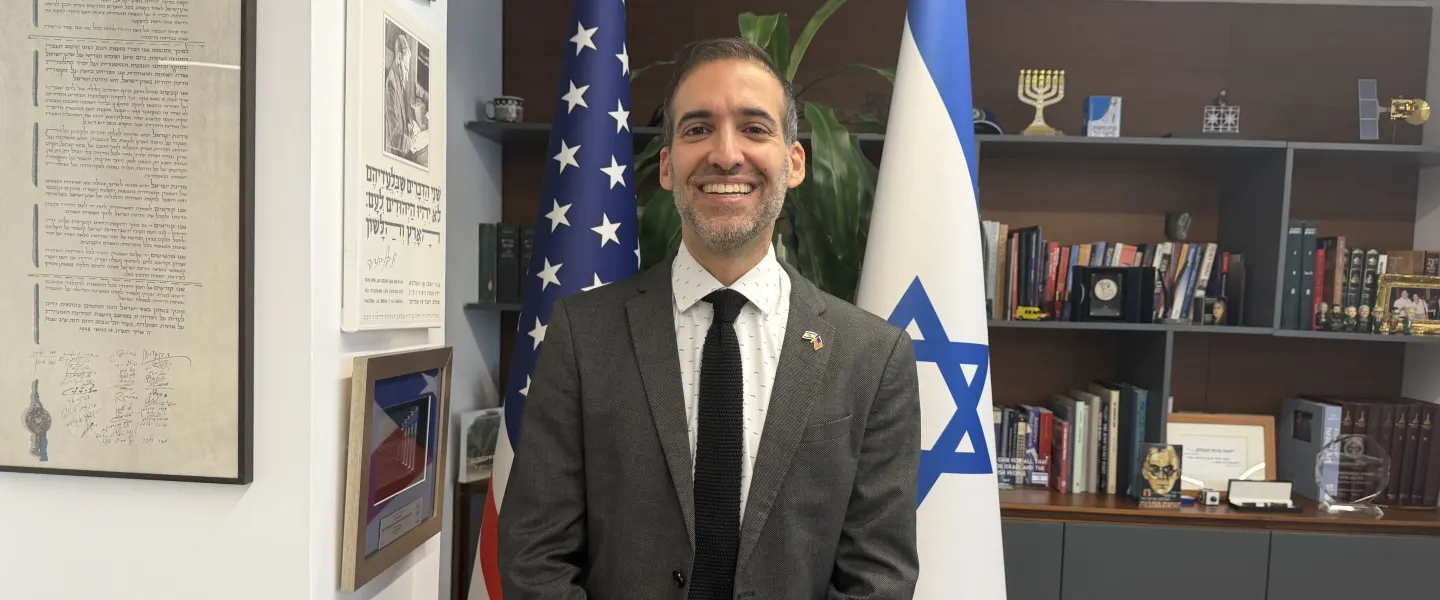
Eyal David, 40, was still unpacking boxes in his office at the Consulate General of Israel in New-York three weeks into his new post as deputy consul general when he told JNS that his time in the Big Apple was already “flying by.”
“It feels like I’ve been here forever,” he said. “I don’t have time to unpack my boxes, because I’m out all the time.”
The envoy arrived in New York after diplomatic postings in Nairobi, Kenya and Morocco, where he helped rebuild Israel’s official presence after the Jewish state and the kingdom renewed relations in 2021.
David’s schedule was also rapidly filling ahead of Israeli Prime Minister Benjamin Netanyahu’s scheduled address to the United Nations General Assembly in Turtle Bay on Thursday.
“As you can imagine, the security surrounding the prime minister is very tight,” he told JNS. “There are ongoing talks between our security team and the New York City Police Department.”
New York City Mayor Zohran Mamdani said recently that he hadn’t encouraged protests against the Israeli premier, although he appeared to have first recommended that New Yorkers take to the streets. Some city police officers reportedly said that the mayor’s rhetoric would put cops at physical risk.

Mamdani, who campaigned on having Netanyahu arrested and more recently said that he lacked that authority, said that he doesn’t plan to protest the Israeli leader. He called on federal authorities to arrest Netanyahu.
David told JNS that it is “unfortunate” that Mamdani is “anti-Israel” and that the mayor had “just a few weeks ago called us ‘monsters.’”
“This use of this hate terminology—he needs to understand it, and elected officials need to understand that words have consequences,” David said. “When there is such rhetoric that is anti-Israel—and it’s not only anti-Israel, not only anti-Zionist, it’s anti-Jewish—we see the consequences on the street, and it can be very dangerous.”
David spoke to JNS when he was filling in for Ofir Akunis, the consul general, who was in Israel. He described himself as “number two” to Akunis.
“I think it’s an important milestone in a career for each and every Israeli diplomat to understand that the United States is the biggest ally of Israel,” he said. “New York. Well, of course, we have Washington, the embassy. But New York is also the vibrant heart of the Jewish world.”
A career diplomat who has spent nearly nine years in the Israeli Foreign Ministry, David said that the posting offers a chance to work at what he described as the Jewish state’s largest diplomatic mission in the world.
“I see myself growing in the ministry,” he said. “I will, inshallah, be an ambassador one day, but I didn’t want to miss this opportunity.”

David grew up in Tel Aviv in a family that he described as “masorati, so not completely secular, not completely Orthodox.” His family was “not at all” political, and it was his “childhood dream” to become a diplomat.
“Being a diplomat is not politics,” he said. Akunis, the “number one here in New York,” is a political appointee, “but the number two is professional,” David told JNS.
To David, it “doesn’t matter which government is leading Israel.”
“Whether it’s a right-wing government or a left-wing government or a center, I’m a civil servant,” he told JNS. “Whoever the minister is, I’m among the other diplomats that serve the policy of Israel around the world.”
As David unpacked, he directed the attention of JNS to a copy of a Moroccan newspaper that featured him on its front page when he left the country. He had been told that his departure would be covered, but assumed it’d be buried.
“I was looking from the last page to the second page,” he said. “I didn’t even look at the cover, and then it’s on the first page. It was crazy.”

The newspaper was in Arabic, a language which David speaks and reads. He also speaks French, the language he primarily used while posted in Morocco, and kept a Hebrew-Swahili dictionary on his desk in Kenya.
David described his time in Morocco as a “honeymoon” and said his connection to the country is “forever.”
“Kenya is always in my heart, because it was my first posting ever. The nature there is amazing,” he said. “But Morocco is forever. I will be the one who opened the liaison office after the resumption of relations, of course with the team.”
Before entering the Foreign Ministry, David began doctoral research on white Jewish communities in sub-Saharan Africa. When the ministry later sent him to Kenya, the coincidence became a running joke among the diplomats in his cadet course.
“I’m becoming the white Jewish community in sub-Saharan Africa, because I was sent to Kenya,” David said, laughing.

There, the self-described “energetic” diplomat joined a cycling group with Rachel Ruto, whose husband, William Ruto, was then deputy president and is now president of Kenya. When David left Nairobi, he said, the first lady came to his home with members of the cycling group to say goodbye.
“It’s something that you cannot expect in other countries,” he told JNS.
David also met three African presidents during his time on the continent: Uganda’s Yoweri Museveni, Tanzania’s John Magufuli and then Kenyan President Uhuru Kenyatta.
“I even had a four-eye meeting with President Museveni of Uganda,” he said, referring to a private, face-to-face one.
His encounter with Magufuli was less formal. “By chance, I met the president. I met him in an elevator,” David told JNS. “It was my elevator pitch.”
“Israel is a desert,” like Africa, he said. “They have many challenges also with their desert areas and also how to use technologies, many from Israel, to save money, to save water, to protect the environment in a better way.”
In his new office in New York, photographs document a visit to Uganda and Knesset Speaker Amir Ohana’s trip to Morocco. David also pointed to an artwork already hanging in the consulate commemorating Oct. 7. It is composed of swirling text messages sent on the day of the Hamas-led attacks.
Asked about his dynamic with Akunis, who can have an outspoken personality, David said it was too early to tell.
“Ask me in a few months,” he said. “It will be feeling like a year.”

David shared Akunis’s criticism of Mamdani but said there is a “good balance” in New York City. He noted that both NYPD Commissioner Jessica Tisch and New York City Council Speaker Julie Menin are Jewish.
“If he doesn’t want to listen to Israel or to be in touch with us, it’s OK,” David said, of the mayor. “We don’t need him. We have others. This is each one’s choice. We cannot impose ourselves on anyone who doesn’t want us.”
David said that he arrived in New York with “a great thrill” about the work ahead.
“It’s an important mission to Israel, to the connection with the Jewish organizations, with the Jewish world and also with the politicians from both sides, Democrats and Republicans, from five key states—Ohio, Pennsylvania, New York, New Jersey, Delaware,” he said.
His goals include strengthening those relationships and showing Americans “the best that Israel has to offer” beyond just war, he said.
Outside of work, David said that one of his New Year’s resolutions is to “find the balance between work and enjoying the city, which has many things to offer.”
He spoke of “canoeing” in the river outside his apartment and going to see a Broadway show.
The unmarried diplomat has another goal for his posting: to meet his wife.
“Maybe here I will form a family,” he said. “Who knows? Only God.”
He may already have help.
“The minute they hear I’m single, I don’t even have to say that I’m looking,” David said. “They’re already looking for me.”
“You know how the Jewish mothers are,” he said.