


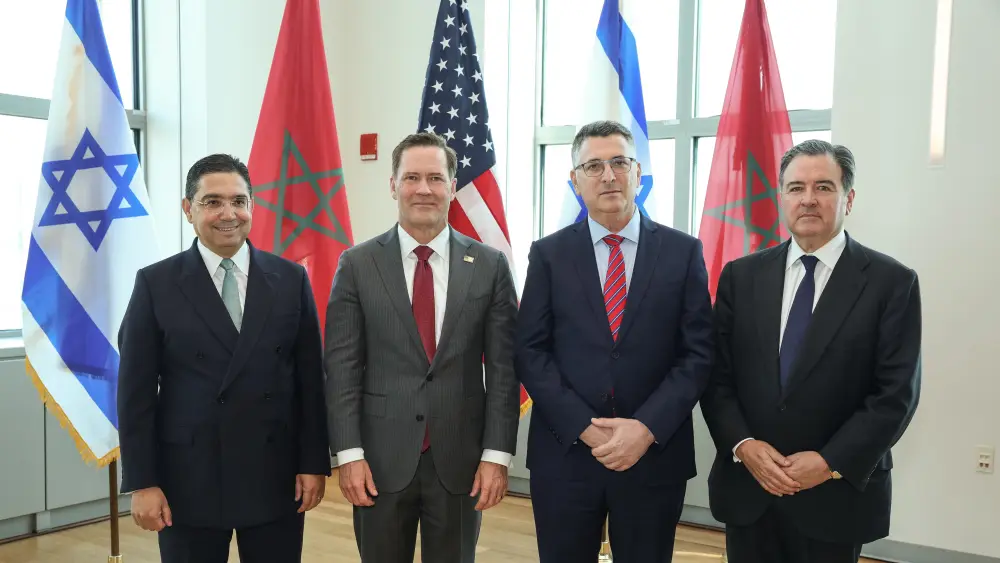

Israel and Morocco announced the elevation of their diplomatic missions to the status of full embassies and the appointment of ambassadors during a trilateral summit with U.S. Ambassador to the United Nations Mike Waltz at his New York residence on Sept. 16.
Israeli Foreign Minister Gideon Sa’ar and Moroccan Foreign Minister Nasser Bourita reaffirmed their commitment to a number of measures aimed at upgrading relations between their countries during the meeting, which took place on the sidelines of the U.N. General Assembly’s annual General Debate.
Observers told JNS that the meeting underscores the commitment these countries have to the Abraham Accords.
David Aaronson, a visiting fellow at the Heritage Foundation who served as senior adviser to Israel’s minister of regional cooperation during the signing of the Abraham Accords, told JNS:
“The fact that Morocco, the United States and Israel held this high-level meeting, even during such sensitive times, is a testament to the strength of the Abraham Accords and the legacy of His Majesty King Mohammed VI, President Donald Trump and Prime Minister Benjamin Netanyahu,” Aaronson said.
Israel and Morocco agreed to conclude agreements on investment protection and the prevention of double taxation by the end of this year; to expand flights between the countries to include those operated by Moroccan airlines; and to conduct high-level reciprocal visits in the coming months.
“Trade between Israel and Morocco grew by 70% in the first half of 2026 and continues to reach unprecedented levels. Direct flights have now been restored for the first time since Oct. 7, 2023, and tourism continues to grow as a result,” Aaronson said.
Sa’ar said, “The declaration we signed today outlines practical ways to upgrade ties between Israel and Morocco for the benefit of both peoples and we will work to implement it.” He noted that “the friendship between the Moroccan and Jewish peoples has deep roots and a rich history.”
Aaronson confirmed that the relations, while being upgraded, are not new. “Jews have lived in Morocco for close to 2,000 years. The Moroccan constitution recognizes the ‘Hebraic roots’ of the country, and Moroccan newspapers display the Hebrew date on the front page. In Israel, nearly one million people are of Moroccan origin, and the Knesset recently passed legislation to preserve Moroccan heritage and culture in national institutions,” he said.
Key to the success of the agreement was Netanyahu’s decision in July 2023 to recognize Moroccan sovereignty over Western Sahara, Aaronson said, describing it as “a smart and far-sighted investment in the relationship that paid big dividends.”
Morocco claims the Western Sahara is historically part of the Moroccan state and seeks international recognition of its sovereignty over the territory. It is challenged by the Polisario Front, a nationalist movement that argues Western Sahara should have independence.
Morocco was the fourth Muslim country to join the Abraham Accords, signing a U.S.-Morocco-Israel Joint Declaration in Rabat on Dec. 22, 2020. The United Arab Emirates and Bahrain were first to join on Sept. 15, 2020. Sudan announced it would do so just over a month later, though it only signed the agreement in January 2021.
Abraham Accords countries met on Thursday on the sidelines of the United Nations General Assembly in New York City, marking their first gathering in more than three-and-a-half years.
The N7 Foundation convened a roundtable event, hosting U.S. Under Secretary of State Allison Hooker and her counterparts from Israel, the United Arab Emirates, Bahrain, Morocco and Kazakhstan.
Kazakhstan participated for the first time in an Accords event.
Mordechai Kedar, a senior research associate at the Begin-Sadat Center for Strategic Studies at Bar-Ilan University in Ramat Gan, told JNS that the agreement between Morocco and Israel is on much sounder footing than Israel’s agreements with Egypt and Jordan, where normalization of relations doesn’t exist.
“The king is legitimate, and this actually what makes the difference between Morocco and many other Arab countries,” he said. “His legitimacy is why he he can pass such a thing, although I do believe that in Morocco there are Islamic circles who do not like this.”
Despite the ingrained hostility toward Jews within Islam, Kedar said that the Abraham Accords will survive and thrive so long as the agreements serve the interests of both sides. “They have every chance of succeeding and becoming stronger,” he said. “If they cease to serve both sides then they might be rethought.”
Kedar expressed hope that Saudi Arabia will join the Abraham Accords. The Saudis are under pressure from the U.S to do so, he said. And they are fearful of the Iranians and the Houthis, and need the U.S., which may create an opening. “I hope that the Saudis, at the end of the day, will join, but Israel should not pay anything for this.”



