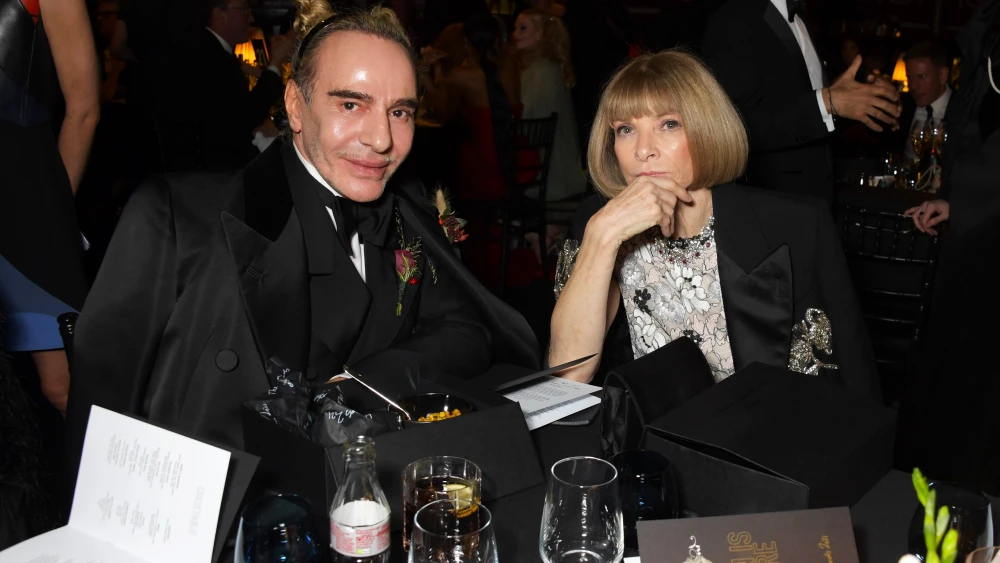

Media executive Anna Wintour, for years the editor of Vogue magazine, called British fashion designer John Galliano’s decision to withdraw from the Metropolitan Museum of Art’s planned exhibition of his work “very courageous.” On this, she was right.
Galliano’s words in 2011 were vile. His antisemitic and racist abuse cost him his position at Dior, as well as resulting in a criminal conviction in France. Nothing he does now can erase what he said. But Galliano subsequently entered recovery, apologized, sought guidance from Jewish leaders, visited Auschwitz and met a Holocaust survivor. If we believe that people can change, sustained efforts to do so must mean something.
Judaism has never treated repentance as a performance of perfect words. Maimonides taught that its highest test comes when someone encounters the possibility of repeating a wrong and chooses differently. Repentance is demonstrated through conduct.
That principle should guide how we understand both the controversy and its resolution.
The Met planned “John Galliano: Horizons,” an exhibition devoted to the designer’s work, to be launched by the Met Gala on May 3, 2027. That evening is also the beginning of Yom Hashoah, Holocaust Remembrance Day.
The objection voiced by many Jews was not to Galliano’s second chance. It was to making his restoration the centerpiece of a celebration on the night they count their dead.
On Yom Hashoah, Jewish families light candles and read the names of people murdered in the Holocaust. For me, those names include members of my own family murdered at Auschwitz. They are not abstractions. They are my inheritance.
There is no reason to believe the date was chosen because it was Yom Hashoah; still, an accident of the calendar does not make its meaning disappear. A gala celebrating the career of a man convicted after antisemitic and racist tirades would have unfolded as Jews began commemorating 6 million murdered members of their people. The collision was painful, avoidable and impossible to dismiss as merely symbolic.
It was made more painful by the world in which Jews are living now. Jews are again being harassed in public spaces and on campuses, threatened at synagogues, denied service because they are Jewish and held collectively responsible for the actions of Israel. Antisemitism is not merely remembered on Yom Hashoah. It is being lived.
Precisely because the Met matters, its choices matter. The museum is one of the world’s great cultural institutions, and the Costume Institute’s work deserves serious attention. But cultural authority carries the responsibility to understand not only whom an institution celebrates, but also when and how it does so.
Then Galliano did something meaningful. He could have defended the exhibition as the culmination of years of rehabilitation. He could have insisted that he had apologized, changed and earned the right to be honored. Instead, he listened to the pain being expressed and stepped aside.
His withdrawal does not erase 2011, and it does not require anyone to forgive him. Forgiveness cannot be demanded from those who were wounded. But atonement can be recognized when it is expressed through action, particularly when that action carries a personal cost.
A museum may one day tell the full story of Galliano’s career: his extraordinary talent, his disgrace and what he did afterward. There may be another time and setting in which that examination can occur with honesty, rather than celebration. In better times, perhaps many of us who objected now could support it then.
The Jewish community was not saying never. Instead, we were saying not this way and not this night.
John Galliano heard that distinction. We should have the generosity to say so.