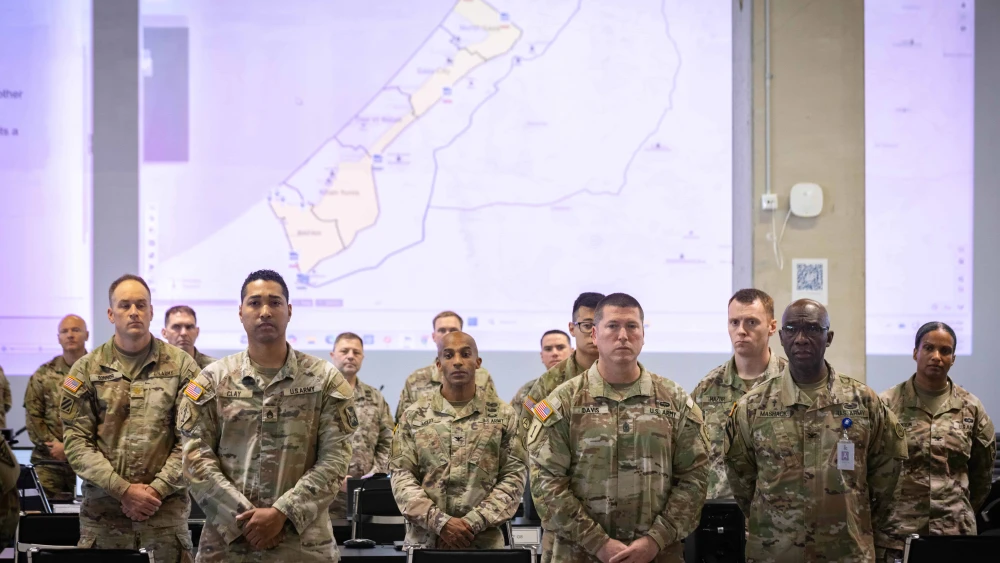

I was invited this week to speak at the new Civil-Military Coordination Center (CMCC) run under the auspices of U.S. Central Command (CENTCOM) in Kiryat Gat.
The center, located in a repurposed industrial building near southern Israel’s transport hub, is a focal point for planning an international stabilization effort for Gaza and coordinating humanitarian flows. The facility hosts U.S. military personnel alongside allied officers and civilian partners.
My assignment was to present findings from a long-running review of Palestinian Authority schoolbooks and to summarize what the U.N. Relief and Works Agency for Palestine Refugees (UNRWA) is currently offering in Gaza through its education programming.
I offered a brief, evidence-based synopsis drawn from years of review and from research commissioned by my organization and authored by recognized experts on Palestinian curricula, including Arnon Groiss, whose work on Palestinian textbooks and the portrayal of Jews and Israel is widely cited.
U.S. personnel were allotted only a few minutes for our presentation.
Earlier in the meeting, a UNICEF official made a passionate appeal for rebuilding schools and restoring education in Gaza.
UNICEF data and statements underscore the scale of the educational collapse in Gaza, where hundreds of thousands of children have been out of school, and a large majority of school buildings were damaged or destroyed. Those humanitarian facts are indisputable and demand an urgent response.
The contrast between the humanitarian imperative and matters of oversight was quite stark. Roundtable conversations prioritized reconstruction, stabilization, and the rapid flow of funds and services. Repeatedly, officials insisted that no funds would go to Hamas.
That reassurance was offered as if transfers to the Palestinian Authority and to relief agencies were automatically secure and transparent. In practice, the record shows serious vulnerabilities in how money and materials move inside Gaza and the West Bank. Recent U.S. Treasury actions against sham charities illustrate the risk that humanitarian channels can be abused by groups that support terrorism.
I warned the assembled CENTCOM officers that education content matters. UNRWA in Gaza historically has relied on P.A. textbooks and materials. My presentation summarized documented instances, identified in expert studies, where Palestinian schoolbooks contain problematic content and where revisions have been incomplete.
Those findings are not ideology-driven. They are based on a detailed text-by-text review. This is relevant because education shapes the next generation’s attitudes and because donor-funded programming can confer legitimacy and reach.
The humanitarian case for rebuilding schools is powerful. UNICEF and other aid organizations rightly describe a humanitarian catastrophe for Gaza’s children. But rebuilding without robust oversight and without clear safeguards against the diversion of funds or the perpetuation of incitement risks repeating past errors.
In Kiryat Gat, I urged planners to combine reconstruction with mechanisms that ensure curricular standards that promote tolerance, peace, and civic responsibility.
There is also a human cost that hangs over every conversation. While officials discussed stabilization, families in Israel continue to grieve the fate of the victims of Oct. 7, 2023. The slow and partial return of bodies and the continued captivity of surviving hostages are a raw, ongoing reality for Israeli society.
Those facts shape public sentiment here and make symbolic or diplomatic gestures feel immediate and consequential. Any plan that touches Gaza will be judged against that human ledger.
From my vantage point inside the CENTCOM hangar, I saw earnest professionals trying to reconcile competing priorities. They sought to enable humanitarian relief and a longer-term stabilization architecture. They also struggled to account for risks that education content and charitable flows might be exploited by actors committed to violence.
My view is that good intentions will not be enough. Practical safeguards are essential. They must include curricular oversight, transparent auditing of funds, and rigorous monitoring on the ground.
I left Kiryat Gat with lingering concern. Reconstruction and education are indispensable. So is scrutiny. Donors and military planners must not treat them as alternatives. They must be simultaneous and properly sequenced. Failure to do so will have consequences for security, for children and for regional stability.