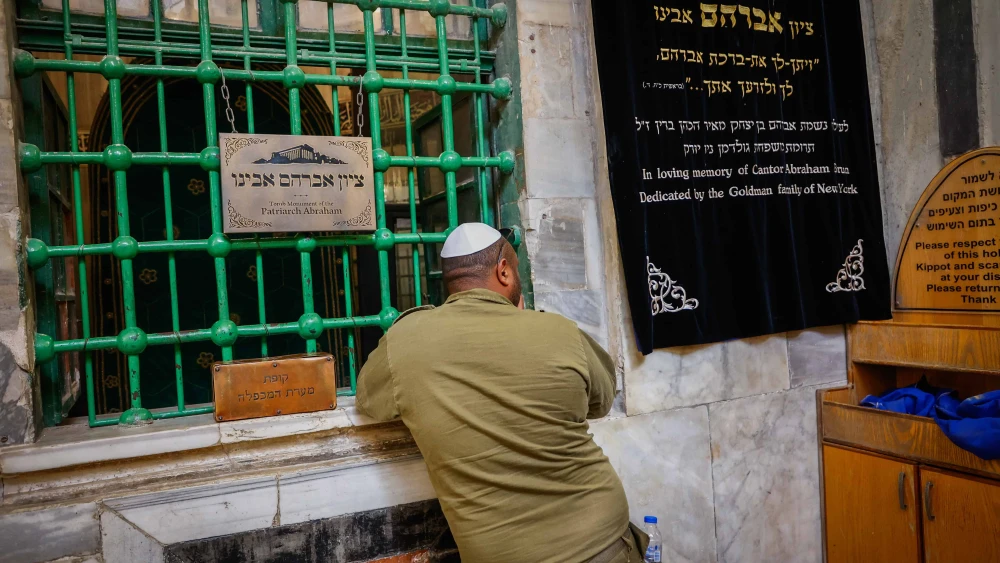

This week, thousands of Jews will spend Shabbat at the burial place of Sarah and Abraham, the mother and father of the Jewish people, as we read Chayei Sarah, the “life of Sarah,” the Torah portion that narrates their deaths and foreshadows the legacy they leave.
This custom is unique, as far as drawing large numbers of people to a biblical burial place at a certain time, year after year. It illustrates how Abraham and Sarah are still embraced as our national parents. This concept is spiritually powerful and contains important lessons about family, especially the way that leaders balance their communal roles with the roles and responsibilities they have in their own families.
This balance, a perennial challenge faced by community leaders throughout the ages, is what, today, we may call “work-life balance.” The many pressing needs of the community often compete with the needs of the leader’s own family, a spouse and children, who look to their partner or parent for love, care and attention. It is true that a life of leadership can offer wonderful opportunities for one’s family not available to others. In such families, children often witness firsthand a rich and multifaceted Jewish experience, as they live within a home engaged in community needs, that takes stands on important issues and is involved in education and lovingkindness (chesed).
Yet this very life of purpose can sometimes come at a cost. The demands of public service can strain devotion to one’s own family; a tension faced by three of the most important figures in Jewish history: Avraham Avinu, “Abraham our patriarch,” Moshe Rabbeinu, “Moses, our teacher,” and Dovid Hamelech, “David, the king.” Each of them responded to the challenge in different ways, allowing us to study and learn the consequences of their different strategies.
Let us begin with who is often seen as the prime example of total devotion to the Jewish people, even at the expense of family: Moses. The Midrash (Sifrei Bamidbar 99) informs us that to remain constantly in a state of readiness for prophecy, Moses separated himself completely from his wife, Tzippora. Although we are told the names of Moses’ two sons, the Torah records not a single interaction between him and them after the exodus. In the Jewish tradition, the consequences are clear: According to one midrash (Bamidbar Rabbah 21:14), Moses’ sons distanced themselves from Torah study, and another (Mekhilta Derabbi Yishmael, Massekhta De’amalek 1) suggests that one even turned to idolatry. Apart from an ignominious part that they played in the story of Micha’s idol (see Judges 18:30 and the remarks from the biblical commentator Rashi), their descendants would recede into obscurity, not playing any major role in subsequent books of Tanach.
Significantly, after Moses dies at the close of the Torah, we are told: “No one knows his burial place” (34:6). This is because a person’s gravesite is primarily meant to be a place for his or her own descendants to honor their ancestor’s memory. But since Moses’s connection with his children was severed, the place of his burial was never preserved. Perhaps it was Moses’ great responsibilities and dedication to the Jewish people that caused this chasm. However, as students of Moshe Rabbeinu, “Moses our teacher,” we need to learn from all sides of his personality: from his amazing virtues, such as his leadership, his dedication and extreme selflessness, but also from the important things he sacrificed along the way that we might want to work to preserve ourselves.
In contrast to Moses, our Torah portion presents Abraham as a model of balance, who was famously renowned for his hospitality and devoted considerable resources to outreach and moral leadership. But in our Torah reading this week, he shows no less zealous attention to those closest to him, mourning and tending to Sarah’s burial, making sure that Isaac finds a proper wife and proactively providing for his other children (Genesis 25:6). It thus comes as no surprise that Abraham’s burial place, Ma’arat Hamachpelah (Cave of the Patriarchs), is extremely well known and visited constantly by thousands of people of numerous faiths, most of whom count themselves among his descendants.
In this week’s haftarah, we are given a third model, that of King David. A visionary and passionate monarch, David wrote and compiled the Book of Psalms, founded Israel’s first ruling dynasty and paved the way for the building of the Holy Temple. Yet when it came to his family, David often found himself caught off guard. A rebellion initiated by his charismatic son Avshalom temporarily succeeded in toppling his reign (II Samuel 15). And in our Haftarah, an aging David is initially unaware while his son Adoniya attempts a similar coup.
While not fully withdrawn like Moses, David tends to his family’s needs in a reactive, rather than a proactive, way. He does not devote independent energy to engaging with his children and ensuring their futures like Abraham has done. Fittingly then, David’s burial spot lies somewhere between the two extremes. While a modest site, known as “David’s Tomb,” exists outside the Old City of Jerusalem, it serves as a site of pilgrimage and visitation to only a few, and its authenticity is disputed by many, including important Jewish religious authorities.
A comparison of the three figures of Moses, Abraham and David teaches a valuable lesson. The endurance of the legacy we leave—symbolized, in this case, by our burial sites—is proportional to the time and energy we devote not only to our communities but to our families.
We must make space for the continuity of the values most precious to us through the people most precious to us, our spouses, children and grandchildren, because it is through them that those values live on. Our prioritizing family is not, heaven forbid, an act of selfishness. On the contrary, by demonstrating the importance of this most basic building block of Jewish continuity, we can exemplify to the community at large what God desires from each one of us. In doing so, we will guarantee not only our own personal future, but that of our nation as a whole.