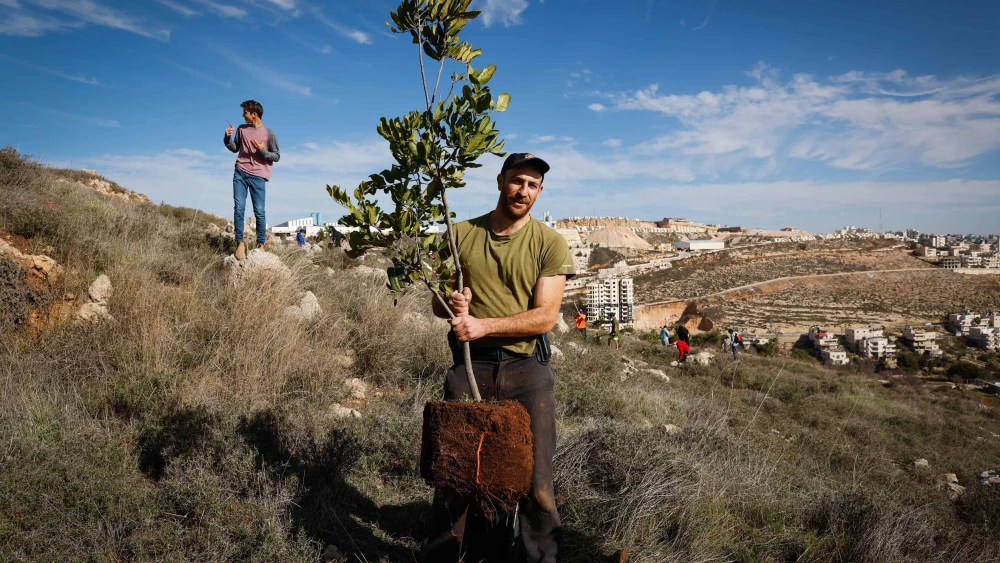

Every year on Tu B’Shevat, tens of thousands of new trees take root across Israel. Jews from all parts of society and all stages of life participate in this ritual—from preschool children to soldiers to tourists—as a way to mark the day commonly explained as the New Year of the Trees.
With this celebration of Israel’s bounty comes a reminder of our obligations in the land. After all, the main reason for a “New Year of the Trees” is tied to observing the biblical commandment that we must not eat any fruit until the tree it comes from is at least three years old. The planting of trees also reminds us of the greater mitzvahof living in the land of Israel, and continuing to build a modern Jewish society inspired by our traditions and values.
Those values go far beyond the land and trees.
They also endow us with responsibility toward the people who live here, including those from other cultures and religions. Our tradition teaches that “Man is a tree of the field” (Deuteronomy 20:19). Among the many ideals embodied in this deceptively simple verse is a reminder that all people have roots in the places they live, along with the potential to bear fruit. They should not be uprooted, disrespected or hurt. Respecting those different from us is an ancient Torah value, embodied in multiple sources over the millennia.
In light of the incredible miracle and blessing of the sovereign State of Israel, such concepts need to be re-examined to make sure that the nation embraces the requirement to treat others with respect. About 25% of the people living in Israel today are Muslim, Christian or Druze. A failure to grasp the modern understanding of Jewish law (halachah)—of how to relate to them—risks fanning the flames of extremist voices and contributing to the broader sidelining of minorities.
For generations, this issue of how to relate to others was not so relevant for most of the Jewish people, as we were a scattered minority bereft of dominion over the land promised to us. As a result, for 2,000 years, there were only a small number of Jewish legal texts, written long before the modern State of Israel was established, that addressed the treatment of non-Jews in the Holy Land and their right to live in the land of Israel. Some might argue that these sources create barriers to non-Jewish residence, though a careful examination of the texts reveals otherwise.
For example, the Torah’s discussion (in Exodus 23:32,33 and Deuteronomy 7:1,2) of a prohibition against non-Jews owning and living in the land of Israel is clearly limited to the seven Canaanite nations, a category of nations that has long been extinct. Because these peoples do not exist anymore, such a prohibition is no longer relevant (Yoma 54a; Berachot 28a).
While early rabbinic sources interpret these commandments in Exodus as including a prohibition against all non-Jews who are idolaters from having a foothold in the land of Israel, a prohibition codified by Maimonides (Sefer HaMitzvot, negative precepts, pp. 50-51), this, too, is not relevant in our contemporary circumstances. None of the non-Jews living in Israel today, including members of the Christian and Muslim communities, is considered idolaters. In fact, Rabbi Rafael Meyuchas, chief rabbi of Jerusalem in the 18th century, publicly endorsed selling land in Israel to Muslims based on the fact that the prohibition does not apply to them.
While some halachic commentaries suggest that the prohibition of non-Jews living in Israel includes all those who do not abide by the seven Noachide laws, this perspective is not fully endorsed. According to the 12th-century scholar Rabbi Abraham ben David of Posquières, this demand is textually undocumented (Hilchot Avoda Zara 10:6). Furthermore, even those who require the observance of the seven Noachide laws would not require a formal embrace of these laws (Kesef Mishnah, Hilchot Avoda Zara ibid.). In these cases, an informal commitment by non-Jews to the seven Noachide laws, which include basic moral concepts such as refraining from murder and theft, is sufficient to permit their residence in the land of Israel.
These teachings make clear that in modern Israel, there is no halachic justification for discriminating against Christians, Muslims or Druze. In fact, according to many, such as Israel’s first chief Ashkenazi rabbi, Rabbi Isaac Herzog, we have a responsibility to be inclusive and fair. Anything else constitutes a chilul Hashem—a desecration of God’s name—and places Israel in danger.
In reality, our relationships with minorities continue to be a work in progress, with room for improvement. While we should be proud of achievements such as equal access to health care and representation on the Supreme Court, discrimination persists in government investment in the Arab sector, in housing policies, in workplaces, in educational institutions and elsewhere.
Meanwhile, only about one-third of Arabs in Israel say they feel that the state ensures their security, in contrast to more than half of Jewish Israelis, according to a study by the Israel Democracy Institute. These feelings were on public display this month as thousands of Arabs demonstrated against the abandonment of policing and other services in their communities. Both Arabs and Jews alike cite tensions with one another as one of the largest sources of social friction in Israel today, making it clear that interfaith and intercultural relations remain a challenge for everyone.
As Israelis and Jews, we do indeed face real threats that are based on hatred toward us. We are also grappling with the enormous loss of more than 2,000 Israelis over the past two years of war, and with the fact that many leaders in the Middle East decline to call out Islamic extremism or hold terror groups responsible for the terrorist attacks of Oct. 7, 2023, and the ongoing Palestinian suffering in Gaza, instead choosing to place blame on Israel. But none of this means we can abandon our principles.
Rather, we must be patient and seek to do good, for that is what God commanded. This is an idea rooted in Jewish law and symbolized by Tu B’Shevat’s call for ethical responsibility beyond the environment itself. We must let others plant their trees alongside ours.