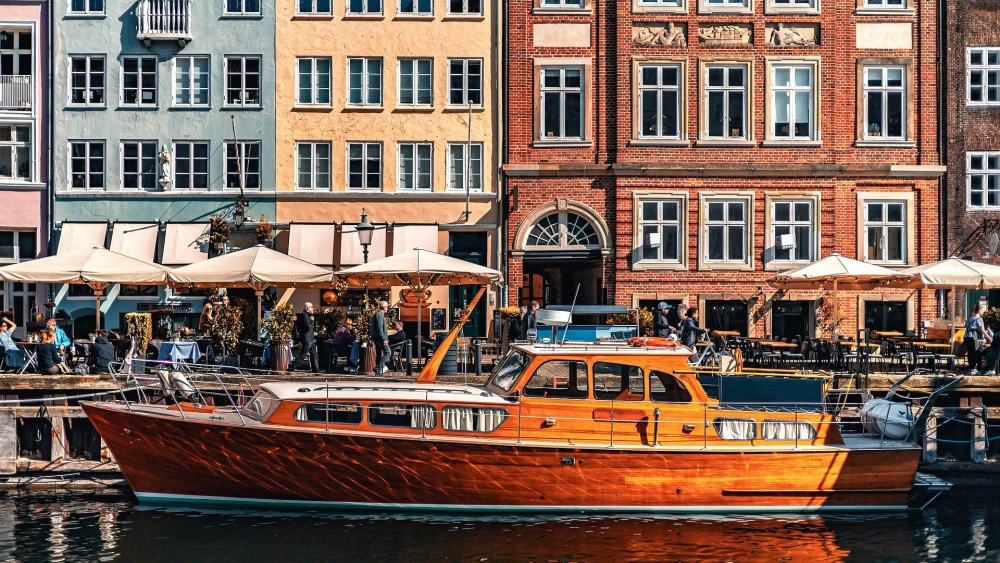

On Friday night in Copenhagen, I went to Shabbat dinner. Nobody else there knew that’s what it was.
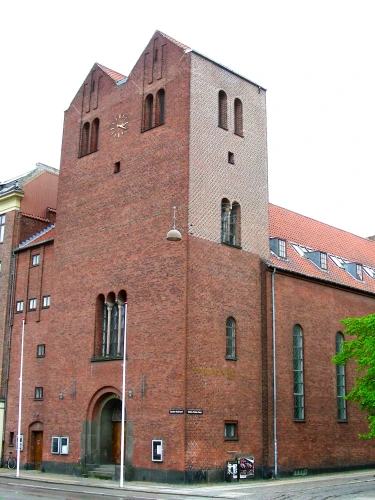
There were no candles, no Kiddush, no challah. Instead, I found myself at Folkehuset Absalon, a community house created inside a former church by Danish Jewish entrepreneur Lennart Lajboschitz, the founder of Flying Tiger Copenhagen. There was already something unusual about a Jewish Israeli spending Friday night over dinner in a former Christian sanctuary.
Absalon is built around a remarkably simple idea. Bring strangers into the same room. Feed them. Give them a reason to talk.
Every day, tourists sit beside Copenhageners, young visitors beside pensioners, friends beside those they have never met. Large dishes are passed around. You do not choose everyone around you. If something you want is beyond your reach, you have to ask someone else to pass it.
It sounds almost embarrassingly simple. It also felt strangely familiar.
Around me were tourists from India, the Netherlands and Slovenia, as well as a group of Danish pensioners. Questions moved around the room together with the serving dishes. Where are you from? Why are you in Copenhagen? Where have you traveled? What do you do?
Eventually, someone asked where I came from. Israel, I said.
And almost nothing happened. The young tourists could not have cared less. There was no dramatic pause and no sudden transformation of our conversation into a seminar on the Middle East. They wanted to talk about travel, cities, work and one another.
I was an Israeli having dinner, not Israel having dinner. That distinction has become more important than we sometimes realize.
Sitting with strangers works differently. You meet the individual before constructing the category.
We live in an age in which identity often arrives before the individual. Nationality, religion, generation and politics become shorthand for deciding who someone is before we have learned much about them.
Social media has made the process brutally efficient. We sort strangers before meeting them and increasingly encounter the world through categories that tell us whom to admire, distrust or blame.
Sitting with strangers works differently. You meet the individual before constructing the category.
The Danish pensioners provided a useful reminder that proximity does not necessarily produce harmony. They were far less welcoming than the tourists and strikingly hostile toward the United States. Their politics entered the conversation quickly. They were entitled to their opinions, of course, just as I was entitled to disagree. But that was precisely what made the encounter interesting.
The point is not to manufacture agreement. Conversation does not dissolve political differences or magically produce common values. The achievement is considerably more modest and perhaps more important. Those who disagree remain seated beside one another.
Jews know something about that.
For thousands of years, the Jewish table has been far more than a place where we consume food. On Friday night, time itself is reorganized around it. We bless wine and bread. We talk, argue, tell stories and invite others into our homes. For a few hours, an ordinary domestic space becomes a community.
The Passover seder makes the connection still clearer. One of Judaism’s most important rituals is constructed around memory, questions, conversation and eating. We do not merely recount the Exodus. We do so collectively, asking questions as the story unfolds. Jewish tradition understood long before modern social science that ideas are transmitted differently when embedded in ritual and human interaction.
Perhaps that is why Absalon felt so familiar.
Lajboschitz did not create a synagogue, and those around me had not come to observe Shabbat. Yet the impulse behind it was recognizably Jewish. Community does not simply happen. It requires rituals and spaces that make encounters possible.
Modern cities are very good at allowing us to avoid one another. We can live in the same building without knowing our neighbors, travel on the same train without exchanging a word and sit in a restaurant speaking only to those with whom we arrived. Technology has made isolation even more convenient. Food reaches our door without conversation. Entertainment is individually selected. Political opinions are delivered by algorithms that increasingly know which views will keep us comfortable or angry.
Absalon disrupts that convenience by doing something almost primitive. It makes strangers sit together.
There is something worth considering here for Israelis and Europeans as well. The encounter between Israelis and Europeans has become intensely political. We speak about governments, institutions, wars, diplomatic disagreements, trade, universities, boycotts and foreign policy. These debates matter. But they can create the illusion that relations between societies exist only at the level of politics. They do not.
Europe is also millions of ordinary encounters. Israelis studying at European universities, Europeans visiting Tel Aviv, researchers working together, tourists sharing railway compartments, businesspeople meeting colleagues, and, occasionally, an Israeli finding himself among Indians, Dutch, Slovenians and Danes in Copenhagen.
None of this erases disagreement. Nor should it. What it does is restore proportion.
The young tourists did not need to agree with Israeli government policy to speak with an Israeli. The Danish pensioners did not need to abandon their hostility toward America for the conversation to continue. Nobody had to issue a declaration of shared values before asking for another serving.
That sounds trivial until one considers how much of contemporary politics is devoted to doing precisely the opposite.
We increasingly demand political agreement as the price of social legitimacy. We withdraw from conversations, institutions and sometimes even relationships because those on the other side hold views we dislike. The result is not a world with less disagreement. It is a world in which disagreement increasingly occurs among groups that rarely encounter one another.
I was an Israeli having dinner, not Israel having dinner. That distinction has become more important than we sometimes realize.
Judaism offers a more demanding model. Anyone who has attended a large Jewish family dinner knows that consensus is hardly a prerequisite for breaking bread. Argument does not mean something has gone wrong. Sometimes, it is evidence that the relationship is alive. The challenge is to disagree without destroying the bonds that make disagreement possible.
Perhaps the setting at Absalon mattered, too. A building once devoted to one form of religious community has been transformed into a space for another kind of human encounter. On a Friday night, inside a former church, visitors from different countries and generations, and presumably different faiths or no faith at all, sat under the same roof. Nobody asked what anyone believed. It didn’t matter. The ritual was simply eating together.
I found myself thinking about the Jewish idea of tikkun olam, “repairing the world.” We often use the expression for enormous ambitions. Fighting injustice. Protecting the vulnerable. Improving society. These are worthy goals. Yet repairing the world may also require repairing some of its smallest institutions. The table is one of them.
My accidental Shabbat did not solve anything. Nobody left Absalon with a new theory of international relations. I doubt the Danish pensioners reconsidered their views of America, and I certainly did not reconsider mine because of them. Perhaps that is asking too much.
What Absalon offered was something smaller. Nationality did not disappear. Politics did not disappear. Neither did disagreement. But none of them determined who was allowed to remain in the conversation.
And when something was beyond our reach, we still had to ask a stranger to pass it. In a world becoming remarkably skilled at keeping us apart, that may be a modest form of repair.