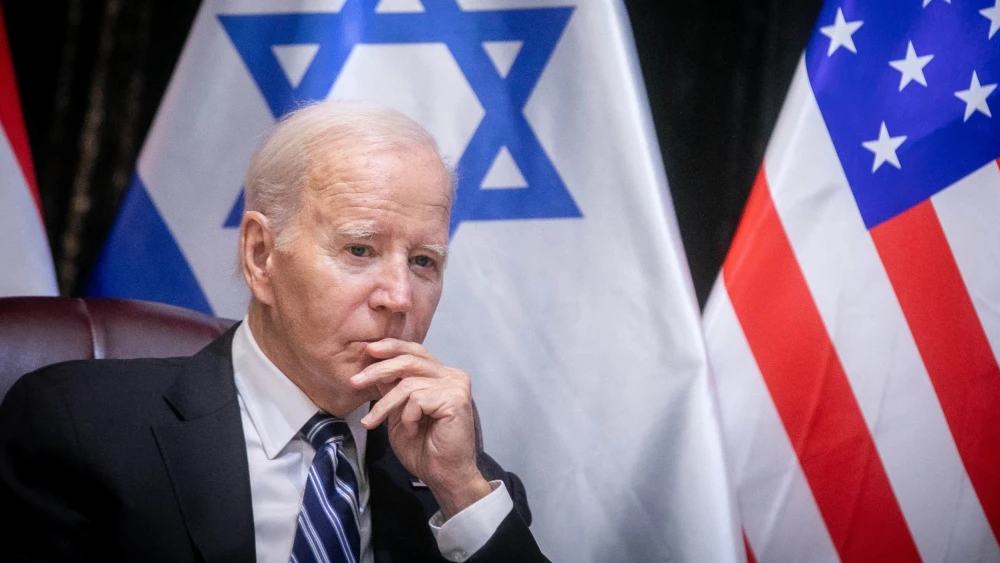

U.S. President Joe Biden’s statements during his recent visit to Israel were extraordinary. There is no other way to say it.
“To the people of Israel, your courage and commitment is stunning. I’m proud to be here,” he said.
Regarding the false claim that Israel had destroyed a Gaza hospital, Biden stated, “I’m deeply saddened and outraged by the hospital blast, which appears to be done by the other team.” Biden’s National Security Council later confirmed this: The blast was likely caused by rockets fired by Palestinian Islamic Jihad.
Israeli Prime Minister Benjamin Netanyahu was appropriately grateful to Biden, particularly for the security cooperation that has ramped up in the past week.
But while statements are good—excellent, even—as was the decision to impose sanctions on “ten key Hamas terrorist group members, operatives and financial facilitators in Gaza and elsewhere including Sudan, Türkiye, Algeria and Qatar,” it appears that the Biden administration’s pre-Oct. 7 political paradigm remains.
The administration’s policies on Iran, the Palestinians, Lebanon and Israel went a long way towards bringing Israel to this catastrophe. When the history of the debacle is written, it will be clear that oil sanctions waivers, unfreezing assets and ignoring the suffering of the Iranian people under the mullahs gave Tehran the sense that it was driving events.
Moreover, the administration’s insistence on a “two-state solution” gave veto power not only to the Palestinian Authority, but also to Hamas. It pulled the rug out from under the Abraham Accords countries, who had agreed that the economic and social future of the region would not be held hostage to intransigent Palestinians. Biden was even willing to sink Israel-Saudi rapprochement with a requirement that Israel provide concessions to the P.A. while requiring nothing from P.A. strongman Mahmoud Abbas.
In addition, the White House announced in July that it was giving more than $315 million to the Palestinians, bragging that it had raised the total to nearly a billion dollars since the administration took office. This gave Hamas and the P.A. the same idea as Tehran: that the U.S. was on their side.
The Biden administration also forced a natural gas/maritime border deal on Israel that ceded resources to Lebanon and signaled to Hezbollah that its position in southern Lebanon was probably safe from Israeli attack.
The White House’s continuous slaps at Israel and propensity for poking its nose into Israeli domestic politics certainly didn’t help ward off the Hamas-Iran terror assault that was coming.
OK, you say, but now push has come to shove, and Biden has made the choice to stand with Israel.
This is not entirely true.
First, the White House has announced that it is prepared to send $100 million in “humanitarian aid” to Gaza. This new infusion of cash, combined with Biden’s remark that Hamas does not “represent the Palestinian people,” is dangerous.
Maybe Hamas does represent the Palestinian people. Maybe it doesn’t. How can Biden possibly know?
Indeed, for years, when terrorists emanating from Palestinian-controlled territories kill Israelis, sweets are passed around and celebrations held among ecstatic Palestinians. Gazans were widely seen celebrating on Oct. 7. While it would be unreasonable and unfair to say that all Palestinians support Hamas and other terror groups, a great many clearly do.
How then, will the President ensure that U.S. taxpayer dollars earmarked for the Palestinian people won’t be handed over to the terror groups many of them support?
Clearly, if humanitarian aid is needed, the money should be distributed through the government of Israel, not corrupt and malicious actors who cannot be trusted.
Biden’s policies towards Iran are equally problematic. According to the IMF, in 2019, a year after the adoption of the “maximum pressure policy” by then-President Donald Trump, Iran’s accessible foreign exchange reserves fell from $122.47 billion to $14.95 billion.
They’ve been climbing since Biden took office in 2021. A Heritage Foundation analyst suggested that Iran has more than $42 billion in accessible funds now. That’s without the $6 billion the administration put in Tehran’s Qatari bank account.
Clearly, the Biden administration should end all oil sales waivers and sanction the government of Iraq (yes, Iraq) which permits Iran to take Iraqi oil and sell it on the international market.
Then, the white House should freeze all funds going to Iran from the U.S. and encourage the E.U.—Iran’s largest trading partner—to end all trade with the mullahs’ regime. It must tell the Brazil-Russia-India-China (BRIC) consortium to rescind their invitation to Iran or face American trade restrictions. It should work to reinstate the U.N. ballistic missile and other missile technology sanctions on Iran that were lifted this week with no objection from the U.S.
Moreover, the White House must finally put an end to U.N. support for Palestinian terrorism. First, it should cut all financial support to the virulently racist and anti-Israel U.N. Human Rights Council. It should also cut off the Palestinian refugee agency UNRWA, which operates as a money-laundering operation for Hamas in Gaza.
Finally, the Biden administration must demand that Qatar oust the Hamas leaders who live in luxury in Doha unless Hamas returns the hostages it has kidnapped. The emir of Qatar has said he won’t expel the Hamas leaders he harbors, but in fact the U.S. has yet to make a formal request.
Biden and his administration must remember: Statements of support are good, practical deeds are better.