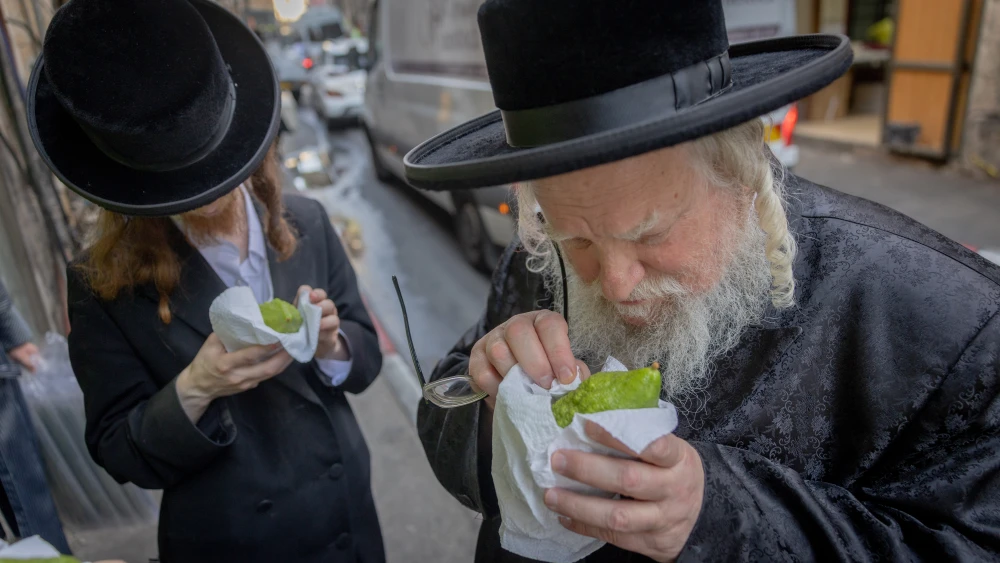
Rabbi A.D. Motzen tries to avoid traveling around Sukkot, a holiday whose accoutrements often don’t fit in overhead bins on planes and can confound airport and border security officials. But the national director of government affairs at Agudath Israel of America has suggestions for Jews who travel with the holiday’s four minim, or “species.”
If one intends to go through airport or border security with a lulav (palm frond), etrog (citron), hadasim (myrtle branches) and aravot (willows), it is important to plan ahead.
“If you are taking arba minim, your security screening may take longer,” Motzen told JNS. “In airports with small bins for the scanner, your lulav case may have to be examined separately.”
The rabbi also advised that one may find limited space in overhead bins, especially on airplanes, if one is among the last to board.
“It is the prerogative of the airline what to do in that case, so other than arriving early,” passengers are response to explain “calmly and respectfully why this long object is very fragile and needs to be handled with care,” he told JNS. “Hopefully, they will find a place for it somewhere on the plane, so you don’t have to check it.”
U.S. Customs and Border Protection stated that it is “committed to treating all travelers with respect and dignity at all U.S. ports of entry.”
The Oct. 3 CBP memo also said that “beginning after sundown Oct. 6, until after nightfall Oct. 13, travelers observing Sukkot may carry religious items that are normally regulated to prevent the introduction of invasive pests and diseases.” The four species “might be allowed into the United States after inspection by CBP agriculture specialists,” the U.S. Department of Homeland Security agency said.
The agency states that etrogim can enter through “specific” North Atlantic and Northern Pacific region ports, and travelers must unwrap the citron so that an agency “agriculture specialist can inspect it.” The etrog “will not be allowed in if they find pests or insect damage,” the agency said.
The agency’s agriculture specialists will also inspect each lulav, hadas and aravah for pests or “symptoms of disease,” per the agency. Absent those findings, travelers can bring them in, except for “European twigs of willow,” which the agency said “are prohibited from entering the United States.”
Willow twigs from other places can enter after inspection, if there are “no pests or symptoms of disease, such as being green in color, having soft tissue or sprouted buds.”
Motzen told JNS that those arriving in the country from overseas should read the agency’s memo carefully.
“It only applies to certain ports of entry, and it requires the traveler to declare the produce. It will be inspected before being allowed into the country,” he said.
The rabbi noted that the agency only allows such items for “personal use.”
“If you are bringing sets for multiple family members, you may be asked additional questions to ensure you are not importing them,” they told JNS. “We once had someone call us upset that CBP confiscated his suitcase full of etrogim.”
The CBO memo only applies to travelers entering the United States, Motzen cautioned. “Entering Canada has its own procedures,” he said, “and Israel only allows a traveler to bring one etrog and none of the other arba minim.”