Yaelle Schachna describes the benefits of her daily biblical study in physical terms.
“You could be having a really hard day, and then you’d listen to the shiur and feel like you got a gentle hug or a pick-me-up,” the resident of Melbourne, Australia, told JNS of taking part in lessons as part of a program of the Orthodox Union’s Women’s Initiative.
“Learning while waiting for the hostages to come home and seeing how these stories still apply today reinforced the timelessness of Torah,” she said. “It wasn’t just stories or old words, it felt like a roadmap for our lives.”
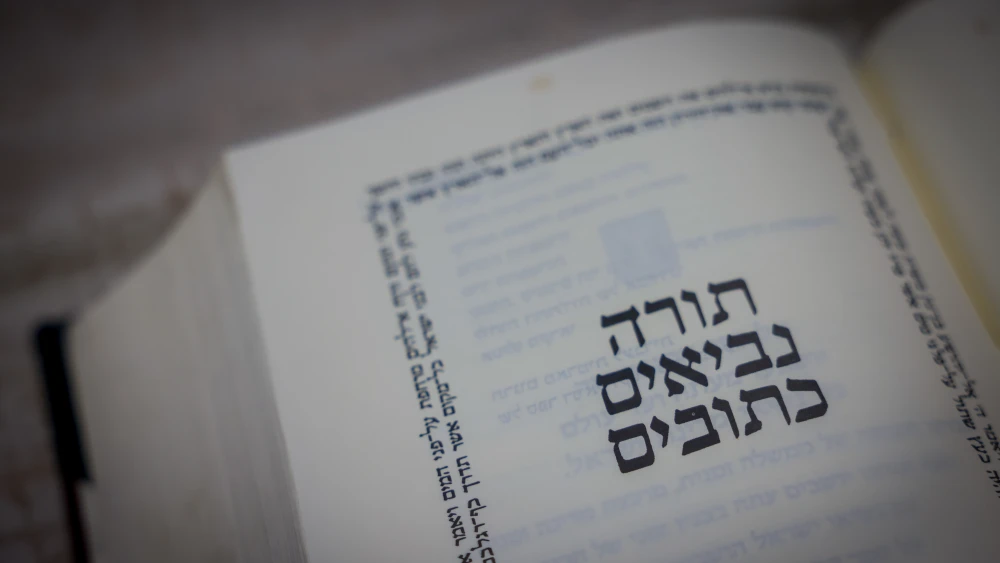
Schachna is one of 22,000 women from more than 30 countries who are taking part in the OU’s Nach Yomi program. Nach is an acronym that refers to the final two sections of Jewish scripture, Prophets and Writings, and yomi means “daily.” In the program, women read a biblical chapter a day, completing all of the 34 books, a combined 742 chapters, every two years.
Participating helped Schachna feel connected to Jewish women worldwide, she told JNS.
“Living in Australia, I’m very far away from the rest of the world,” she said. “Especially post-COVID, we don’t have many speakers coming through. This made me feel like I was part of something global. I didn’t feel so far away.”
When she realized that one of the celebrations marking completing the cycle was scheduled to take place in Woodmere, N.Y., during a time that she planned to visit her grandchildren in California, she opted to extend her trip so she could attend.
“I told my kids, ‘That’s it. I’m going to New York just for this,’” she told JNS.
Finishing the cycle has been so “absolutely life-changing” that Schachna, who says she “can’t imagine a day without Nach Yomi,” has already signed up to begin the next cycle on Feb. 12.
This is the third completion of the cycle since the Orthodox Union launched the women-only iteration in 2020. The OU created a Nach Yomi program for men in 2007. Both are modeled on the daily study of a page of the Talmud, called Daf Yomi, which celebrated its centennial in 2023.
Adina Shmidman, founder of the OU Women’s Initiative, told JNS that the program was created to provide women with consistent access to serious, daily Torah study taught exclusively by women.
“There were women teaching here and there through the OU,” Shmidman said, “but in terms of giving women structured, serious daily access to Nevi’im and Ketuvim,” or Nach, “this was the first time the space was opened.”
Of some 22,000 women subscribed to the program, about 5,000 to 6,000 listen daily to lectures, which the Women’s Initiative posts, the OU told JNS.
Appointing only women as teachers was a deliberate choice and a central aspect of the program’s mission, according to Shmidman.
“The idea that women are learning from women creates a sacred space for learning,” she told JNS. “It also creates a talent pipeline, giving accomplished female educators a platform to teach and be heard.”
Participants span ages and educational backgrounds, and they engage with the program variously, including while “driving carpools or doing laundry,” Shmidman said.
Mara Lassner, a Manhattan-based marketing consultant, joined the program after recognizing gaps in her learning, despite having attended Jewish day schools.
“There’s so much I never learned, and there’s so much more out there,” she told JNS.
Lassner generally multitasks while listening but later compares notes with friends. “We don’t listen together,” she said. “But we marvel together and share what we’ve learned.”
In addition to the Woodmere, N.Y., event, the Orthodox Union is hosting celebrations marking the cycle completion in Chicago, Boca Raton, Phoenix and Jerusalem. It held a Feb. 1 event in Boston. (Most are free, save the New York one, which costs $100, and the Jerusalem one, which has a 100 shekel fee.)
Those who can’t attend in person can request a “siyum in a box,” which includes editable flyers, journals for note-taking and program materials. The events are also to be livestreamed.
For Debbie Fox, a clinical social worker from Los Angeles, joining Nach Yomi was a way to reconnect with Jewish texts later in life.
“I really felt like it would be something of interest to me,” Fox told JNS. “When I went to school, we didn’t learn very much Navi, and we didn’t learn all of Tanach. That was over 50 years ago, so whatever I learned, I can’t say I remember.”
“I have a family. I work. I do all of that,” she said. “But I thought maybe it was time to do something for me—for my own spiritual and educational needs.”
Fox said many of the themes explored in the daily lectures often resonated with current events and personal challenges.
“There were many times when I would sit down at night and talk with my husband about what I learned,” she said. “As an adult, I look at these themes very differently than I did in high school—the ups and downs of Jewish history, the recurring patterns, the concepts.”
Completing the cycle is an important milestone for Fox.
“I accomplished something that is very meaningful to me personally,” she said. “Being part of this learning over two years was a real achievement.”
Shmidman told JNS that 75% of current participants plan to begin the next cycle, and another 20% have said that they are considering it.
“That level of retention is remarkable,” she said.
One elderly participant told Shmidman that she wants her tombstone to read, “I learned Nach Yomi,” and another woman named her son after the book she was studying on the way to a fertility clinic, she told JNS.
She also recalled a woman in her 90s, who was completing the third cycle, who told her that she “never imagined women would have access to this kind of serious, daily learning in her lifetime.”
“There is a recurring theme that women feel deeply connected through Nach,” Shmidman said. “They feel connected to God and to Jewish history in a profound way.”
Studying the texts during periods of crisis has intensified that connection, according to Shmidman.
“Women learning during illness, grief and war experience these words as both timeless and timely,” she told JNS. “The miracles we’re witnessing today remind us that we’re living in remarkable times. We’re living the next chapter of Nach.”