Newsletter
Newsletter Support JNS

Florida man facing death sentence allowed to cover swastika face tattoos for trial

Wade Wilson is on trial for the murder of two women in 2019. His lawyers argued that the tattoo could bias the jury against him.

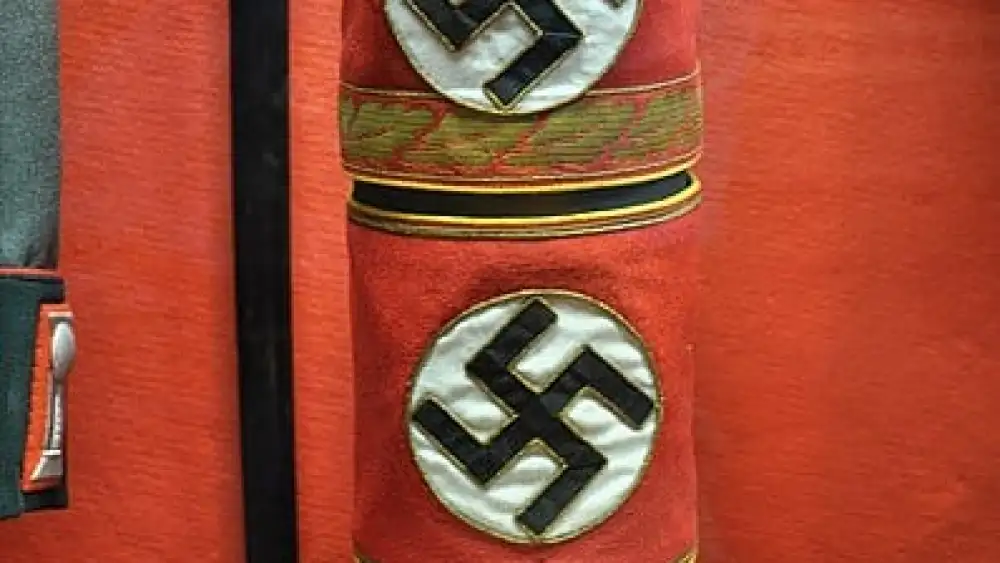
Nazi Armband
Armband of the German Nazi Party, worn around the upper left sleeve of the uniform tunic and bearing a swastika. Credit: Joe Mabel via Wikimedia Commons.

A Florida man facing a potential death sentence was granted permission to cover a swastika tattoo under his right eye after his lawyers argued that it could bias the jury against him.

Accused of murdering two women in 2019—one by strangulation and the other with a car—Wade Wilson, 30, allegedly confessed to his father and ex-girlfriend. He spent the last five years behind bars, his trial delayed by his first attorney’s death and his escape attempt. The trial began on Monday in a Cape Floral courthouse.

Despite Judge Nicholas Thompson’s approval of his lawyers’ request to cover up a small swastika under his right eye and other images, most of the defendant’s provocative body art remained visible.

Other intimidating illustrations Wilson chose to apply to his face include lines extending up his checks from his mouth like a cut-out smile, with simulated stitches holding his face together, reminiscent of the Joker antagonist in the Batman film “The Dark Knight.”

Additional charges against Wilson include grand theft auto, battery, burglary and petty theft.

More than 700 injured as a state of emergency is declared and international aid is rushed to the South American country.
Basil Sweid, 32, a driver in the military’s 75th Battalion, was “a virtuous man of good character,” his city council said.
Banning brit milah would prevent Jewish life from flourishing in Europe, said Katharina von Schnurbein.
“If this is false information, negotiations would end, immediately!” he said.
The Jerusalem-based India x Israel Nexus seeks to strengthen business, cultural and policy cooperation between the two countries.
Panelists at JNS Summit say educational reforms, new media voices and opposition to extremism are laying the groundwork for broader Middle East normalization with Israel.
Benny Gantz, JNS editor-in-chief Jonathan S. Tobin, Gilad Erdan, Mosab Hassan Yousef, Nissim Black and leading voices in security, diplomacy, media, law and Jewish communal affairs headline the summit’s third day in Jerusalem.