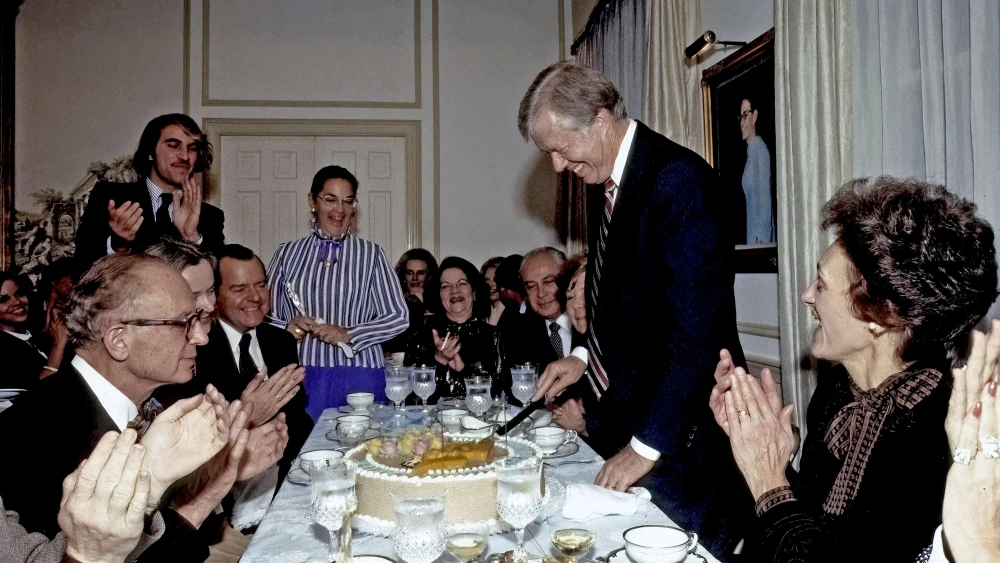
A longtime Washington insider who used her dinner table to nurture Middle East peace and bipartisan dialogue died on March 26 after a battle with cancer. She was 94 years old.
U.S. President Joe Biden released a statement last week praising the life of Esther Coopersmith. The president said that she “shaped history” and called her a “skilled diplomat, committed advocate and genuine bridge-builder” who “helped forge a ground-breaking peace accord.”
Coopersmith was born Esther Lipson on Jan. 18, 1930, into a family of Eastern European immigrants living in Des Moines, Iowa. Upon moving to Mazomanie, Wis., they became the only Jewish family in the town. Coopersmith became interested in politics as a child, listening to President Franklin Roosevelt’s radio broadcasts.
She met her husband, Jack Coopersmith, a real estate entrepreneur, at an Adas Israel synagogue tea dance; they married in 1954 and raised four children. He died in 1991.
Coopersmith worked as a Democratic Party activist, lobbying, philanthropist and advocate of women’s rights. Members of both parties and diplomats from diverse countries could gather for cordial conversations at her regular dinner parties.
Meir Rosenne, the Israeli ambassador to the United States from 1983 to 1987, told The New York Times regarding Coopersmith’s parties that “there are no boundaries, no protocol for her guest list” and one could find “an orthodox Jew who wouldn’t touch anything that is not strictly kosher sitting next to an ambassador of an Arab country that has no diplomatic relations with Israel.”
Biden called Coopersmith “a dedicated public servant and legendary hostess.”
He said, “as Jill and I knew firsthand, she was a wonderful friend.”
Biden also noted Coopersmith’s support of him politically—that she “was one of my early boosters, and her belief in me meant the world. Over the years, our conversations inspired, challenged, delighted and energized me.”