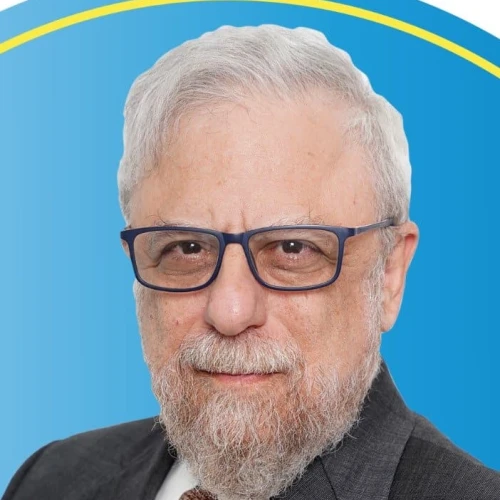
Rabbi Avraham Korf, regional director of Chabad-Lubavitch of Florida and a trailblazing shaliach, or “emissary,” whose work transformed the Jewish landscape of the southeastern United States, died on July 7. He was 92 years old.
A beloved figure in Florida’s Jewish community and one of the longest-serving shluchim in the world, he is credited with bringing nearly 400 emissary couples to the state, as well as overseeing the establishment of hundreds of Chabad centers in cities, suburbs and college campuses across Florida, serving the Jewish needs of the entire state.
Born in 1933 in Kharkov, in the former Soviet Union, Korf was raised in a family steeped in mesirat nefesh—self-sacrifice to grow Jewish life in an autocratic environment. His father, Rabbi Yehoshua Korf, was a noted Chassid who courageously upheld Jewish life under Soviet repression.
With the outbreak of World War II in September 1939, the family fled to Samarkand, Georgia. In 1947, they were able to leave the Soviet Union during the “Great Escape” organized by Chabad Chassidim, traveling alongside Rebbetzin Chana Schneerson, the mother of the Lubavitcher Rebbe, Rabbi Menachem Mendel Schneerson.
After a brief stay in a displaced persons camp in Poking, Germany, the young Korf studied at the Lubavitch yeshivah in Brunoy, France, before arriving in the United States in 1953, where he merited his first audience with the Rebbe.
In 1960, he married Rivka Eichenbaum, and their wedding was one of the last at which the Rebbe personally officiated as mesader kiddushin. When another Chassid requested that honor and mentioned the Korfs’ upcoming wedding that the Rebbe was going to officiate, the Rebbe replied that they were planning to be his emissaries.

Later that year, at the Rebbe’s direction and following a request from the Rebbe’s secretary, Rabbi Chaim Mordechai Aizik Hodakov, the Korfs relocated to Miami. There, they began their lifelong mission of building Jewish life from the ground up.
Until the 1940s, most of the state’s Jewish residents were concentrated in the northern ocean port of Jacksonville, but migration southward—coupled with an influx of retirees from out of state, and a swell of Jewish immigrants from Latin America and the Caribbean—established Miami as Florida’s new Jewish hub.
By 1960, the state had about 175,000 Jewish residents.
‘I hold him dear to my heart’
In a 2010 interview with Chabad.org days before a 50th-anniversary gala celebrating his and his wife’s launch of Chabad activities in Florida, the rabbi recalled that Miami had only three synagogues at the time, while Florida as a whole had just two ritual baths.
When the young couple arrived, milk adhering to the strict kosher standard known as chalav Yisrael was unheard of. So he found a local dairy and supervised the milking of cows himself.
For meat, the rabbi would kosher chickens, and his wife would salt and soak them.
“When we first came here, there was no glatt-kosher meat, no glatt-kosher restaurant, no kosher bakery,” he said. “Everything we needed, we had to bring or ship or find.”
Within a few years, they had opened a Chabad House and worked to establish mikvahs. They launched a summer camp despite facing local opposition and antisemitism that required legal battles to secure land.
Under Korf’s leadership, a small Torah class grew into a vast educational network. He founded the Lubavitch Educational Center, now serving nearly 3,000 children.
“It started with six children,” Korf said of the school, “then 32 children the next year, then 67, and then hundreds. As people started hearing about it, it grew.”
Feige Knight, who was known back then by the name Teri Veccica, was one of the Korfs’ first students at the yeshivah. She was only 6 years old when her non-religious family sent her to school.
“My mother and my grandmother took me to the first [Jewish] school they’d heard of opening in Miami Beach,” says Knight. “Rabbi Korf is the reason that I was able to get a Jewish education. I hold him dear to my heart, and I give him the credit for not allowing my mother to walk out of that office.”

The children hardly saw their father during the week, and so Shabbat was a special time for the family. He would catch up with them and quiz them on their studies. Jacobson remembers being one of the only visibly religious students at her parents’ school, but it didn’t bother her.
“We just knew it was the reason why we were there,” she said. “There was never any judgment.”
There also wasn’t much money. “We lived on a shoestring budget,” explained Jacobson. “But we had such inner pride in what we were doing. That came from my father. He lived it and breathed it.”
An example was when she was in her second year of post-high school seminary in New York and had a job teaching fifth grade at a boys’ school. She earned $15 an hour and was about to up it to $25 when Beth Rivka offered her a job for just $100 a week. She turned it down.
“Well, somehow my father got wind of this,” she recalled. “I told him it didn’t make sense to take the job and get a quarter of the pay.”
“Leah,” said Korf, “if those were my calculations, the money, I would never have gone [to Florida]. I didn’t raise my children to make those calculations.”
He also founded the Yeshiva Gedolah of Greater Miami in 1972, creating a bastion of Torah and incubating countless Chabad rabbis.
Since the young rabbi did not know English well, he would share with his wife the lessons he planned to teach to college students in Yiddish, and she would teach him the English words to use.
He was instrumental in guiding the construction and restoration of mikvahs across the state and became internationally recognized as an expert in mikvah construction, frequently traveling to provide guidance in halachah, Jewish law, and support to Jewish communities worldwide.

Perhaps Korf’s most enduring legacy is the generation of shluchim he inspired and mentored. Nearly 400 emissary couples currently serve in cities and campuses across the state of Florida, many of whom were personally recruited and guided by the rabbi himself.
Yet even as the empire he oversaw expanded beyond anyone’s wildest imagination, he remained as unpretentious as ever. In the sweltering Miami heat, he would walk the streets in his long frock and black hat, an authentic figure from the shtetl transported into South Beach.
With his heavily accented English, he taught Torah one-on-one, and guided, counseled and encouraged everyone to do one more mitzvah.
Korf passed away after nightfall, when the Hebrew date crossed into the 12th of Tammuz, the birthday and anniversary of the liberation of the sixth rebbe—Rabbi Yosef Y. Schneerson—under whose wing Korf grew as a young man into the legendary leader he became.
Predeceased by his wife, Rivka Korf, in 2017, the rabbi is survived by their children: Rabbi Yossi Korf, Rashi Raices, Shevi Sossonko, Rabbi Benjy Korf, Leah Jacobson, Mendy Korf, Motty Korf, Rabbi Zalman Korf, Sari Korf; in addition to many grandchildren and great-grandchildren.
Reprinted with permission from Chabad.org/News.