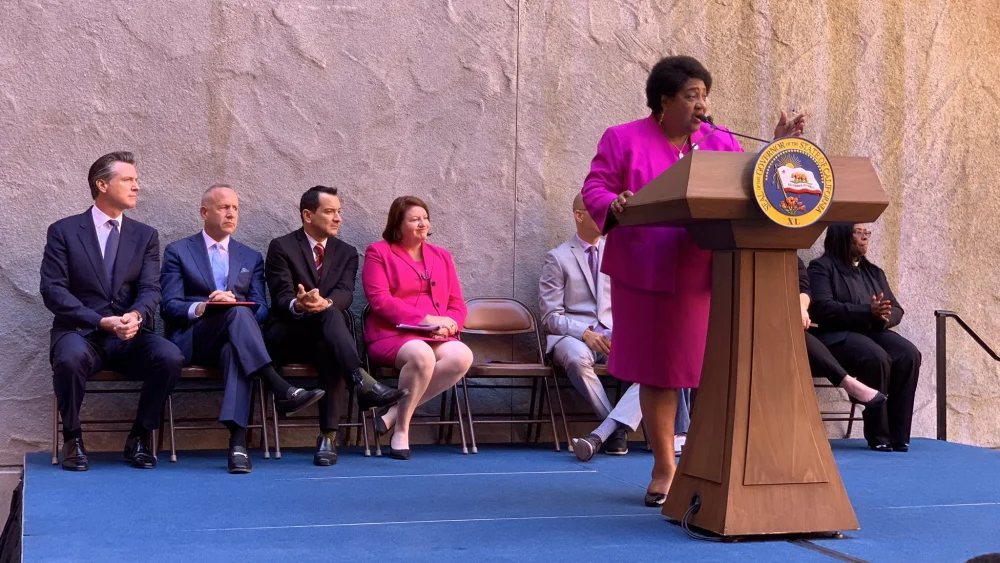
California Secretary of State Shirley N. Weber defended her office’s handling of antisemitic content published in the state’s official voter guide, saying no objections were raised during the legally required public review period before the material was distributed statewide.
“There was a 20-day public display period of the Statewide Voter Information Guide that allowed anyone to review and challenge candidate statements,” Weber’s office told JNS. “No challenges were received during the public display period.”
The controversy stems from a candidate statement submitted by gubernatorial candidate Don J. Grundmann, which included antisemitic conspiracy theories, including claims that Israel orchestrated the September 11 terrorist attacks.
Daniel Gryczman and Rabbi Noah Farkas, senior executives at the Jewish Federation of Los Angeles, released a joint statement rejecting “claims that state and federal law left the secretary with no choice but to publish and disseminate this disgusting material.”
“While the United States Constitution protects even the most abhorrent hate speech from government suppression, the First Amendment does not require the government itself to print and distribute it,” they wrote. “California’s own standards make it clear that candidate statements are meant to describe qualifications, not to serve as vehicles for hate.”
They added that “a genuine commitment to public integrity and common decency” would have included “an unequivocal repudiation” of the content and a refusal to publish it.
Weber’s office told JNS that candidate statements are reviewed by legal staff for compliance with state law, which currently permits rejection only in limited circumstances, including references to an opponent.
“Preventing racism and discrimination has been a cornerstone of Secretary Weber’s life’s work,” her office stated, adding that she “takes this matter seriously and shares in any hurt and frustration that any type of racism or discrimination may cause.”
The secretary’s office also reiterated that it is working with the California Legislature “to explore possible solutions so our systems reflect the inclusive values of our state.”