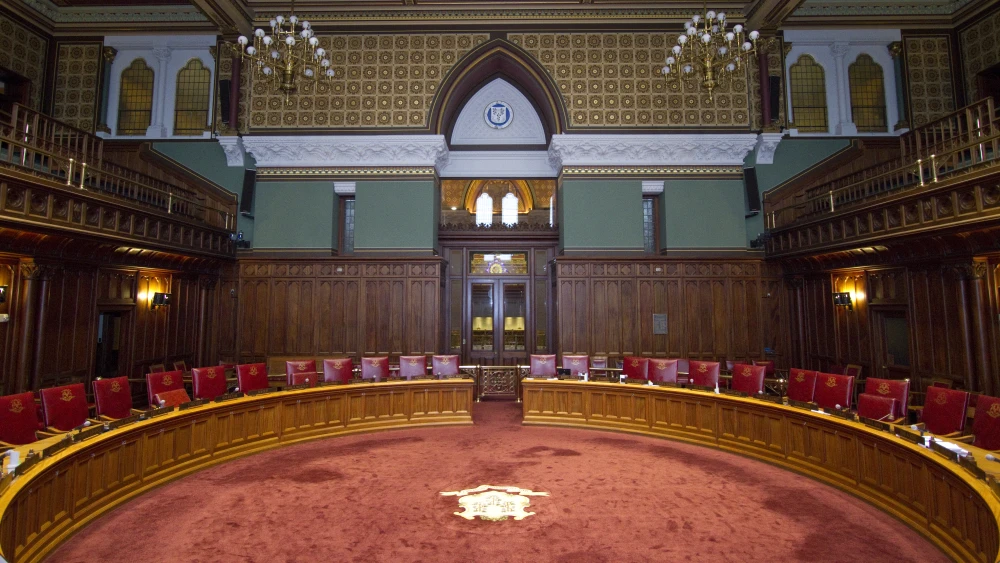
The Connecticut state legislature passed a bill, which consolidates the state’s hate crime laws into one statute, on Tuesday.
The state House voted 139-8 to pass the bill, which the state Senate passed 36-0 on April 28.
Tara Cook-Littman, executive director of the Jewish Federation Association of Connecticut, an advocacy group for the state’s seven Federations and four Jewish community centers, told JNS that the bill gathers together statutes that “were all over the Connecticut criminal code” and standardizes the definition of hate crimes.
“This is meant to make the job of the police and prosecutors easier, because right now, there were, I think, over 20 separate hate crime statutes,” she said. “Now it’s just reorganized into one chapter.”
The bill also removed “malicious intent” as a prerequisite to determining hate crimes, which will make it “easier to prove the bias motivation,” according to Cook-Littman, a former New York City prosecutor.
“It aligns more closely with federal hate crime statutes, and it’ll likely increase the viability of hate crimes being prosecuted,” she told JNS.
A suspect was charged with vandalism but not a hate crime in Fairfield—where Cook-Littman lives—for attacking a menorah in front of a synagogue in December. There was no hate crime charge, because “the prosecutor felt they couldn’t prove the intent, that the motivating factor was hate,” Cook-Littman told JNS.
“I believe that the changes in the statute would now allow for the prosecutor to be more comfortable prosecuting a bias hate crime without needing to prove malicious intent,” she said.
Robin Kipnis, a founding member of Grassroots Jewish Women of Connecticut, told JNS that the bill has practical significance.
“When you have a police officer out on the street who perhaps is seeing a hate crime in front of him or her, they can just figure out what to charge a person with by going to one section of the statutes, instead of wandering all over the statutes, looking for, ‘Well where does this fall?’” she said.
“It was inconsistent across all these 20 statutes, so now it’s made it consistent,” Kipnis told JNS. “You had ‘malicious intent’ in one section and you had ‘intent’ in another.”
“Now it makes it uniform across the statutes,” she said.
Current statutes have “provisions dealing with what we consider hate crimes,” but the statutes don’t actually call it a hate crime, according to Kipnis.
“That sends, I think, a really strong message across Connecticut that this is something we are serious about—about no person being intimidated by a hate crime,” Kipnis said.
The bill “clarifies that there can be a hate crime committed against a house of worship, whether it’s a mosque, a synagogue, a church,” she said.
Under the hate crime statutes, “there has to have been an underlying criminal act, like a trespass, like a threat, like a damage to property,” Kipnis said.
Kipnis thinks that Connecticut Gov. Ned Lamont, a Democrat whose office proposed the bill, will sign it into law, she told JNS.