


For decades, debates about Israel’s “defensible borders” have focused on geography: mountain ridges, buffer zones, demilitarized areas, fences, surveillance systems and military depth. These elements matter. In a dangerous neighborhood, physical terrain can be decisive. But after the Hamas-led terrorist attacks on Oct. 7, 2023, it’s no longer possible to speak about defensible borders in purely military or cartographic terms.
A border is not truly defensible if the people living behind it do not believe that it can protect them. It is not defensible if parents cannot send their children to school without calculating the range of anti-tank missiles. It is not defensible if entire communities remain displaced for months, uncertain whether returning home is an act of resilience or an act of recklessness.
But most importantly, it is not defensible if citizens believe the enemy’s ultimate goal is their total destruction and elimination. This is the reality now facing Israel’s citizens.
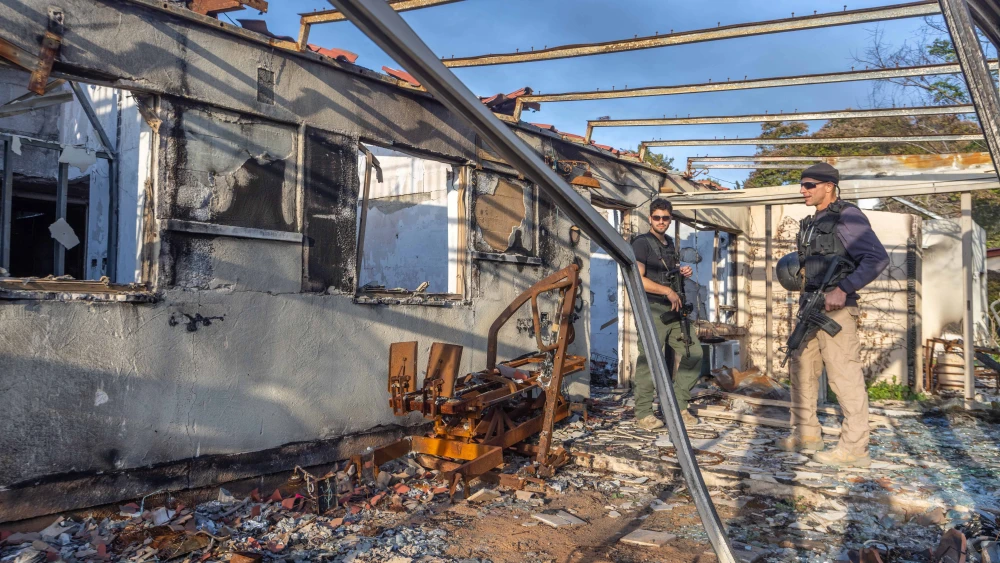
Since the massacre of 1,200 people in southern Israel on Oct. 7, and the subsequent escalation by Hezbollah terrorists along Israel’s northern border with Lebanon, tens of thousands of Israelis from northern communities have lived away from their homes.
Many victims of the invasion by Hamas from Gaza are in the same boat. For them, the question of security is not theoretical. It is not a matter for think tanks, diplomats or foreign ministries alone.
It is painfully practical: Can we return? Can we sleep at night? Can we raise children within sight of a border controlled by an Iranian-backed militia? Can the state guarantee that what happened in the south will not happen in the north? For other Israelis, the threat of missiles aimed at their homes or terrorists who seek to harm them in their neighborhoods is a reality that they refuse to live with any longer.
These questions reveal a dimension of national security that is too often overlooked in Western policy debates: the psychological border.
A psychological border is the line between a society that feels protected and a society that feels exposed. It is the internal frontier of public trust, civic endurance and collective confidence. Once that frontier is breached, concrete walls and sophisticated sensors are not enough. A state may still possess military power, but its citizens may no longer feel secure enough to live ordinary lives.
Oct. 7 was a military and intelligence failure, but it was a psychological awakening. It shattered the assumption that Israel’s technological superiority, intelligence capabilities and deterrent power were sufficient to prevent mass infiltration, slaughter and abduction.
The trauma was national, not regional. Israelis all identified with each other. They understood that no one in the country is immune from the threat posed by enemies who live by a code of jihad or a national consciousness that refuses to recognize their right to exist on a land that they see as belonging only to them.
That is why the concept of “defensible borders” has become the central test of Israel’s future security doctrine.
“Two states for two peoples” has long been a political mantra that now has lost any relevance. For many outside observers, the Arab-Israeli conflict is still understood primarily as a territorial dispute. The assumption is that if the right lines are drawn, the right guarantees are issued and the right diplomatic pressure is applied, then stability can be restored.
But this view is incomplete. It often underestimates the ideological nature of the threats Israel faces, especially from jihadist and Islamist movements that do not see the conflict as a negotiable disagreement over borders, but as a struggle over Israel’s very legitimacy and existence.
This distinction matters. In ordinary territorial conflicts, compromise can be a strategic endpoint. In jihadist frameworks, compromise is often viewed as temporary, tactical or illegitimate. A ceasefire may not mean reconciliation. A lull may not mean moderation. Withdrawal may not produce peace. It may instead create space for rearmament, indoctrination and the next assault.
Israel’s experience in both the south and the north has reinforced this lesson. Hamas turned the Gaza Strip into a fortified terror enclave after Israel’s withdrawal in 2005. Hezbollah has embedded itself in Lebanon while building one of the world’s most heavily armed nonstate military forces.
Ballistic missiles threaten every corner of Israel—from Tel Aviv to Jerusalem to Eilat to Haifa. Iran’s broader “ring of fire” strategy, using proxies in Gaza, Lebanon, Yemen, Syria and Iraq, is designed not merely to threaten Israel militarily, but to exhaust it psychologically.
The goal is not only to damage infrastructure or force tactical concessions, but to make normal life feel impossible. It is to convince Israelis that no border is quiet, no home is safe, and no civilian routine is beyond the reach of terror.
This is why Israelis cannot depend on diplomatic language alone. They don’t need abstract assurances. They need a new security reality. They need to know that the ability of Hezbollah, Hamas, Iran and Palestinians in Judea and Samaria to threaten their homes, schools and roads has been decisively reduced. They need to see that Israel has restored not only deterrence, but credibility.
The issue is not whether Israelis are courageous enough to endure hardships; they have already demonstrated extraordinary resilience. The issue is whether a democratic state can ask its citizens to resume life under conditions that no reasonable society would accept as normal.
Here, Western policymakers must confront an uncomfortable truth. Any diplomatic arrangement that looks acceptable in Washington, Paris or Brussels, but is not trusted by the people who must live next to eliminationist forces, will not be sustainable. Security arrangements must be judged by whether they allow families to actually feel safe in their homes and communities.
This requires a shift from imposed formulas to what might be called “sovereign consent.” The legitimacy of any border arrangement must begin with the lived reality of the citizens it is meant to protect. If the residents of Kiryat Shmona, Haifa, Tel Aviv, Jerusalem, Beersheva and Eilat cannot reasonably believe that their homes are safe, then the arrangement has failed, regardless of how persuasive it sounds in diplomatic briefings.
None of this means that diplomacy is irrelevant. On the contrary, diplomacy is essential. But diplomacy that ignores psychological reality will not produce security.
International guarantees, monitoring mechanisms and ceasefire understandings must be tied to enforceable outcomes: the removal of terror infrastructure, the prevention of rearmament, the distancing of armed forces from civilian communities and the restoration of Israeli civilian life. Most of all, it must guarantee that your enemy never has the state-sanctioned structure that would allow it to develop the means to end your existence.
In today’s psychological reality, it is not enough to ask what borders the international community prefers. The more urgent question is what borders Israelis can actually live behind. That question is strategic realism.
Israel is not seeking psychological comfort as a luxury. It is seeking the minimum condition for national life: the ability of citizens to live securely in their own homes.
After wars with Hamas, Hezbollah, Iran, the Houthis and Palestinian terrorists, the meaning of security has changed. Israel’s challenge is not only to draw lines on a map, but to ensure that those lines correspond to a reality that civilians can endure.
In the end, a defensible border is not defined by diplomats. It is validated by the people who live beside it.


