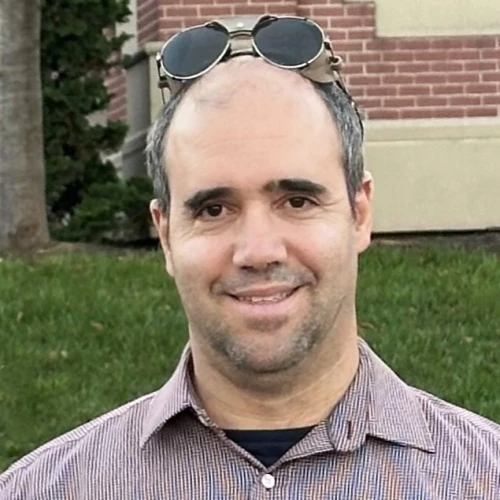
Avid Shooshani, an Iranian-American Jew who lives in Beverly Hills, Calif., and works in real estate, decided to donate traditional Iranian items, including a wool and silk termeh textile, a kohl flask and a sefidab cosmetic container, and her great-grandmother’s wedding dress to the Skirball Cultural Center in Los Angeles when she learned about the museum’s new Iranian Jewish heritage project.
Her great-grandmother, Monavar Hazan, who was born in the Iranian city of Hamedan in 1901 and immigrated to the United States after the 1979 revolution, passed the items down to her. Hazan died in 1984.
“I find it so incredible that a handmade, very domestic, feminine, everyday item has become one of the founding articles for this project,” Shooshani told JNS, of the textile.
She added that the “quiet work always done by women, almost always going unacknowledged, has become a bridge to the past and can help carry the voice of many generations of Iranian Jews.”
Shooshani was one of about 300 people who gathered at the museum on March 8 for a three-hour program titled “From Iran to Los Angeles: Honoring Persian Jewish Culture and Community.”
The museum said the new program is to be “a long-term, collaborative effort between the Skirball Cultural Center and the Younes and Soraya Nazarian Family Foundation to honor, preserve and explore Persian Jewish history and lived experience across time and place.”
“Rooted in community stories and shaped by scholarship, the initiative ensures these histories—and the objects that represent these histories—are visible, valued and thoughtfully stewarded within a major Jewish cultural institution,” the museum stated.
Jessie Kornberg, president and CEO of the Skirball Cultural Center, told JNS at the event, during which traditional Persian instrumental music was performed and traditional tea and desserts were served, that “when the Nazarian family expressed their interest in developing Persian Jewish museum exhibitions, I was utterly thrilled.”
“Now we would have a leader from within the very community we hoped to include and highlight to help us accomplish that goal well,” Kornberg said.
Sharon Nazarian, president of the nonprofit family foundation, told JNS that the new program is slated to include a 2029 exhibit marking the 50th anniversary of Jewish immigrants arriving in Los Angeles from Iran after the 1979 Islamic revolution.
“We have built rich and full lives here as part of the Los Angeles community, and we are forever grateful to the city and to the United States for opening its arms and welcoming us so warmly,” Nazarian told JNS.
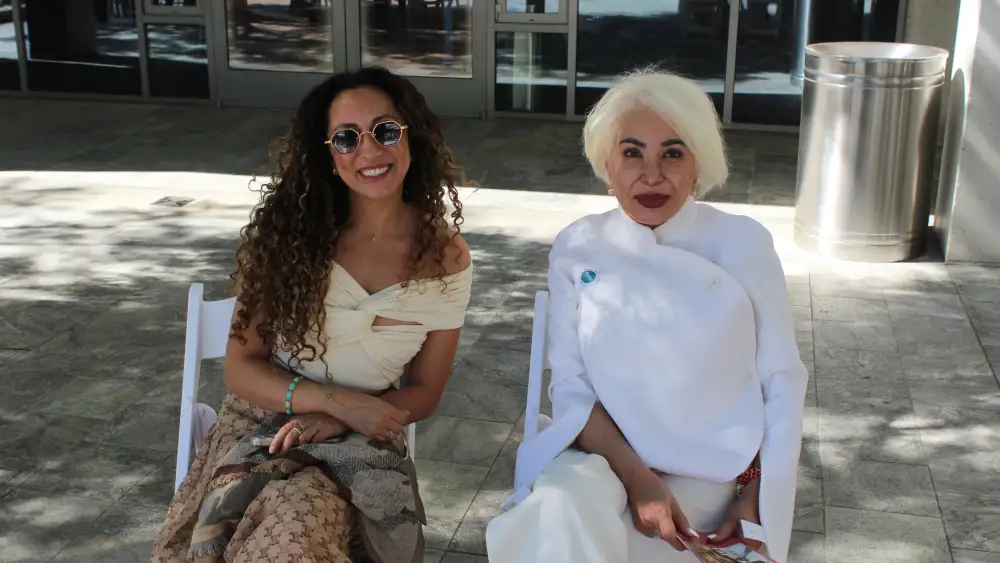
“To commemorate and celebrate half a century of life and community while maintaining our heritage and culture is certainly an auspicious event,” she said. “The preservation of our culture and education of the broader Jewish and American communities is one step we have not taken until now.”
“The time has certainly arrived,” she added.
Nazarian told JNS that her family’s foundation and the museum enlisted a committee of volunteers, including local Iranian Jewish scholars, activists, clergy, media personalities and communal leaders, to guide project organizers and to add depth to the program.
Rabbi Tarlan Rabizadeh, vice president of Jewish engagement at the American Jewish University in Los Angeles, told JNS that the project will be transformative for those who haven’t been to Iran and for non-Jewish Iranians.
“This exhibit will be eye-opening and a real point of pride not only for the broader Iranian community in Los Angeles but also for younger Persian Jews, who often grew up learning Judaism primarily through Ashkenazi institutions and may not realize how much of their own heritage is tied to the roots of Jewish history,” she said.
The estimated 50,000 to 55,000 Iranian Jews in Southern California are thought to be the largest population of Iranian Jews after the 100,000 thought to live in Israel. An estimated 35,000 to 40,000 live in New York.
“Our partners in this work, our lead researcher for this project, our steering committee—they are all Persian Jews,” Kornberg said. “They are guiding and advising this project so that when we open a fantastic exhibition about their culture, it will not just be for the community, but it will have been built by the community.”
Yousef Setareh-Shenas, an Iranian Jewish businessman and amateur historian in Los Angeles who is part of the advisory committee for the Skirball project, told JNS that Jews “have been fleeing Iran for nearly 50 years.” (The event highlighted the Iranian Jewish website that Setareh-Shenas works on called 7dorim.)
“With each passing year, those living in America or elsewhere in the world get further and further away from our rich history,” he said. “It’s a tragedy, as we are the oldest Jewish community in the world, and our history is slowly being lost.”
The Nazarian family “cares a lot about our community’s history and culture and has the means to introduce it to the new generation living in America,” Setareh-Shenas said.
Rabizadeh, of the American Jewish University, is also part of the advisory committee.
“I think many people will be surprised by how deeply connected Persian history is to the development of Judaism itself,” Rabizadeh told JNS.
The rabbi noted that Jews were allowed to return from exile and rebuilt the Temple under Cyrus the Great in the Persian empire, and Isaiah 45:1 refers to the ruler as divinely “anointed.”
That is “remarkable for a non-Jewish ruler and shows the deep historical connection between Persia and the Jewish people,” Rabizadeh said.
Nahid Pirnazar, another member of the advisory committee and a lecturer in Judeo-Persian at University of California, Los Angeles, told JNS that the project at the Skirball will also let visitors learn more about the extensive contributions of Iranian Jewry to past and contemporary life in Iran.
“Throughout the Middle Ages, Iranian Jews contributed to Iranian culture and heritage in medicine, poetry, music and philosophy,” Pirnazar told JNS. “Among the achievements of Iranian Jews in modern times, prior to 1979 revolution, has been the translations of European literary masterpieces, compiling dictionaries and journalism.”
“Iranian Jews have also owned publishing companies,” the professor said. “In terms of legal and military positions, they were able to reach the highest levels allowed by the Iranian Constitution to religious minorities.”
Older Iranian Jews, who live in Los Angeles, and who still suffer from the trauma of having fled Iran after the revolution, can benefit from the museum’s new efforts, according to Nazarian.
“I truly believe that by building cultural programming celebrating our identity, our history, the good along with the painful is part of that healing process,” she told JNS. “Having grandchildren asking grandparents while visiting the exhibit about their lives in Iran is a powerful mechanism for all of us to start with the joyful memories and then possibly delve into the more painful ones.”
Matthew Nouriel, an Iranian Jewish activist in the city and director of community outreach at Jews Indigenous to the Middle East non-profit organization, told JNS that the museum’s efforts are “critical now more than ever, as we are on the precipice of a potentially free, liberal, democratic Iran, liberated with the help of Israel,”
“We are talking about a nation of over 90 million people, many of whom support the State of Israel,” he said. “We see a partnership between two ancient civilizations and nations.”
“It’s important that this relationship extends beyond politics and that we nurture mutual understanding and who is better poised to facilitate and nurture this partnership than Iranian Jews,” he added.