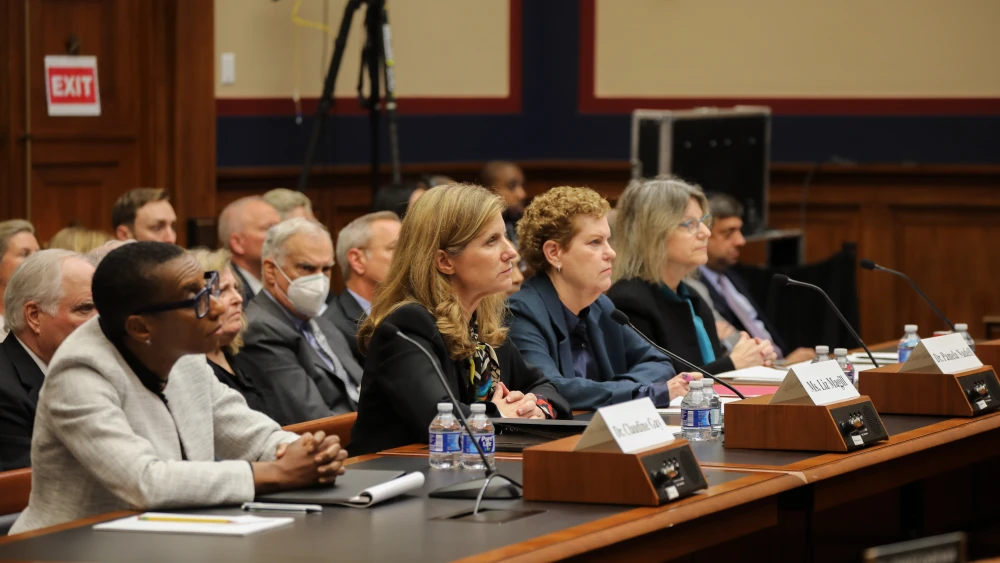
Rep. Elise Stefanik (R-N.Y.) went viral in December 2023 when she cross-examined the presidents of the University of Pennsylvania, Harvard University and Massachusetts Institute of Technology during a congressional hearing.
The trio failed to clearly condemn the Jew-hatred that roiled their campuses after Hamas’s terror attack less than two months prior, and two of the three—Liz Magill of Penn and Claudine Gay of Harvard—subsequently resigned. Sally Kornbluth, who is Jewish, remains at the MIT helm.
A fourth panelist that day, Pamela Nadell, Patrick Clendenen chair in women’s and gender history at American University in Washington and director of its Jewish studies program, has received considerably less attention in the context of the House Committee on Education and Workforce hearing.
The author of Antisemitism, an American Tradition, which W. W. Norton and Company published last month, Nadell was a bystander in late 2023, as Stefanik grilled the college presidents and gained so sufficiently broad national attention that the upstate New York Republican had a short-lived nomination to be U.S. envoy to the United Nations and is now running for governor of New York.
Nadell told JNS that the hearing didn’t attract much attention until Stefanik began questioning the college presidents.
“She went after them and they got ambushed, and their answers were not smart by any means,” the scholar said. “I was glad that nobody asked me the question.”
Had the question been posed to her, whether it violated a school’s policy to call for the genocide of all Jews, Nadell told JNS that she would have said that such a statement violates student conduct and constitutes hate speech.
“Had anybody shouted for genocide of the Jews, I would not have said it’s only about the context,” she said. (The three presidents said at the hearing that it would depend on “context” whether the speech constituted “conduct” in the legal sense.)
During the hearing, the presidents gave what Nadell called “lawyerly answers” when asked if “calling for the genocide of Jews” would violate their universities’ codes of conduct.
“If the speech turns into conduct, it can be harassment,” then Penn president Magill testified. “It is a context-dependent decision.”
“It depends on the context,” Gay, then the Harvard president, testified.
Kornbluth, of MIT, testified that “I’ve heard chants which can be antisemitic depending on the context.”
Nadell estimated that she spoke for about 15 minutes at the five-hour hearing. “I didn’t get very many questions, and it was very interesting to observe,” she told JNS.
She said she wasn’t surprised that it went vital. “Everything gets out on social media and then you know, social media amplifies things,” she said.
Nadell noticed something else, though.
“As somebody who writes about women’s history, when I walked into that room and I saw four women looking out of what was mostly a sea of white men, the underlying thing for me was the misogyny on display,” she told JNS.
“They used Stefanik, so that they couldn’t raise that issue, but there was really something very clearly operating there that they invited three female presidents,” Nadell said. “The longest one had been in her job for a little over a year, and the shortest one had been in her job for a couple of months.” (JNS sought comment from Stefanik.)
Nadell told JNS that there was a major difference between the protests of the 1960s and 1970s and the pro-Palestinian demonstrations against Israel.
“If you think about sort of the eras, when there were lots of protests and encampments on campus—Vietnam War, anti-apartheid movement, South Africa—those were protests that did not pit students against students,” she said.
“It was students against the government, especially students who were trying to save their lives by not going to war, and then it was students championing an international cause—the anti-apartheid movement,” Nadell said.
“But what we have now is essentially students against students,” she said. “They are contested factions on campus.”
While ostensibly anti-Zionist, the protests after Oct. 7, 2023 veered into Jew-hatred quickly.
“Years ago, the chancellor of the Berkeley system tried to figure out when anti-Zionism, anti-Israelism crosses the line, and he wasn’t able to do it because that line is so fuzzy,” Nadell said.
“I think that the moment when 23 student organizations at Harvard announced that Israel was entirely responsible for all violence unfolding from the Oct. 7 attacks, we had crossed a line to antisemitism,” she said.
In her new book, Nadell traces modern anti-Israel sentiment on college campuses to the Oslo Accords, when Palestinian groups began what would become an international campaign to delegitimize Israel.
Then the United Nations conference in Durban, South Africa, turned its focus on Israel, featuring antisemitic rallies and flyers. Then conspiracy theories blaming the attack by Muslim terrorists on the Jews followed the attacks of September 11, 2001, and academic groups like the American Studies Association endorsed a boycott of Israel.
“They see themselves as activist-scholars, and they don’t denounce what’s going on with the Uyghurs, they don’t denounce other countries, but they do denounce Israel,” Nadell said. “I wasn’t surprised and it leads to all sorts of episodes of antisemitism on campus, and I have some of them in the book.”
“I often tell my students that if somebody came down from Mars and they read the media in the United States years ago, or now, they would think Israel, the State of Israel, is the size of the Soviet Union and China combined.”
“It occupies such a powerful place in the world and the American imagination,” she said.
The book was written after the worst antisemitic attack in American history—the murder of 11 worshippers at Shabbat services at a Pittsburgh building hosting three congregations.
That attack “sent me on the path” to write the book, Nadell told JNS.
“That trauma echoed across American Jewry, because as American Jews we never thought we would live to see murder in a synagogue on a Shabbat morning in this country,” she said. “Pittsburgh is the first time Jews were murdered in their house of worship in the United States that I know of. It was such a shocking, shocking event.”