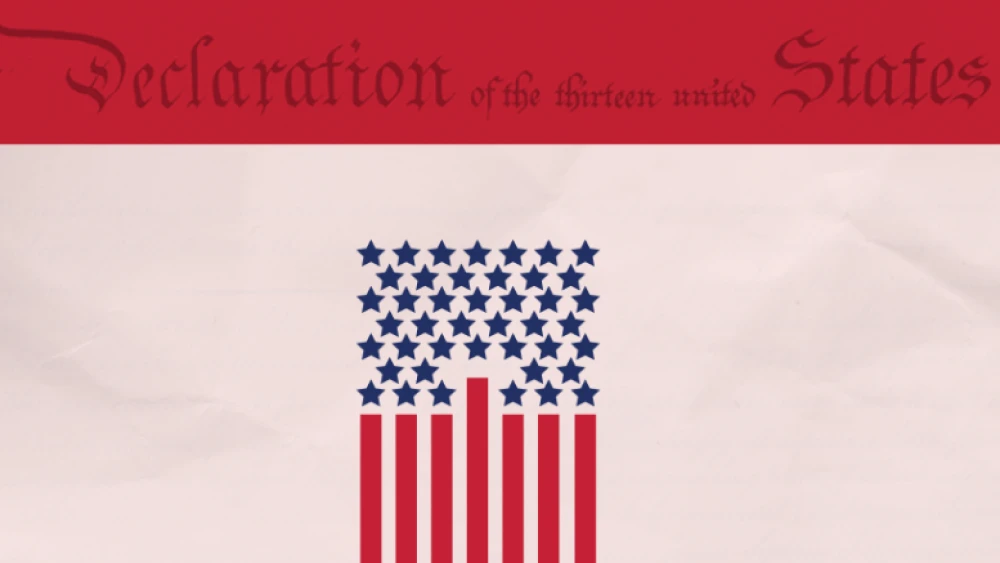
A new “Talmud of America” invites users to celebrate the 250th anniversary of the founding of America by exploring new commentaries on key phrases from the U.S. Declaration of Independence. The connections to Jewish texts are provided by leading rabbis and educators at the Pardes Institute of Jewish Studies in Jerusalem.
“There will be no shortage of pomp and circumstance to mark this anniversary—as there should be,” said Rabbi Leon A. Morris, president of Pardes. “We wanted to offer something different. For Jews, text study that reveals complexity, challenges readers, illuminates contradictions and embraces different perspectives is an integral part of how we reflect on the past and think about the future. The United States has been a refuge and a home to Jews since its founding. Sharing our interpretation of words that both define and reflect aspirations of the nation’s character is a fitting way for us to mark 250 years.”
Hundreds of rabbis and educators shared the special Talmud during Shavuot. Pardes is partnering with organizations, including Civic Spirit, to engage audiences in the lead-up to July 4 and in the months that follow.
Following a foreword by Morris, each essay introduces a seminal phrase and offers insight into its meaning and historical significance, in addition to implications for the present and future of the United States. Authors cite the Passover Hagaddah, the Mishnah, Torah and other rabbinical figures to elaborate their perspectives and pose questions for reflection at the end of each essay.
The phrases discussed are:
• That All Men Are Created Equal by Rabbi Rahel Berkovits, a senior faculty member at the Pardes Institute of Jewish Studies in Jerusalem. Berkovits writes, “The Divine understood that the nature of humans is to fight for dominance over one another. To ensure that people would not truly have a claim of superiority, God purposely created the first human, from which all people descend, as one sole individual, encompassing all genders and all future nations and ethnic groups. As all people descend from the same single being and share the same ancestry, they are all equal.”
• Life, Liberty and the Pursuit of Happiness by Yiscah Smith, a spiritual activist, educator, mentor and meditation guide. Smith writes, “The Jewish tradition values the individual’s decision and dedication to earn the blessing of liberty. Freedom is neither bequeathed nor guaranteed to the individual. However, the joy of experiencing freedom is not limited to a certain personality, a specific living environment or educational/economic status.”
• Prudence and the Right of Rebellion by Leah Rosenthal, the Shapira Family Chair in Rabbinic Literature and a senior educator in Talmud at Pardes. Rosenthal writes, “This passage … captures a central tension at the heart of political life. On the one hand, there is a recognized wisdom in preserving established institutions, even when they are imperfect. Stability itself carries moral weight, and the disruption of social order is not to be undertaken lightly. Yet that patience is not without limit. There exists a threshold at which injustice becomes intolerable, and at that point, the preservation of the system gives way.”
• Our Lives, Our Fortunes and Our Sacred Honor by Dr. David I. Bernstein, dean emeritus of Pardes. Bernstein writes, “The cadence and the words of this three-fold statement bring to mind another similar command: from Deuteronomy 6:5—‘to love your God with all your heart, all your soul, and all your might.’ These words form the Hebrew Bible’s pledge of allegiance to the One God; in fact, they are traditionally recited twice daily as part of the Shema prayer. Like the Declaration’s closing line, this verse is structured as a total demand. It calls for devotion not in part, but in entirety—emotional, physical and material.”
The Talmud of America is available at: pardes.org.il/talmud-of-america/. The project is made possible by the support of the Maimonides Fund.