Newsletter
Newsletter Support JNS

Abbas announces PA general elections in 2020

Rival Palestinian factions Fatah and Hamas have reportedly agreed to hold elections for the P.A. presidency and the Palestinian Legislative Council in 2020.

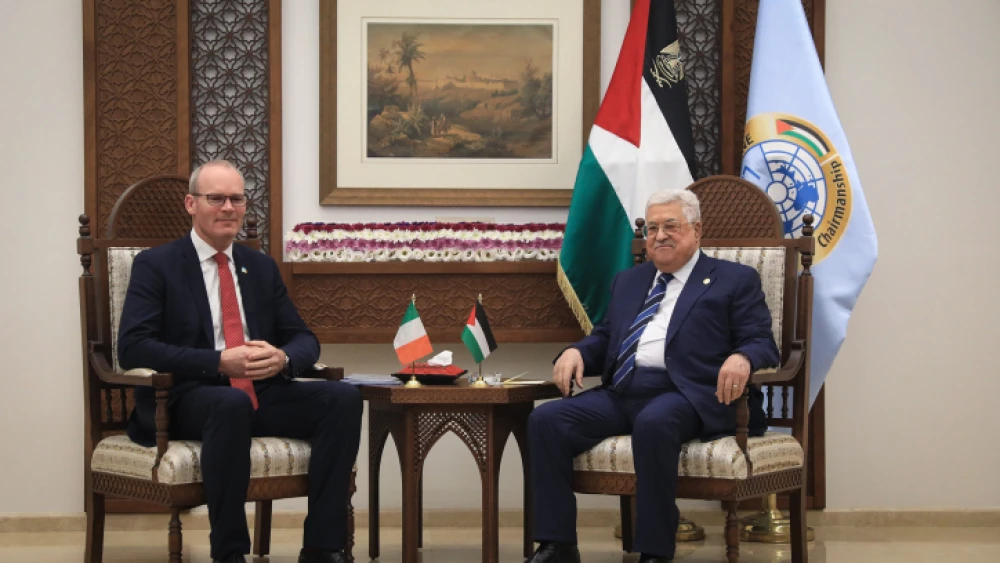
Palestinian Authority leader Mahmoud Abbas meets with Irish Foreign Minister Simon Coveney (left) at P.A. headquarters in Ramallah, on Dec. 3, 2019. Photo by Flash90.

Palestinian Authority leader Mahmoud Abbas announced on Tuesday that Palestinians in the West Bank, Gaza Strip and eastern Jerusalem will go to the polls next year for the first time in 14 years.

Speaking at an anti-corruption conference in Ramallah, Abbas said that Palestinian faction Fatah, which he controls, and Hamas, which rules Gaza, have agreed to hold two-pronged elections for the presidency and the Palestinian Legislative Council in 2020.

Chairman of the Palestinian Central Elections Commission Hanna Nasser was instrumental in achieving the factions’ consent, said Abbas.

The only issue that has yet to be resolved in full is the voting process in eastern Jerusalem. Israel opposes allowing the capital’s Palestinian residents to participate in the vote.

“We are continuing with our efforts with European and other countries in the world to urge Israel to allow the elections to take place as they did in 1996 and 2006,” said Abbas.

The 2006 vote saw Hamas, an Islamist terrorist group, win a majority in Ramallah’s parliament. In 2007, Hamas ousted Abbas and his Fatah movement from Gaza in a bloody coup. The move effectively split the P.A. into two separate political entities.

All efforts made over the past ‎‎decade to ‎‎promote a reconciliation between the rival ‎‎Palestinian factions—the latest ‎‎having been brokered by Egypt ‎‎in late 2017—have failed, despite the growing criticism among the Palestinian public. ‎

This article first appeared in Israel Hayom.

“A soldier is missing from the tank,” a handwritten report appears at 6:40 a.m. on June 25, 2006, more than an hour after the abduction.
Israeli forces later killed six Hezbollah terrorists in separate engagements as troops continued operations inside the Security Zone.
The Israeli airline said it would review its decision next week following an assessment of the situation.
The Israeli leader said the Jewish state turned the table on its enemies after Oct. 7, breaking through “the barrier of fear.”
The newly released State Archives trace the Israeli response from the Air France hijacking to the successful hostage rescue in Uganda.
Panelists at the JNS Summit argued that Israel must expand its domestic military capabilities while continuing strategic cooperation with the United States.
Benny Gantz, JNS editor-in-chief Jonathan S. Tobin, Gilad Erdan, Mosab Hassan Yousef, Nissim Black and leading voices in security, diplomacy, media, law and Jewish communal affairs headline the summit’s third day in Jerusalem.