


At many schools, buses bring students to campus. But the Simon Wiesenthal Center’s “mobile museums of tolerance” are classrooms on wheels that bring lessons about Jew-hatred, the Civil Rights Movement, media literacy and the Holocaust to students.
Ann Pesahovitz, the center’s director of educational development, led JNS on a tour of one such bus outside the center’s gala in Manhattan on Tuesday. (The mobile museums are a joint program with the Museum of Tolerance in Los Angeles.)
“We bring tolerance and values-based education right to the doors of schools,” she said.
JNS saw digital images of Anne Frank, Mahatma Gandhi, Martin Luther King Jr. and Jackie Robinson on the inner walls of the bus. Movie theater-style seats on the buses can be configured in various positions.
The Wiesenthal Center operates two such buses in New York—one which serves the five boroughs and Long Island, and the second crisscrosses western and central New York, from Buffalo to Rochester and Syracuse. The center also has fleets in California, Florida and Illinois.
Jim Berk, CEO of the Wiesenthal Center, told JNS that the center reaches hundreds of thousands of students annually via its programs, including the buses. Many of the center’s programs focus on the Holocaust and Civil Rights, and 98% of the students it reaches aren’t Jewish, Berk said.
“We are building an entrepreneurial organization,” he told JNS. “We continuously beta-test pedagogy to introduce new themes and important ideas.”

‘You have the power’
Some 250 people attended the center’s dinner on Tuesday night, during which it honored businessman and philanthropist Marc Utay with its 2025 “humanitarian award,” and Sabine Taasa and Martin Rosen with “medals of valor.”
Taasa, of the Moshav Netiv Haasara, lost her husband and son in the Oct. 7 attack. Her husband Gil threw himself on a grenade to save two of their sons. Hamas terrorists executed their eldest, Or, at point-blank range as he fled the massacre.
“Her story, although one of tragedy, is also one of extraordinary courage and unyielding devotion to truth and justice,” Berk told JNS. “Sabine speaks out when silence may be easier. She reminds us that true courage is not the absence of fear but the determination to stand firm in the face of it.”
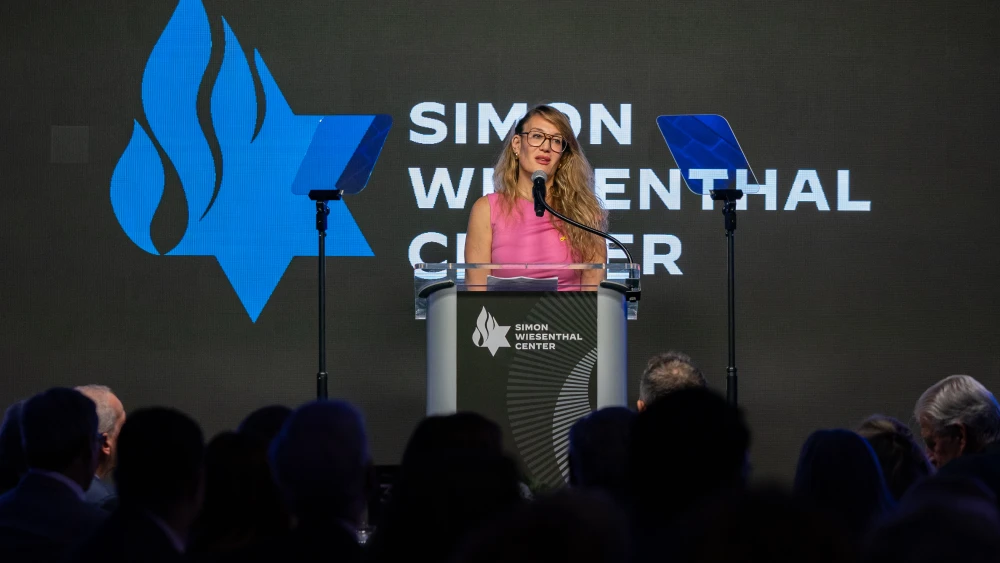
Taasa told the audience not to feel guilty. “Feel proud that you are the reason Israel can survive,” she said. She urged people to show footage, which the terrorists recorded on Oct. 7 and which the Israeli military has released, to educate others about the consequences of hate.
“Show the footage everywhere,” she said. “If you need me, I am here any time, any place. You have the power. You have the possibility.”
‘Fail to connect with participants’
The other “medal of valor” honoree, Rosen, is a founding trustee of the Wiesenthal Center and was a close confidant and attorney to the center’s namesake.
Over a long legal career, including as mayor of Lawrence, N.Y., Rosen helped bring 1,100 Nazis to justice and drove legal efforts to abolish statutes of limitations on Nazi war crimes, reforms that enabled thousands of cases to proceed, according to the center.
Rosen, who recently turned 100, didn’t attend the event, but his granddaughter, Samantha Stern, accepted the medal on his behalf and read his remarks to the audience. “To me, the lesson of Simon Wiesenthal is this,” she read. “One person, if they want to and if they try, can make a difference.”
Founder and managing partner of Clarion Capital Partners and a longtime Wiesenthal Center trustee, Utay received the evening’s highest honor.
Utay told JNS that his connection to the center began 40 years ago—at a dinner much like Tuesday’s.
He was moved by the work of Rabbi Marvin Hier, founder and dean emeritus of the center, and the center’s knack for speaking to broad audiences without alienating them. “Many similar programs have a tendency to become preachy and fail to connect with participants by failing to speak to them in their own language,” he told JNS. “The center stands apart.”
Utay said it is important that Jews as a community stand up against hate and violence. “For 40 years, Jews had a full seat at the American table, but somewhere in the past 10 years this went awry,” he said.
“It is important to defend our community vigorously, but we must defend others with equal vigor,” he told JNS. “Not just concentrate on antisemitism. If we want others to care about our issues, we must show concern for theirs.”



