
Javier Milei, the president of Argentina, announced in a historic first address to the Knesset on Wednesday that his country will move its embassy to Jerusalem next year.
On his second visit to Israel in as many years, Milei has emerged as one of the Jewish state’s most vocal supporters in South America and beyond. He was received with repeated standing ovations and cries of “Viva Argentina!” and “Viva Israel!” in Israel’s parliament from across the political aisle.
Milei reiterated his unequivocal support for the Jewish state at a time of international opprobrium over the 20-month war against Hamas in Gaza.
“Argentina stands by you in these difficult days,” he said in Spanish, which was simultaneously translated into Hebrew. “Unfortunately, the same cannot be said about a large part of the international community that is being manipulated by terrorists and turning victims into perpetrators.”
The Argentinian leader lambasted the “cancer of antisemitism” that has been spreading across the globe following the Hamas-led terrorist attacks in southern Israel on Oct. 7, 2023. He said that Buenos Aires will continue to demand that the remaining 53 hostages still being held by Hamas in Gaza be released, including four with Argentinian citizenship.
“How does the world allow a murderous terrorist organization to continue to hold innocent civilians hostage?” he asked. “When there is good and evil, there is no moral equality here.”
Israel and Argentina forged diplomatic ties 75 years ago, with the Latin American nation maintaining its embassy in Herzliya, north of Tel Aviv.
‘The cause of the West’
Hailing Milei as “a true friend,” Israeli Prime Minister Benjamin Netanyahu pointed out that “12,000 kilometers separate Buenos Aires and the Knesset in Jerusalem. This great difference is compensated by the closeness of our hearts.”
“You have taken a stand for truth against falsehood, understanding that this is a war of unparalleled justice—an all-out battle between barbarism that threatens the entire world,” Netanyahu said in an address at the special evening parliamentary event.
“Time and again, you have chosen to prefer truth over comfort, faith over fashion and a moral compass over belonging to an automatic majority,” Israeli opposition leader Yair Lapid said in his address. “By standing by the State of Israel, you have woven yourself and the Argentinian people into the eternal story of the Jewish people.”
Since his election a year and a half ago, Milei has broken with decades of Argentine foreign policy by siding firmly with Israel, propelling relations between the two nations to unprecedented heights.
Last year, in one of his first official trips as president, he paid a wartime solidarity visit to Israel, where he had reiterated his pledge to move his country’s embassy to Jerusalem.
An iconoclast and political outsider, Milei was elected in November 2023 amid an economic crisis and skyrocketing inflation that has long beleaguered the South American country, which is making major strides toward recovery under his leadership.
A week after his election victory, he visited the United States for government meetings, stopping at the gravesite of the Lubavitcher Rebbe—Rabbi Menachem Mendel Schneerson—in Queens, N.Y. It was his third such visit that year.
Since taking office, Milei has listed Hamas as a terror group and called out Iran’s terrorism, vowing to try in absentia Iranian suspects in the 1994 bombing of the AMIA Jewish Community Center in Buenos Aires.
Earlier this year, Milei declared two days of national mourning for the Bibas children—Ariel, 4, and 9-month-old Kfir—who were murdered in captivity by Palestinian terrorists in Gaza, along with their mother, 32-year-old Shiri Bibas. The family, which held Israeli, Argentine and German citizenship, had become symbols of the plight of the 251 hostages abducted by Hamas when it infiltrated the border on Oct. 7 and slaughtered 1,200 men, women and children.
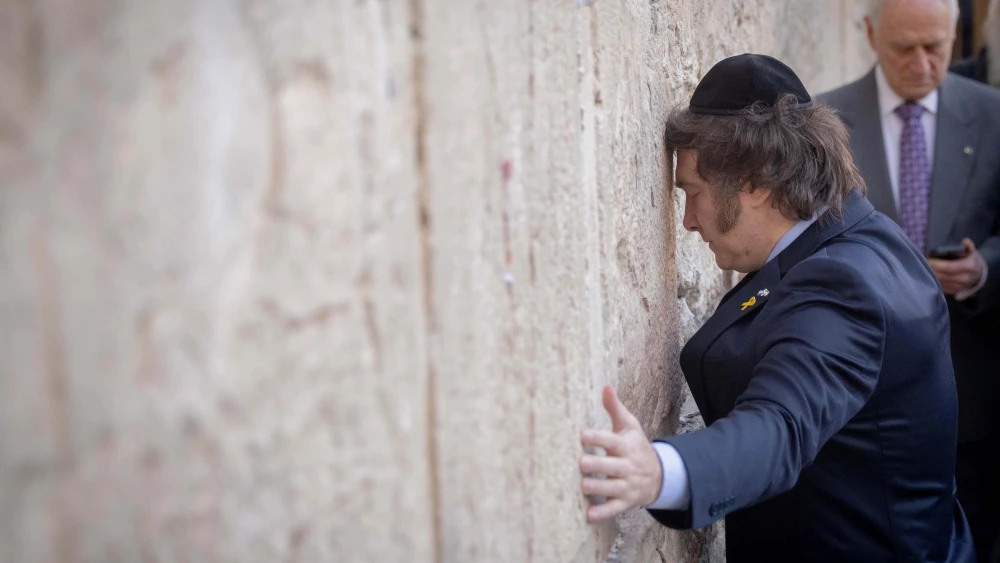
The Argentinian president began his latest visit to Israel this week with a stop at the Western Wall in Jerusalem, where he made an emotional pledge that he will “always stand” with the Jewish state, which he called “the cause of the West.”
Six countries have their embassies in Israel’s capital: the United States, Guatemala, Honduras, Kosovo, Paraguay and Papua New Guinea.
All other nations that maintain ties with Israel have their embassies in Tel Aviv or its suburbs, due to the political sensitivities of Jerusalem.
U.S. President Donald Trump’s decision to move the U.S. embassy to Jerusalem in December 2017, which it did in May 2018, set the stage for other countries to follow suit. But the war against Hamas in Gaza, triggered by the massacre on Oct. 7, delayed such action.