


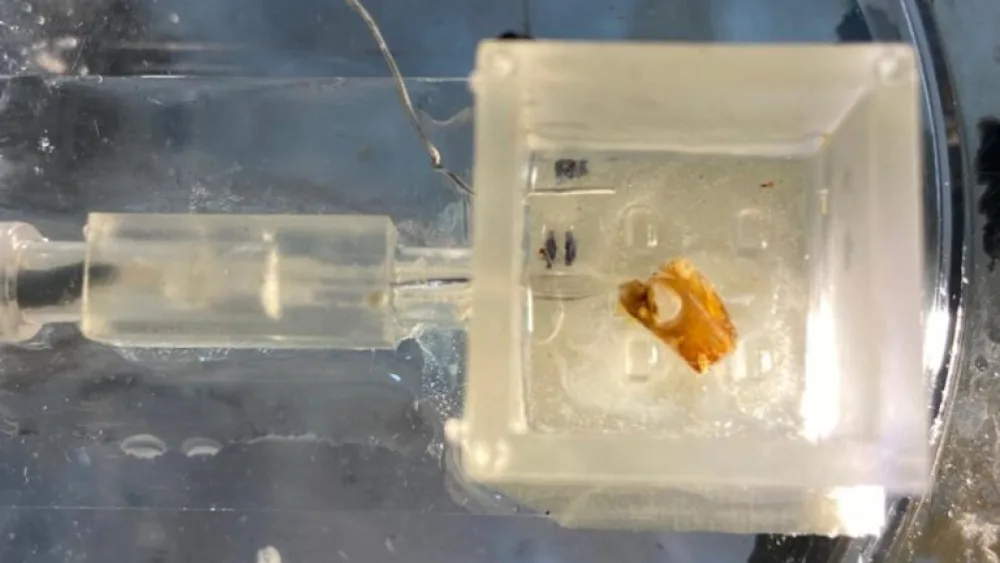
In a scientific breakthrough, Israeli researchers have for the first time succeeded in using a locust ear as a robot’s sensor.
The result: a robot that moves forward when you clap once and back when you clap twice.
The researchers from Tel Aviv University sought to examine how biological systems could be integrated into technological ones.
They first built a robot that can respond to signals it receives from the environment. Then they isolated a dead locust’s ear and kept it functional long enough to connect it to the robot. Finally, they were able to pick up the signals received by the locust’s ear in a way that could be used by the robot.
Their findings were recently published in the Sensors journal.
“We chose the sense of hearing because it can be easily compared to existing technologies, in contrast to the sense of smell, for example, where the challenge is much greater,” explained TAU researcher Ben M. Maoz.
“Our task was to replace the robot’s electronic microphone with a dead insect’s ear, use the ear’s ability to detect the electrical signals from the environment—in this case, vibrations in the air—and, using a special chip, convert the insect input to that of the robot,” he continued.
The principle they demonstrated can be used and applied to other senses, such as smell, sight and touch, he added.
“For example, some animals have amazing abilities to detect explosives or drugs; the creation of a robot with a biological nose could help us preserve human life and identify criminals in a way that is not possible today. Some animals know how to detect diseases. Others can sense earthquakes. The sky’s the limit.”
This article was first published by Israel21c.



