Newsletter
Newsletter Support JNS

Days after two Jews shot dead, Tunisian president compares Israel to Nazis

“Since the attack, the Jewish community of Djerba has not been visited or contacted by any members of the government,” said Rabbi Pinchas Goldschmidt of the Conference of European Rabbis.

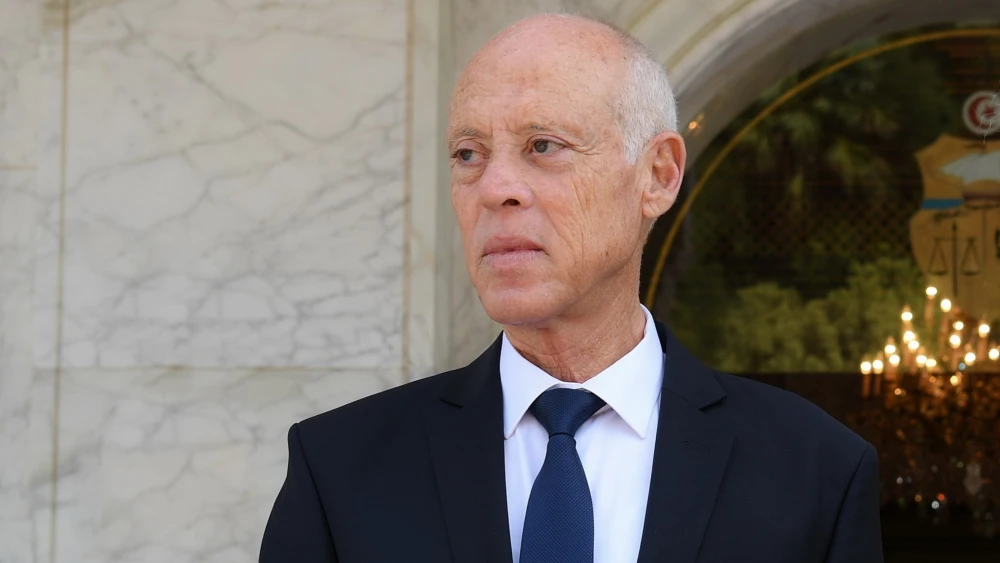
President of Tunisia Kais Saied. Credit: Houcemmzoughi via Wikimedia Commons.

Two Jewish cousins were among those murdered on May 9 near a Tunisian synagogue. Four days later, Tunisian President Kais Saied compared the Jewish state to Nazi Germany.

“While Tunisians protected Jews during the Holocaust, today elderly, women and children are being bombed in Gaza,” he said, according to a translation that Rabbi Pinchas Goldschmidt, president of the Conference of European Rabbis, posted on Twitter.

Goldschmidt called on European governments to condemn Saied’s statement, which he said implies “that the Jews of Tunisia are responsible for the bombing of Gaza.”

“Through such wanton remarks, the president continues to incite further hatred and even attacks against the country’s Jewish community, heaven forbid,” Goldschmidt said. “Since the attack, the Jewish community of Djerba has not been visited or contacted by any members of the government. The Tunisian president together with the relevant authorities should instead be offering support to the Jewish community and working to ensure its safety.”

Aviel Haddad, 30, a dual Israeli-Tunisian, was killed on May 9 alongside his cousin Benjamin Haddad, a 42-year-old French citizen. Three security personnel were also killed when a Tunisian National Guard member opened fire on people near Ghriba Synagogue on May 9 as Lag B’Omer celebrations were underway. A dozen others were injured.

Haddad was buried in Israel on May 12.

“It looks as if the Genocide Caucus in Congress will continue to grow,” Dan Schnur, a political science lecturer, told JNS.
Ahead of the JNS Summit, the Bosnian Serb leader explains her strong support for the Jewish state and warns of Iranian influence in the Balkans.
A coalition of Jewish groups called the law “an important step forward, giving law enforcement and prosecutors additional tools to protect targeted communities and hold offenders accountable.”
The participation of campus-affiliated groups like CUNY for Palestine “openly encouraging and providing support for terrorism and extremist ideologies,” Jayne Zirkle of EndJewHatred told JNS, “represents a serious challenge that universities can no longer ignore.”
After 35 years working across the continent, entrepreneur Haim Taib tells JNS he sees it as the next frontier for Abraham Accords cooperation.
The Islamic Republic is seeking to recover economically and militarily through the memorandum of understanding with the U.S., while avoiding any relinquishment of long-term strategic assets.
