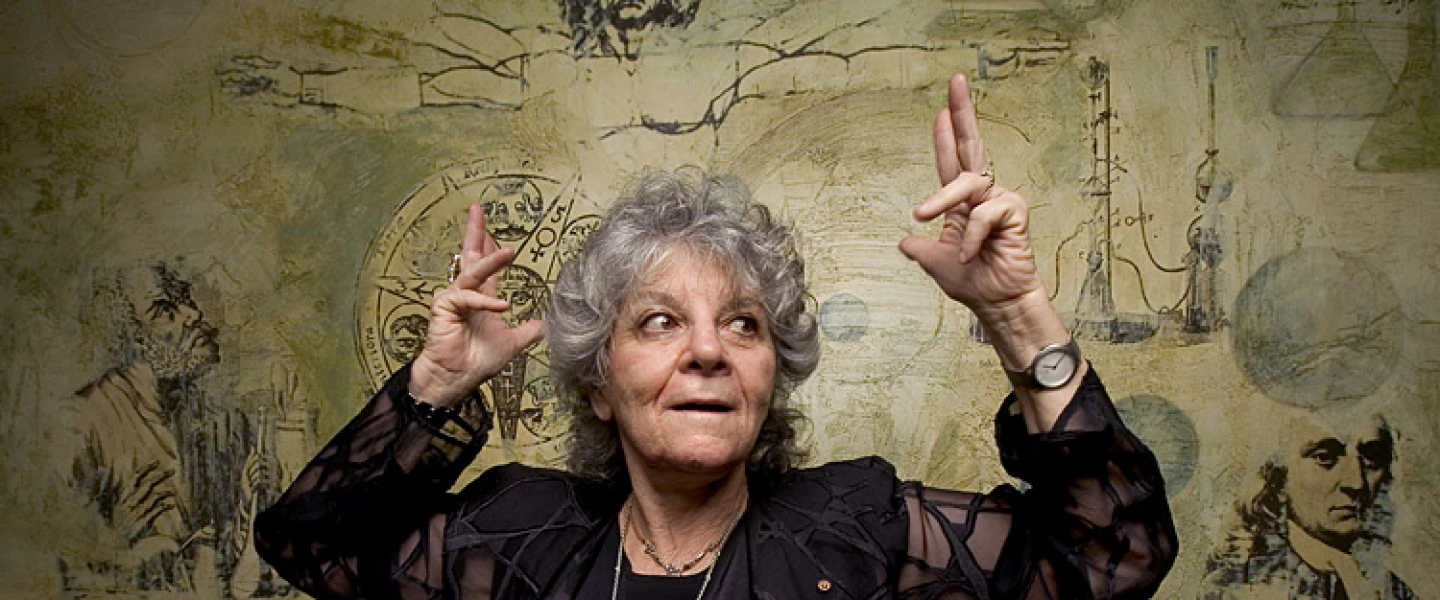
Professor Ada Yonath, the Israeli chemist who won the 2009 Nobel Prize in Chemistry for her groundbreaking research into the structure and function of the ribosome—the tiny molecular machine inside cells that reads genetic instructions and uses them to build the proteins essential for life—died on Monday at the age of 87.
Her life was a quintessential Israeli story. Born Ada Lifshitz in Jerusalem in 1939 to a poor, traditional Jewish family, she lost her father at a young age and began working before she was 12. Her mother struggled to ensure that Ada and her younger sister could continue their education.
From those modest beginnings, Yonath became one of the world’s most distinguished scientists—and the first Israeli woman to win a Nobel Prize. But the most remarkable part of her story was not the prize itself. It was the persistence that made it possible.
In the late 1970s, Yonath set out to determine the structure of the extraordinarily complex ribosome. Leading scientists believed that crystallizing something so large and unstable was virtually impossible.
“People called me a dreamer,” Yonath recalled in a 2009 Weizmann Institute article.
“I wanted to reveal how genetic code is translated into protein,” she added, comparing the scientific challenge to conquering Mount Everest. “It was my dream to contribute something to humanity.”
Yonath and her colleagues made some 25,000 attempts before producing the first ribosome crystals in 1980. Two decades of painstaking research followed before her teams determined the complete three-dimensional structures of the two subunits of a bacterial ribosome.
Her discoveries helped scientists understand how antibiotics attack bacteria and how bacteria develop resistance, paving the way for improved drugs to confront one of modern medicine’s most serious challenges.
Israeli President Isaac Herzog described her as “an international trailblazer” whose “groundbreaking discoveries changed the face of science and brought great honor to the State of Israel.”
“I want to do something that will contribute to Israel and to humanity, to strengthen the positive view of science.” — Professor Ada Yonath
— יצחק הרצוג Isaac Herzog (@Isaac_Herzog) August 31, 2026
I am deeply saddened to learn of the passing of Professor Ada Yonath, Nobel laureate in Chemistry, Wolf Prize laureate, Israel Prize…
Weizmann Institute President Professor Alon Chen saluted a scientist who “never hesitated to choose a path that others considered impossible and to pursue it for decades with determination, curiosity and courage.”
He said in a statement, “She showed generations of scientists what can be accomplished when one dares to ask big questions and persists in the search for answers.”
Yonath did just that until the end. According to the Weizmann Institute, she continued conducting research, publishing papers, running an active laboratory and collaborating with scientists around the world until the final days of her life.
Yonath is survived by her daughter, Dr. Hagit Yonath, a physician specializing in internal medicine, and her granddaughter, Noa Yonath-Komarov.
Among her many honors were the Israel Prize, Wolf Prize and EMET Prize, as well as some 40 honorary doctorates. For her, the most memorable was the “Grandmother of the Year” award bestowed by Noa, who at the age of 5 invited Yonath to explain to her kindergarten class how the ribosome works.
Ada Yonath spent her life pursuing what others thought impossible. Her persistence not only proved them wrong; it changed our understanding of life itself.