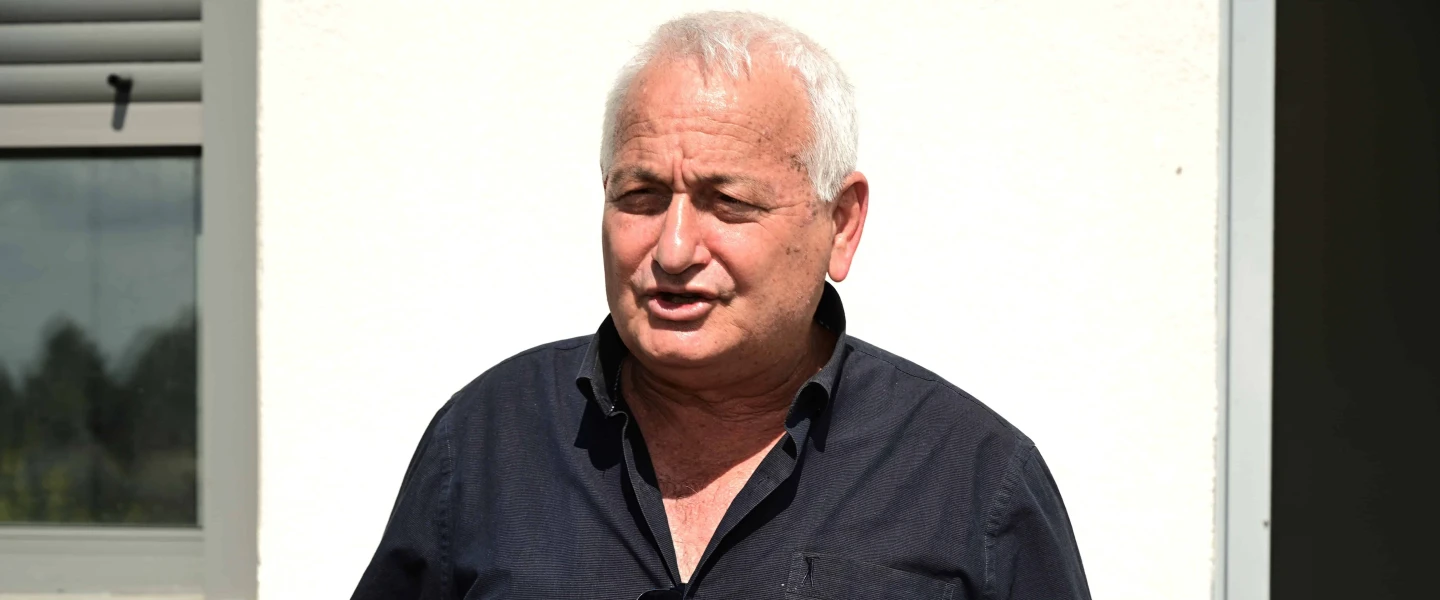
Blue and White lawmaker Alon Schuster tells JNS that his preferred outcome would be for Israel to achieve its goals vis-à-vis Iran through diplomatic means.
The best war is one that never occurs, provided our objectives are achieved,” he said. “I believe it is right to negotiate with Iran, both tactically and strategically. The primary objective, shared by Israel and the U.S., is to ensure that Iran does not acquire the capability to produce a nuclear weapon.
“The two other objectives, not directly related to the nuclear issue, concern ballistic missile capabilities and proxies. If the ballistic threat is not addressed in negotiations, we will need to act in coordination with the U.S., but that is not the preferred option,” he continued.
“Iran is a problem for the world and the region. We should not shoulder this alone without first urging the international community to act. The world must address it. I hope we will see progress in the coming months,” he added.
Meanwhile, Schuster, chair of the Knesset Subcommittee for Security, Foreign Relations and International Trade Relations, said Jerusalem provides the U.S. with intelligence, open skies and full coordination. “President Trump is acting in the right manner in my opinion,” he added.
U.S. President Donald Trump reiterated in his State of the Union address on Tuesday that Iran has not abandoned its pursuit of nuclear weapons. He told members of Congress, the Supreme Court, the U.S. military and his administration that Washington had warned Tehran not to attempt to rebuild its weapons programs following the United States Air Force and Navy’s “Operation Midnight Hammer” airstrikes in June.
The Islamic Republic’s Foreign Minister Abbas Araghchi said Tuesday that talks with the United States would resume shortly and that “Iran will under no circumstances ever develop a nuclear weapon,” but it refused to give up “peaceful nuclear technology.”
Discharged from reserve duty at age 62 with the rank of lieutenant colonel, after serving in the IDF since 1976 and losing sight in one eye during preparations for the First Lebanon War, Schuster has been a member of five Knessets and served as minister of agriculture in 2020–2021 and deputy defense minister in 2021-2022. He lives in Kibbutz Mefalsim, near the Gaza Strip.
Strengthen agriculture, the south
Chair of the Caucus for Strengthening Israeli Agriculture, Schuster has been working to develop the Israeli periphery and lower the cost of living while making sure the agricultural sector remains strong.
The bills he has initiated include one to regulate the maximum price and limit profit margin on fruits and vegetables and one to reduce water expenses for farmers together with MKs Sasson Guetta, Matti Sarfati Harkavi and other legislators from the coalition and the opposition.
Schuster discussed Finance Minister Bezalel Smotrich’s dairy reform, which would eliminate protective tariffs of up to 40% on import and reduce national milk production from 1.5 billion liters to 1 billion liters annually while lowering by 15% the price farmers receive for raw milk. The reform would also close the centralized planning system overseen by the Israel Dairy Board, ending quota allocations and price controls in place since the state’s founding.
Smotrich says that three companies—Tnuva, Tara and Strauss—control 85% of the market and charge prices more than 50% higher than those abroad. Opening the market to imports and reducing domestic production would provide meaningful relief to consumers, he said.
Schuster said the dairy reform is fighting the wrong battle, citing concerns with both its substance and the legislative process. He argued that advancing the measure alongside the state budget and related Economic Arrangements bills to fast-track it, and debating it in the Committee on Public Projects rather than the Economic Affairs Committee, undermines proper legislative procedure.
Substantively, Schuster said the reform targets price reductions at the level of dairy farmers, when the focus should instead be on manufacturers and supermarket chains. He also warned that dismantling the centralized planning system could create problems for products with short shelf lives.
As chair of both the Caucus for Strengthening Residents of the Confrontation Lines and the Caucus for the Gaza Envelope, Schuster said there is an ongoing debate over how best to bolster Israel’s south.
“The question is whether to strengthen regional metropolises such as Beersheva, expecting growth to spread outward, or not to put all our eggs in one basket and instead develop multiple centers,” he said.
“We need to optimize cities like Beersheva so they can continue serving as a metropolitan hub by strengthening transportation, healthcare and culture, while also investing sufficiently in the periphery. Otherwise, we will drain the surrounding areas,” he added.
The population of Israeli villages along the Gaza border has increased by 3,000 since Oct. 7, 2023, even as five communities have yet to return home, a Knesset committee was told Monday.
As chair of the State Control Committee, Schuster praised Prime Minister Benjamin Netanyahu for establishing the Tekuma Authority during the war to coordinate government efforts to rehabilitate the “Gaza Envelope"—communities within 7 km. (4.35 miles) of the Strip—and northern communities affected by the fighting. He was also among the initiators of the Reconstruction Law, which focuses on extensive rehabilitation of towns and villages in southern Israel near the Strip.
On the future of Gaza, Schuster said reconstruction cannot proceed without demilitarization.
“We need demilitarization, but here too I do not suggest going against the world. Trump initiated the Board of Peace because we did not address the ‘day after’ soon enough. We ended up with Qatar and Turkey as partners, but we still need to maintain a presence and push for the best outcome,” he said.
“I am less concerned about whether the Palestinian Authority’s logo appears somewhere. What matters is moving toward demilitarization. At some point there will be Palestinian decisionmakers there; it won’t be only Indonesians and Norwegians,” he added.
Looking ahead to elections, which must be held by Oct. 27, Schuster said Israeli society has been polarized for 10 to 15 years.
“The ‘government of change’ [from June 2021 to December 2022, headed by Naftali Bennett and then Yair Lapid] did not last. The current government is holding up quite impressively, but in my view it is moving to extremes. For the sake of national resilience, unity and practicality, it would be right to move toward a broad centrist Zionist government,” he said.
Schuster cited the draft bill, judicial reform, expansion of the Abraham Accords and ongoing security challenges among the key issues likely to shape the upcoming elections.